When there isn’t much to be said …
Revised 2/16/26 Added a pair to Photo Stories
Topic 1 : Photo Stories
I think there is an old adage: Every picture tells a story. I quibble with that. I think every picture suggests a story. If there is no explanatory text, the story comes from the imagination of the viewer. Many of the images I’ve posted throughout this site have no such text. This page, on the other hand, is dedicated to pictures that have a story.

This image is likely reprinted from a newspaper account (the screening effect running through the photo is indicative a periodical illustration). It depicts opening day of this outdoor pool for men and boys only. The mayor was pitching coins into the pool for the naked boys to retrieve. In practice, males 12 and older were required to wear “bathing drawers.” The facility was closed in 1953.
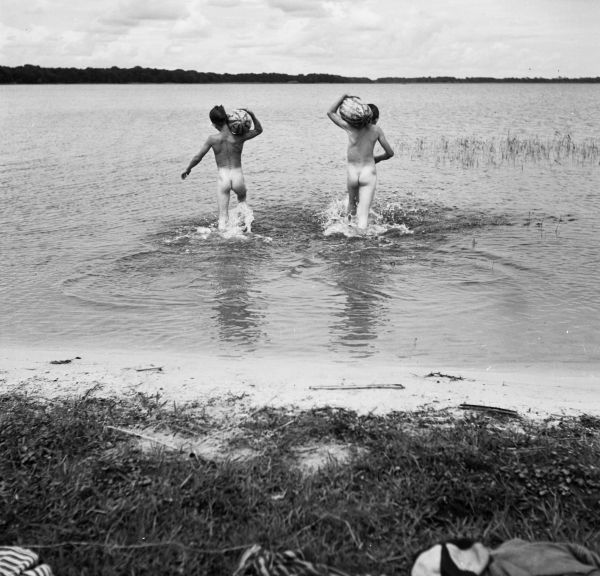
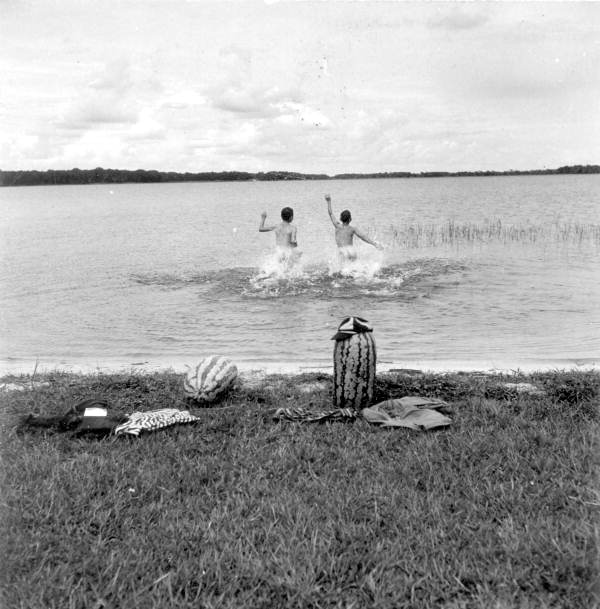
On June 18, 1947 someone did a photo story starring a couple of eleven-year-old boys named Johnny Suggs and Rogers Goolsby, residents of the bustling metropolis of Oxford, Florida. That town styled itself as a noted watermelon growing center.
The ten-photo set showed the boys expropriating two watermelons from a field and hauling them to a lake edge before stripping and frolicking in the water. After that aquatic interlude, they dressed and fell to eating the fruit. Not exactly Shakespeare.
There is no indication in the State Library and Archives of Florida from which these photos were retrieved that this material was ever published. Nevertheless, we present the two images most relevant to our interests.


According to the archive of the State Library of South Australia, a couple of unnamed boys in an unnamed location went skinny dipping sometime in 1924. The only thing remarkable about that incident was that there was a photographer on hand to record it in these two images. Unremarkably, the boys seemed pleased to perform for the camera. These images might be considered a tribute to the uncountable times over the decades and even centuries when young boys in a rural setting shucked their clothes for some innocent fun on a hot summer’s day.

Sometime in the first two decades of the 20th century, a photographer named George Beard took some photos on a family camping trip/picnic somewhere in Utah. The year of this event is variously reported as anywhere from 1900 to 1919. The place is reported to be Glendale and the body of water is reported to be the Weber River. Problem is that the Weber River is in the northern part of the state while Glendale is located far to the south. Curiously, the haphazard documentation is at pains to record the full names and birth and death years of the people captured in these images.
Addressing this image, there is a striking contrast between the (excessively) clothed adult swimmers and the naked youngsters on the shore and wading in the waterfall upstream. By the way, the fully dressed woman on the shore with the fishing pole is Ethel Beard Barber (1878-1954). Keep an eye on her as we examine the next image.

As the adults contend with soggy (probably woolen) swim clothes, note that they are in the presence of three naked boys. The youngest is apparently being dried by Ethel who is still fully dressed with her hat lying behind her. Although these pictures were archived separately with disparate dates (a decade apart) attached to them, this is certainly the same group on the same day.
Without getting bogged down in the details of these images (like what happened to the other two or three naked boys captured in the first picture), the take away is that in this extended family in what is likely a conservative Mormon society, it was perfectly acceptable for boys to be nude while the adults are carefully dressed.
These images come to us from the archives of the Lee Library of Brigham Young University in Utah.
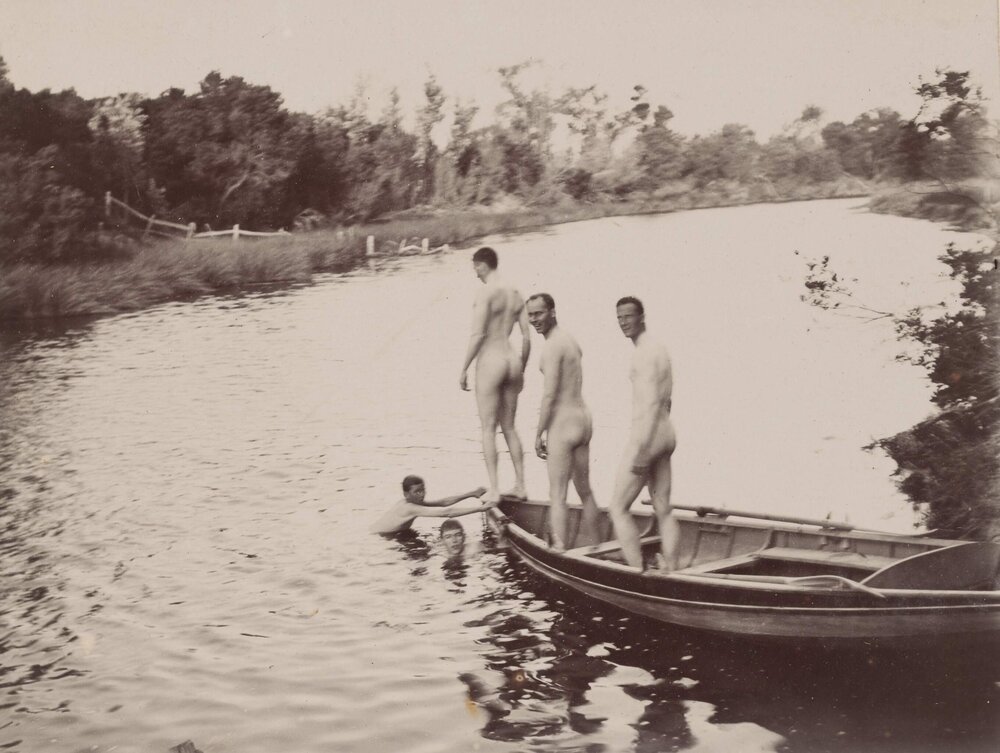

These scenes took place on Coolart Creek, a waterway in far south of Victoria State, Australia. They come from the archives of the University of Melbourne. The adult and sub-adult males were pictured at two widely different times of the same day based on the shadows in the second image. They apparently made a full day of it. That day? The identification strings on each of the pictures seem to consist of a sequential number followed by 31.12.05. I suggest that the latter number sequence denotes a date of December 31, 1905. That would be high summer Down Under. (By the way, these images were cached with several others and one of those is labeled with the name of the rowboat shown above.)
The take away message is that these men and boys apparently were quite comfortable sharing some wholesome nude recreation together. An interesting way to usher in the New Year to be sure.
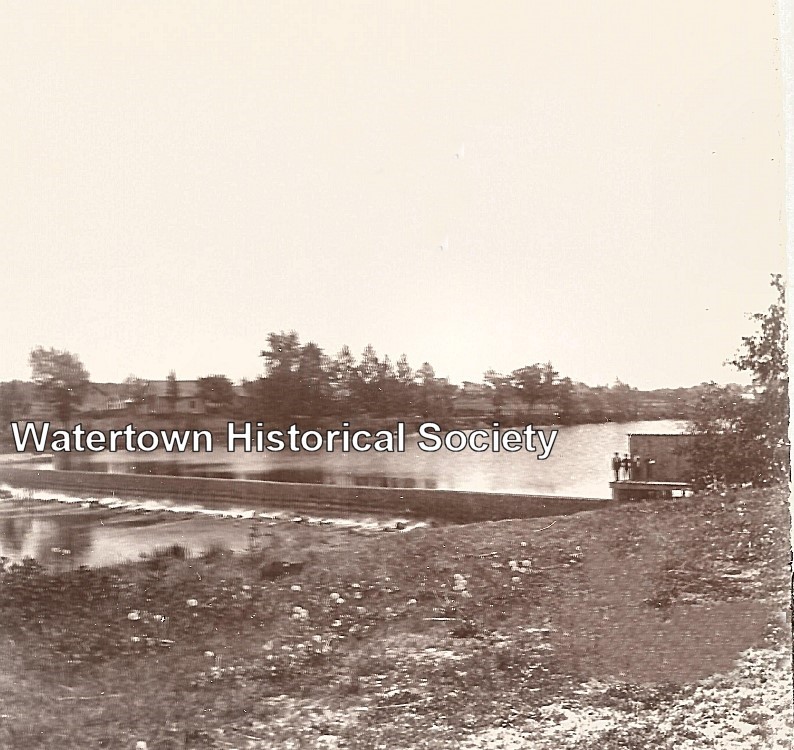

According to a correspondent, during the period of 1880-1920 small towns all over the country recognized skinny dipping by young boys was a harmless and even desirable activity. In the era before towns took on the expense of municipal recreation, boys providing their own diversions (and “staying out of trouble”) was a win-win. Consequently, the town fathers pragmatically decided to legitimize the practice of skinny dipping by regulating it. Communities would have ordinances, regulations or informal understandings that said something like “It is ok for boys to swim naked in the creek, but they need to stay in the area 200 yards south of the road”, or “it is ok for boys to swim in the lake, but they need to stay in the area of the dock, which is not too close to any houses”. The goal of such rules was to keep the boys at a discrete distance from an inhabited area/road – not necessarily out of sight, but far enough away that male nudity was not in one’s face.
This pair of pictures from the Watertown (Wisconsin) Historical Society documents a circumstance in 1895 that appears to be an example of that accommodation between the boys and the town. The Rock River had been dammed to form a lake that was suitable for aquatic activities and the boys were permitted to use the lake dock as a base. In the first photo some figures (probably boys) are visible on the dock above the dam. Examining the close-up second image suggests that the wooden wall behind the boys on the dock might have served as a screen where they could disrobe before taking the plunge.
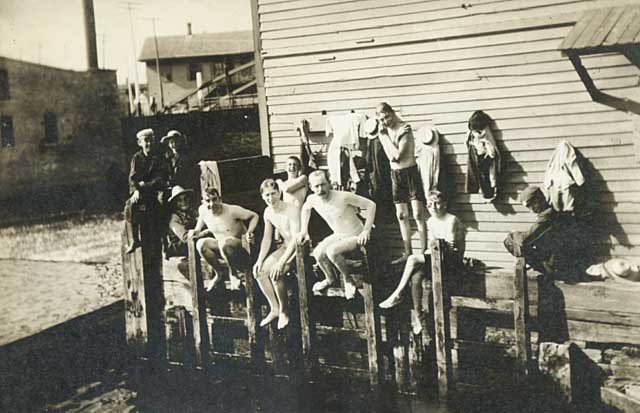
What appears to be additional confirmation of the town tolerance of nude male swimming comes from the Minnesota Historical Society. This image from Northfield MN has a reputed date of circa 1920, but it is likely older.
We should note that this group contains older participants. In fact, it looks as though the teenagers/adults are stripped for action while the younger boys look on. The one potential swimmer appears to have a mustache.
The facility seems similar to the Watertown installation in that there is a screen wall on the dock. The wall has pegs for clothes and hats (note the stiff straw hats that were typical summer wear for men in the decades straddling 1900). There is also an awning protruding into the picture from the right. Then there are the multiple, closely spaced ladders for access to the water. This looks like a purpose-built venue outdoors and adjacent to occupied buildings.
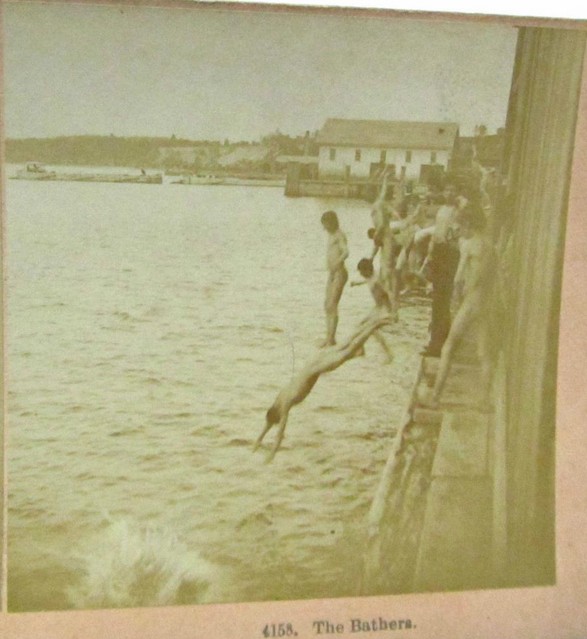
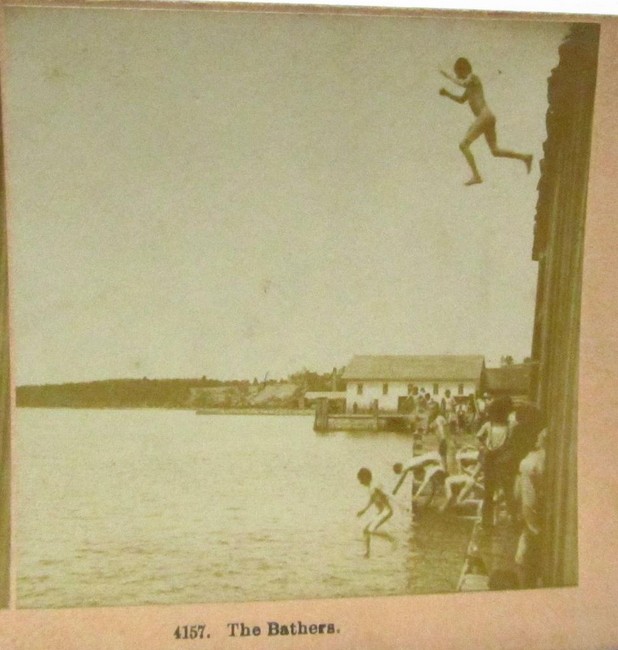
These two photos that were probably taken only minutes apart seem to document another example of a town’s designating a location where skinny-dipping is allowed. In this case, the town is Littleton, New Hampshire. The patronage seems to be quite high on this particular occasion – perhaps a holiday?
Aside from the town name, everything about these to images is guesswork. The publication that these images were scanned from might be a catalogue or a book published by a professional photographer. The waterway is likely the Connecticut River, which forms the boundary between New Hampshire and Vermont. In the first photo, there is a barge transiting the frame, suggesting an industrial setting. The apparent haze also reinforces that impression. Nowadays, a search of the town name yields only suggestions for natural recreation. The region’s industrial heyday may be in the past. Judging from the quality of the photos, I would be comfortable with a date of 1900 plus or minus a decade. However, the speed of the picture taking was sufficient to freeze divers in midair. Therefore, it is possible that these are from a slightly later period.
Then there is the tale of two paintings and a photograph …
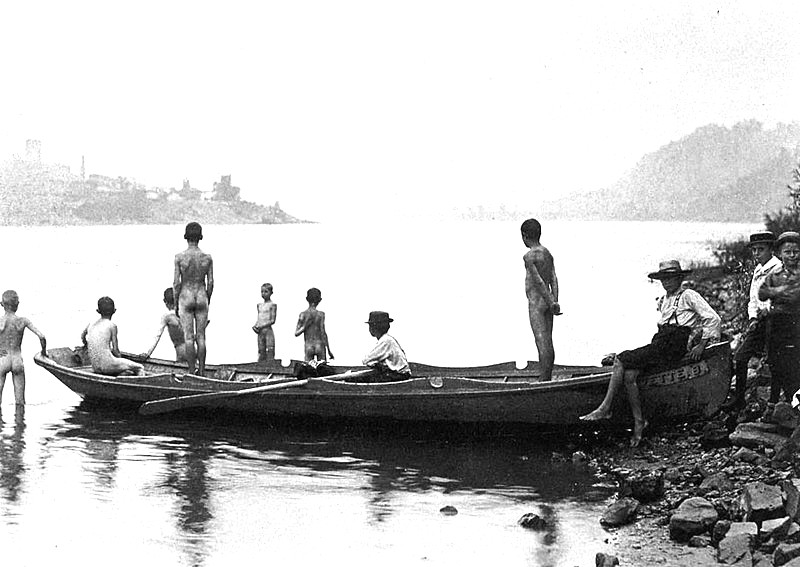
This photo was taken on the Ohio River near Wheeling, West Virginia in 1880. The point of the composition is rather murky, since the naked boys are mostly staring at a non-discernable object while keeping their backs firmly to the camera and while the dressed boys are staring at the camera. The naked boy with his hands clasped behind him seems particularly incongruous.
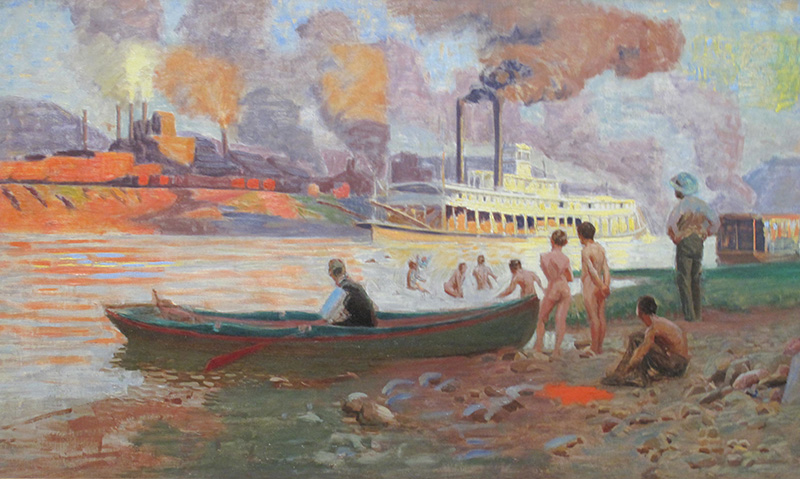
As it happens, the photographer was painter, Thomas Anshutz, who made the photo as a study for his artistic projects. This opus was composed in 1898. Note the boy with his hands locked behind his back, matching the photo.
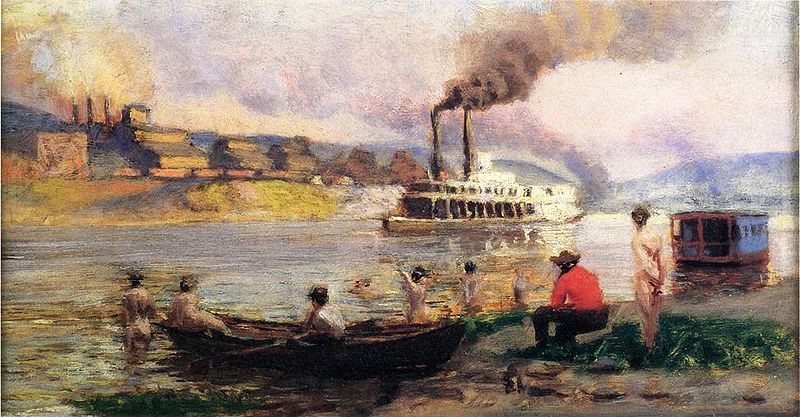
Approximately two years later, Mr. Anshutz tried his hand at the scene again. This time he rendered it in what appears to be an Impressionist style. Diminished detail notwithstanding, the rowboat and the dressed boy at the oars persist as the centerpiece of the nude swimming activity. I wonder if the adult observer in both paintings (which does not appear in the study) is the artist’s attempt to place himself in the scene.
The lingering question is why the 18-year elapsed time between the study and the finished work? My guess is that the artist tried to use this theme in various abortive or forgotten works in that interim.


The Chicago Historical Society deserves credit for preserving these much-abused images. Normally I crop out extraneous margins for a more uniform look, but in a few cases like this one the imperfections are part of the story. The negatives of these photos are damaged not only along the margins but also from contact with some contaminating agent that left tiger/leopard pelt patterns.
The location of this scene is not preserved and no doubt it is no longer the bucolic setting it was then. Since the group pictured seem to differ from frame to frame, it is possible that these photos were taken at various times and perhaps different days. That would suggest that this spot was regularly used by boys for this sort of recreation and that the photographer was a recurrent visitor.


Carl Mansfield (1916-1992) was a professional photographer who operated a photography studio in Steubenville, Ohio for his entire adult life. Popular Photography was a nationally distributed magazine that was started in 1937 and ceased print publication in 2017. Given their respective businesses, it is safe assume that the two entities interacted multiple times over the years.
In 1948 there was a flash point in their relationship. Mansfield won first prize in Popular Photography’s annual photo contest. In addition to the cash award, his submission was printed on the cover of the August issue, shown in the first image. It is noteworthy that the subject of his opus was two naughty, naked boys skinny dipping in a creek in violation of the posted regulation – a recapitulation of a humorous vignette that had been presented many times in popular art and photography. Of course, the scene was staged. The second image apparently captures the activity during the setup for the shot, including the prop sign on which an article of clothing had been scornfully draped. Neither the implied outlawry or the nudity was an impediment to this image’s receiving national circulation.
One last point is that Mansfield was returning to the topic of young boys swimming nude in nature. He was the creator of the 1946 National Geographic photo that was presented on the Noteworthy Skinny-Dipping Scenes page with the caption Under the Falls.
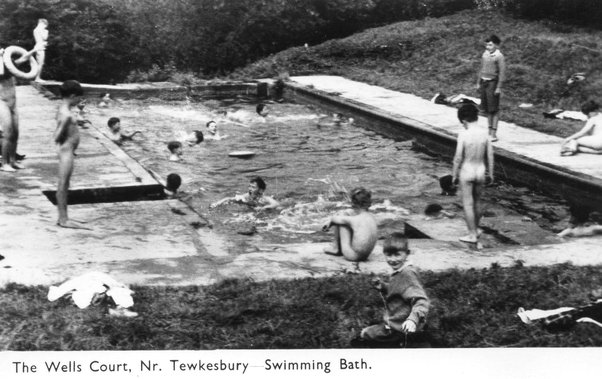
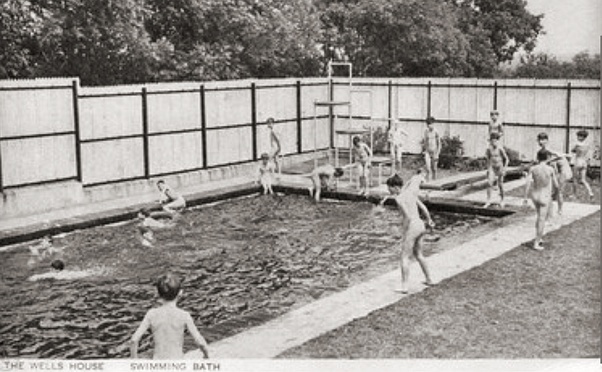
Once upon a time near Tewkesbury, UK, there was a private school called Wells House where all the boys swam nude. This all-boys school was founded in 1860 and closed in 1991. Apparently, the last quarter of the 20th century was not kind to small private English schools. They fell like dominos during that period.
The legacy that school left us was these two images of their outdoor swimming pool which were used at different times in their promotional literature. The first is probably from the 1950s. The second shows some upgrades to the pool environment, especially a privacy fence. It dates from around 1970. It is noteworthy that the practice of institutionalized nude male swimming passed away in the same era as the demise of these schools.
During the Great Depression (1929-1940) the general unemployment rate hovered around 25%. That grim statistic was much higher among young, uneducated men. To have so many frustrated, starving (yeah, really) young males in the population was a real danger to social order. Almost as soon as he took office Franklin Roosevelt asked Congress to authorize the Civilian Conservation Corps, which they did in record time. Although many books and articles have been written about this program, the gist of it was that any able bodied, unmarried young man between the ages of 18 and 25 (later, 17 to 28) could enlist. They would be given food, clothing, shelter, a small allowance and, most importantly, a job with a sense of purpose. The Corps, whose compliment at any time numbered around 300,000, performed projects to maintain, improve and reclaim state and Federal public lands. The participants lived in camps and on military installations and were led by active-duty army personnel. During the life of the program (1934-1942) millions of young men participated in the regimented, military-like life of barracks, mess halls, uniforms and hard physical labor.
One has to wonder what healthy young men in a monastic-like environment in remote locations did for relaxation and entertainment. The following photos give a hint.


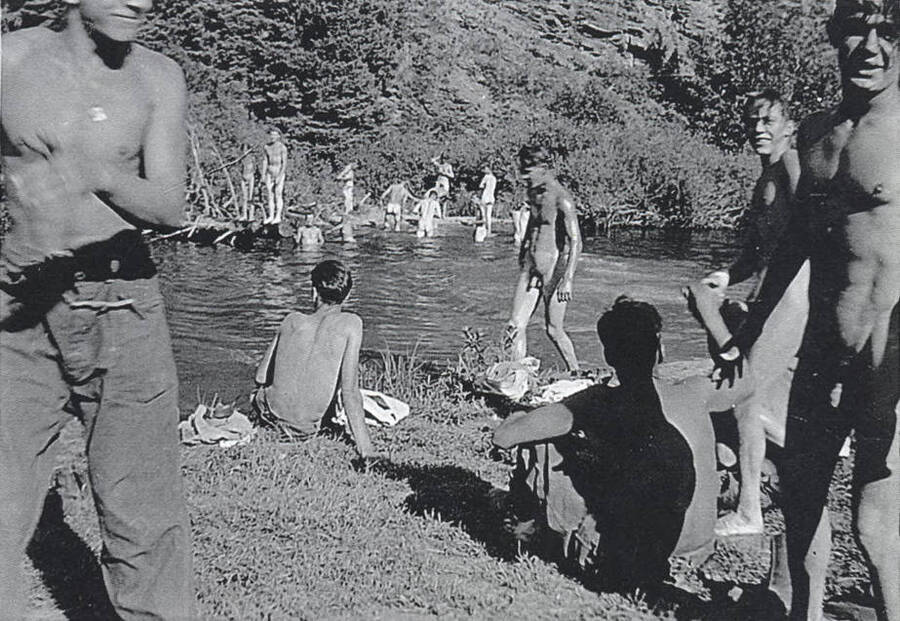
These images which are held by the University of Idaho suggest that skinny dipping, whether for fun or hygiene, was practiced by the CCC enlistees. Indeed, it seems like the natural thing to do (pun intended).
Throughout the history of nude male swimming, much has been made both in this blog and elsewhere of the multiple infectious diseases that plagued young boys during the 19th and the first half of the 20th century. Polio was perhaps the poster child of the latter period. Epidemiologists puzzled over its nature and its means of transmission. By the 1930s, they had taken a tight focus on waste water contaminated with sewage. After several failed attempts to prove out this hypothesis, the work of Dr. Sabin (later the developer of one of the two polio vaccines) clinched the cause in the 1940s.
The first study was conducted in Philadelphia in 1930 where apparently there were already suspicions concerning the connection between waste water discharges and infectious disease outbreaks. Curiously, the photographic evidence below predated the hunt for polio. The following pictures were taken on July 15, 1918 during the Spanish flu pandemic – perhaps suggesting that someone thought the flu was somehow related to waste water.

The late 1940s marked the beginning of municipal sewage treatment. Prior to that, raw sewage was discharged directly into the Delaware and Schuylkill Rivers. This is a photo of a raw sewage outfall on the Delaware side. This location is described as “mud flats.” Since this is not a color photo, the visual impact is muted.

Although there are no common visual markers with the previous photo, there were several other photos (not shown here) in the same series that showed the spatial relationships. The water from one side of the pier was able to communicate freely with the water on the other side. Too, the facilities shown in this image encouraged recreational use of the river on the north side. Taking all the information into account, it’s clear that these guys were swimming in water contaminated with sewage. It follows that pathogens in the sewage could – and did – infect the boys.
Here is a long photographic essay with no words. It is apparently set somewhere in the old USSR back in the 1970s. The eight photos were numbered sequentially (in Roman numerals), so they are presented here in that order.

Besides the presence of four suited females and the carefully posed nude boy, you should note the rickety structure at the right. It figures in all of the subsequent images and forms the backbone of the narrative.


The rustic gangway in the background of this picture does not appear to match the structures in the other photos. This location may have hosted more than one elevated access to the lake.
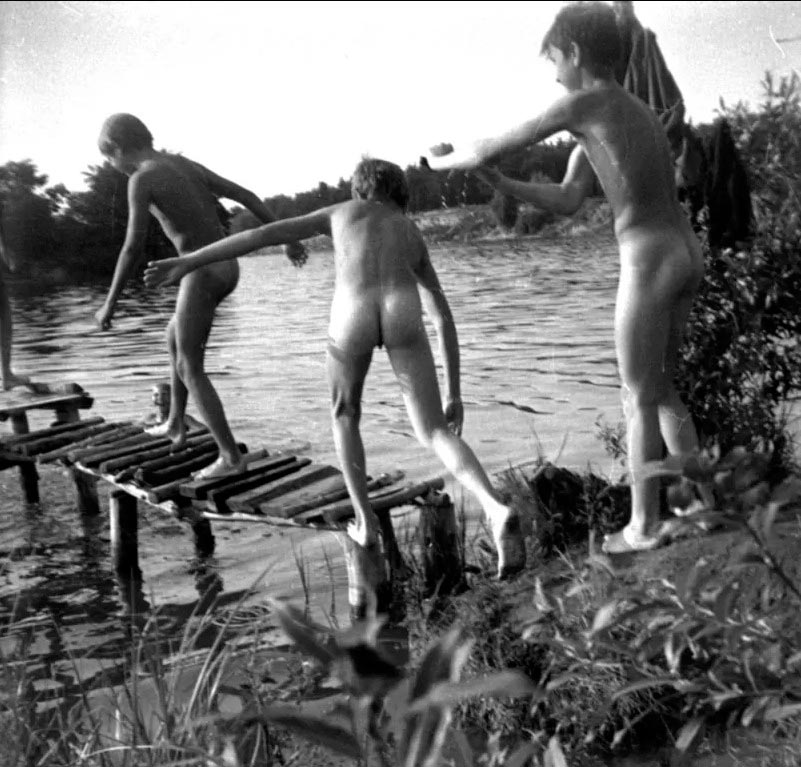
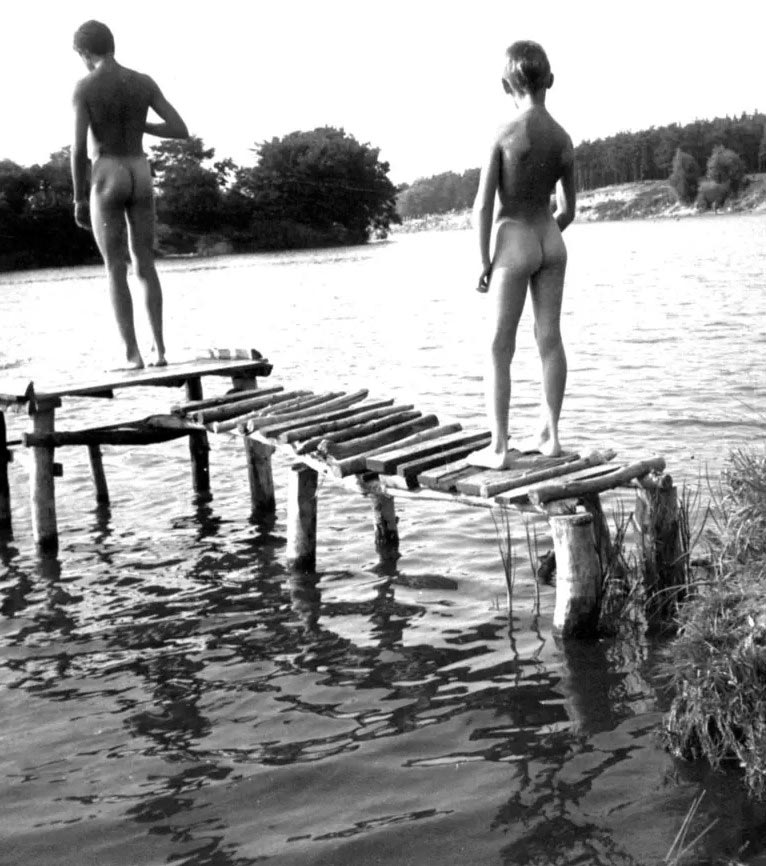
This photo seems to contain an older male. The cast of characters doesn’t appear to be constant, so this series may have occurred over days.

Judging from his tan lines, this lad must have spent the summer attired in nothing but briefs.
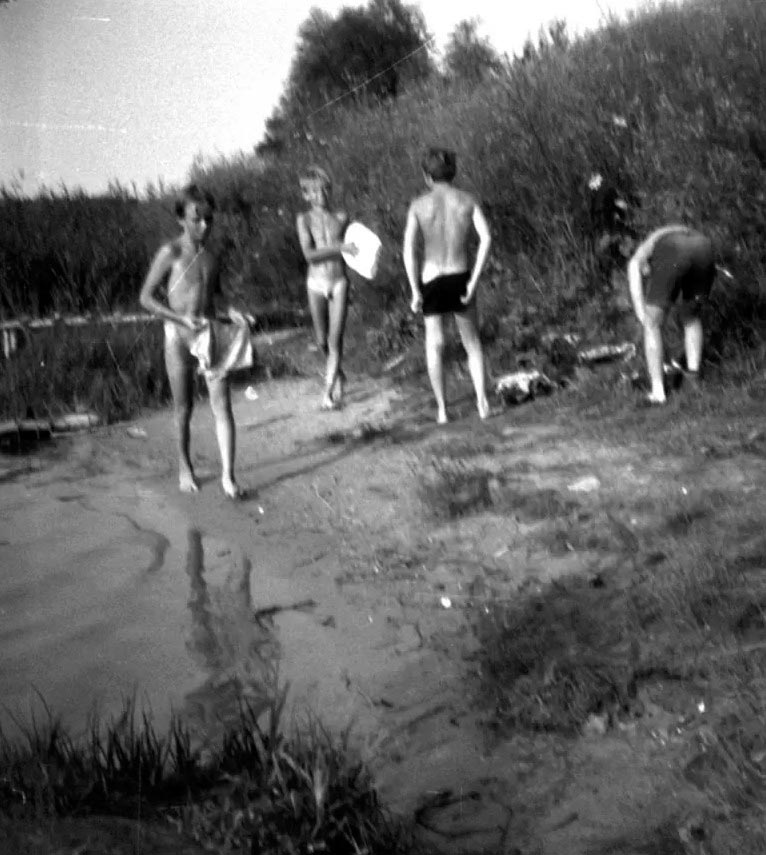
This photo seems out of sequence. It looks as though it should be a companion to III, above.
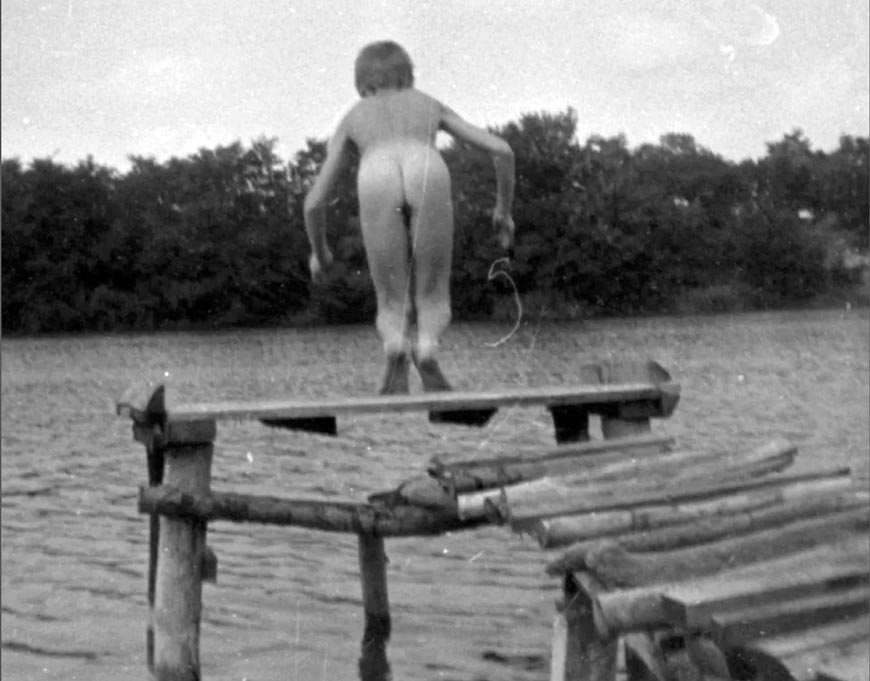
This view seems appropriate for the end of the series.
Topic 2: The Sunday Supplement
In their continuing quest to sell advertising, 20th century newspapers cast their nets wide for topics that would attract readers. “Human interest” and “community news” offered relief from the dreary and worrisome international, national and regional situations that formed mainstream reporting. The happy, uncomplicated news of church socials, organization meetings and high school fund raisers broadened the newspaper’s appeal. Although those sorts of stories could be found in every daily issue of the paper, there was usually an especially large round up of such material included in the Sunday edition. It added an extra section or two to the volume of the paper, guaranteeing longer perusals by subscribers. One of the sure-fire topics was the nostalgia of the old swimming hole.
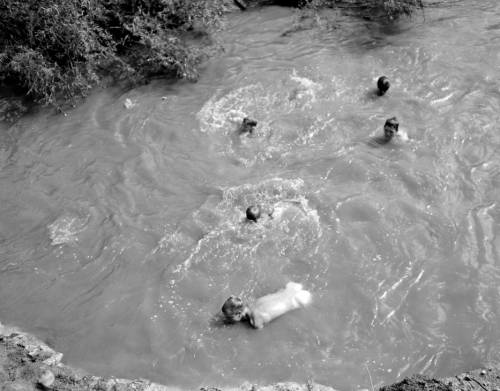

In the summers of the years 1938 and 39 the Bloomington, Illinois newspaper, The Pantagraph, made pilgrimages to a swimming hole in nearby Paxton for the purposes of recording the informal aquatics of the local boys. These two images were made on August 11, 1938. Although the boys are discretely posed, their nudity was not in doubt and suitability of these photos for publication in the newspaper was also undeniable.
These images are preserved in the McClean County Museum of History (Illinois).
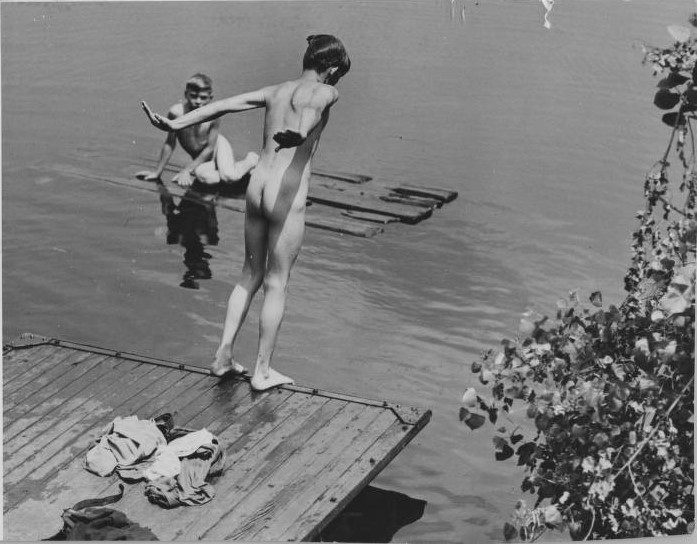
The Minneapolis Tribune did a photo essay on the first day of summer. In 1947, that auspicious occasion occurred on June 20. Here is the swimming picture that appeared in the paper on that date. Once again, no suits, no problem.
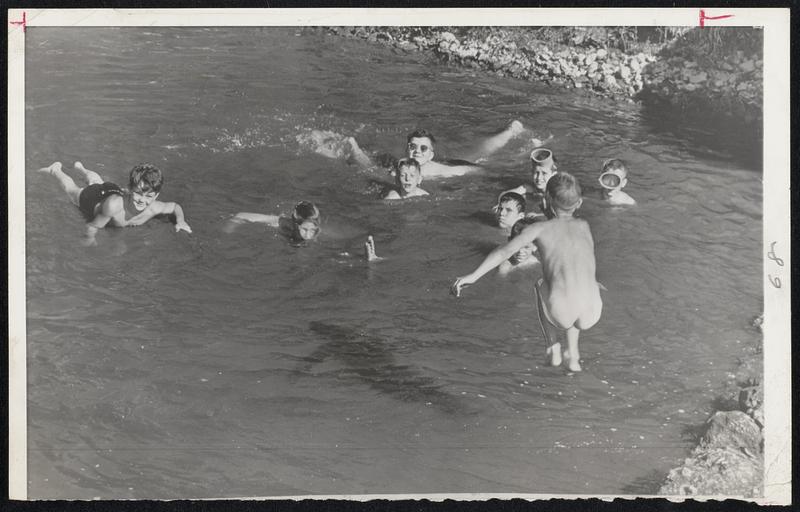

This image traveled from Rockford, Illinois to Boston, Massachusetts through the agency of the Associated Press – a news story supply house for client news outlets. That process testifies to the image’s fitness for publication when it appeared in the Sunday Boston Herald on September 2, 1953. Note the cropping and publication instructions on the front and back of the image. It looks like the photo spanned four newspaper columns in the final presentation. Definitely a feature-sized format.
The accompanying story documents the unusual heat wave that was gripping that Midwestern town and the reaction of the local boys to it. It is noteworthy that there is a suited adult and some suited boys in the group. Nevertheless, it is the naked boy who gets to star in the frame.

This record of some boys’ informal aquatic recreation appeared in the Sunday magazine of the Baltimore Sun newspaper in 1933. Nothing spontaneous about the action in this image – obviously staged. One might wonder how the models were recruited and directed to yield such a striking shot.
Topic 3. The Land of Milk and Honey
Once upon a time (the early 1920s) in a faraway land called the Netherlands there lived a man named Frank Scholten who embarked on many photographic adventures in a magical place, the British Mandate for Palestine. Some referred to this place as the Holy Land.
The scanty information recorded by the University of Leiden library which holds the fruits of Scholten’s photographic labors indicates that he made multiple visits to Jaffa and Tel Aviv over a two-year period. He apparently encountered boys engaged in aquatic recreation and recorded those scenes for posterity. Some of those swimming boys were nude.
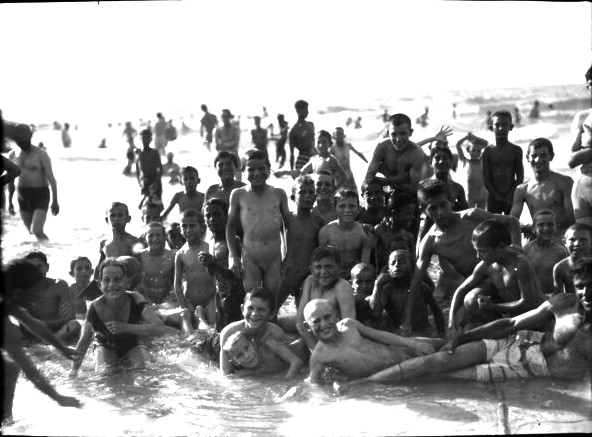
This is a beach scene in Jaffa. It shows a mix of suited and bare revelers. Thanks to the standing, grinning boy just to the left of center who removed any doubt concerning the presence of nude boys in this shot.

Same Jaffa beach but the naked boys are a bit more shy.

This photograph was made in Tel Aviv. Although the diving boy is suited, the young man with his arm raised to the camera is tall enough that a thatch of pubic hair is visible at the water line, testifying to his nudity. His companion in the foreground also seems to be giving a peek.

This is another scene recorded in Tel Aviv. It’s just possible that the pool is the same on as in the previous image. Note that although the lead boy is displaying a fully bare flank, his ultimate modesty is being protected by a fortuitously positioned knee belonging to one of his compatriots. The pipe the boys are clinging to may well be a component of an irrigation system and the “pool” may be a water reservoir.
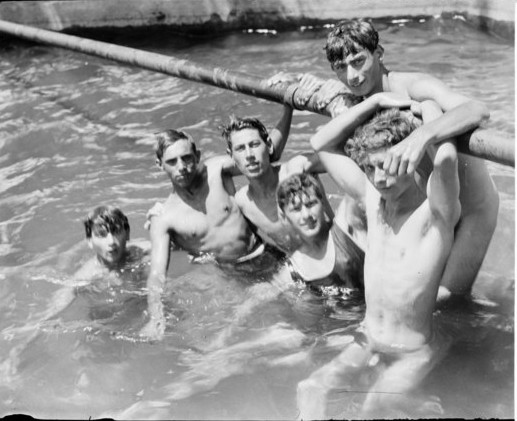
The same boys on the same occasion where the lead boy is now casually displaying his manhood while his equally naked fellow presses himself to his back. No inhibitions here.

This might be the same swimming “tank.” The guy in foreground is favoring us with a laid-back display to confirm his state of undress.
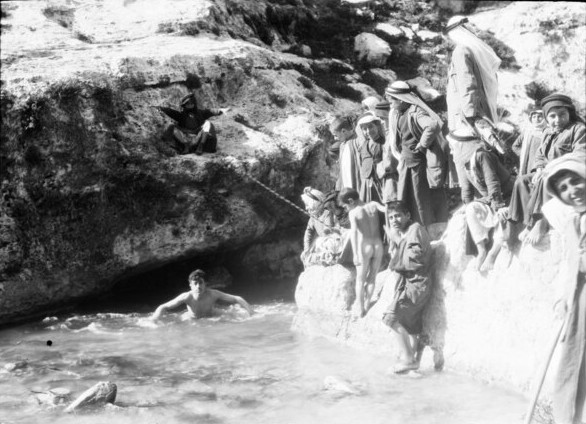
The location of this scene is simply given as Es Salt. One may surmise that the one naked boy is being emulated by his fellow in the water. Their lack of raiment is a sharp contrast with the on-lookers who are not only fully dressed but wearing the keffiyeh or hattah, the traditional Arab men’s headdress. Although Muslims are thought of as obsessively modest, that mindset apparently didn’t apply in this situation.

We step aside from the Scholten collection and fast forward to 1947. The region is now called Israel. This group of naked children is frolicking in a dry pool in which fountains of water are providing the cooling. The caption states that the action is happening outside the dining room. I surmise that this scene is taking place in a kibbutz, a collective farm community that is a uniquely Israeli invention. It is instructive that all of this natural state frivolity is taking place in a common, public area without any apparent concern. One last observation: is the child on the far right a girl?
 Historical Nude Male Swimming Images