Naked in Nature
Revised 12/18/25 Added one image
Many of the organizations that conducted aquatic activities in indoor pools also maintained outdoor facilities in the form of summer camps. The camps greatly augmented the water sports offerings because they could include activities involving watercraft. Add that to the “dry” recreational opportunities and this was a winner by any boy’s standards. Of course, it was no hardship that swim suits were unnecessary.
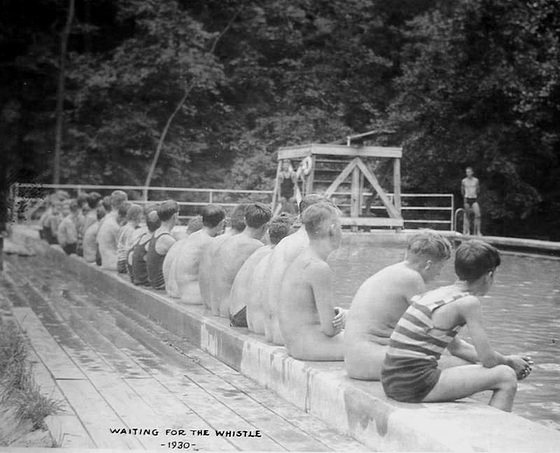
The caption states that this camp scene is from 1930. The supervisors in this image are suited, but their charges appear to be clothing optional – with most opting out.
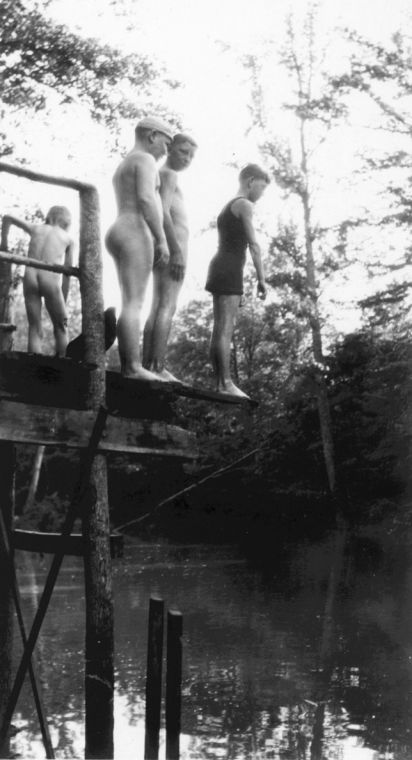
The attribution on this says that it is a YMCA camp scene from Greensboro (NC, SC?). The boy at the head of the line assessing the situation before he commits seems to be the only modest one. This scene is outside the pale of the classic YMCA we’ve come to love. First because this is a natural body of water, so the hygiene accruing from the “no suits” rule would be meaningless here. Second is because the APHA had not yet promulgated their “no suits” recommendation. That occurred in 1926.
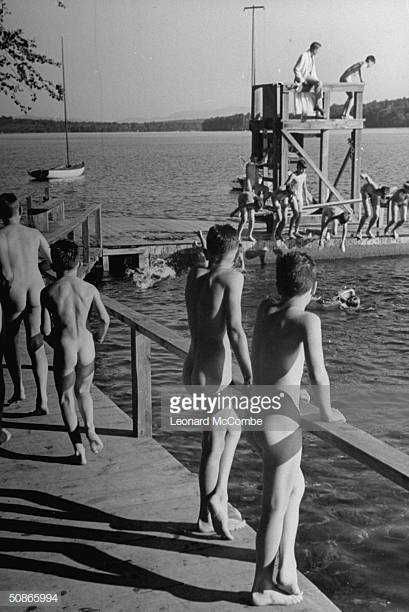
This appears to be another boys’ camp scene. The only clothed person is the guy in the robe on the (life guard?) tower.
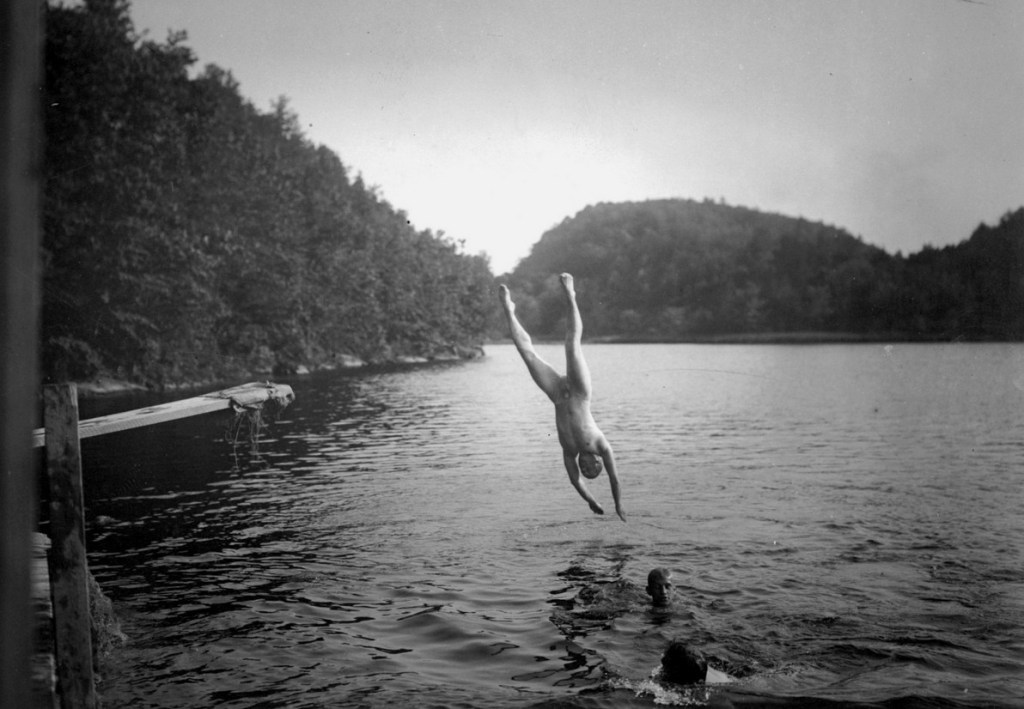
This perfectly framed dive was executed at a YMCA camp “near NYC” sometime between 1910 and 1920. My nomination for the mystery location is Westchester County NY. It is a sprawling area that borders directly on NYC and lies along the east bank of the Hudson River. In this time period there were probably many unspoiled locations that might have been home to this camp.
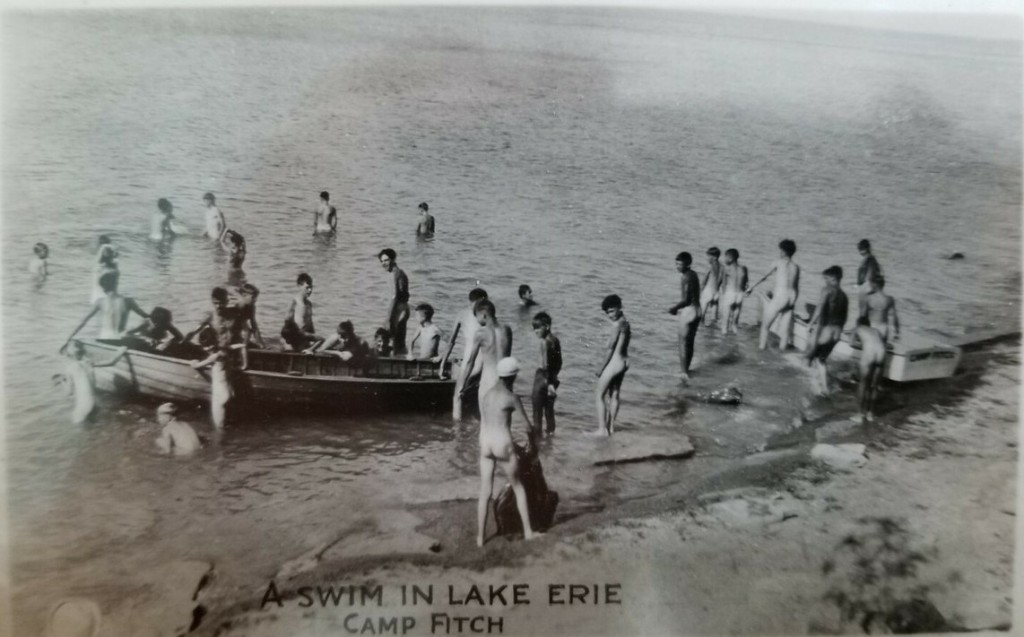
This is from a postcard of uncertain (but obviously old) vintage. The camp named is a YMCA facility founded in 1914 that continues in use to the present. Of course, camp practices have changed since then. They now require life vests when using water craft.
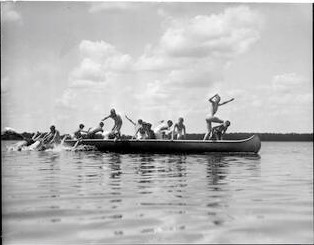
The YMCA in Chisago City, Minnesota ran a camp on the lake back in 1925. The aforementioned city lies between two lakes: Green and Chisago. This scene must have taken place on one of them.
The watercraft appears to be a very long canoe. The naked occupants seem to be engaged in large scale horseplay – a practice that would be frowned upon in modern times.
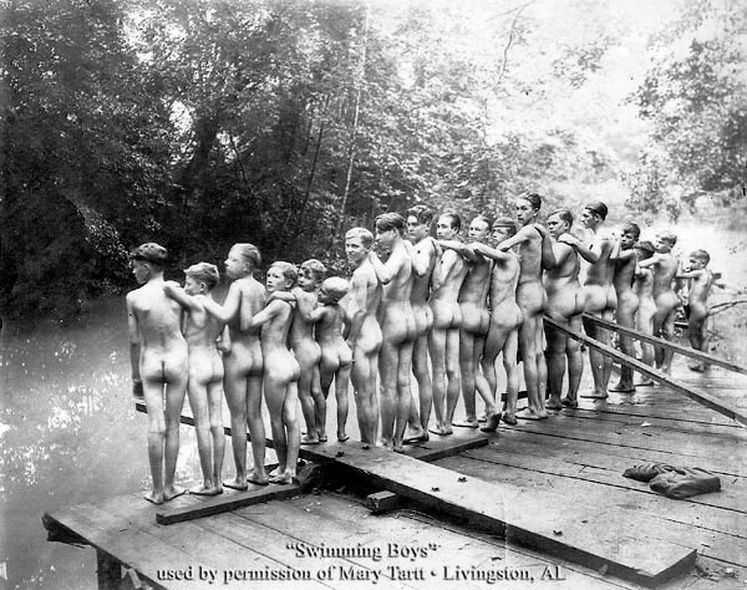
The embedded text on this image suggests that it is a titled work by one Mary Tartt of Livingston, AL. Some googling indicates that the Tartts were/are a prominent family of this municipality in Sumter County, Alabama. The town itself is drained by the Sucamoochee River (yeah, fer real). That body of water might be the setting for this very old (pre-1920?) looking photo.
Although the family boasts one prominent folklorist among its scions, I was unable to find a reference to this putative photographer.
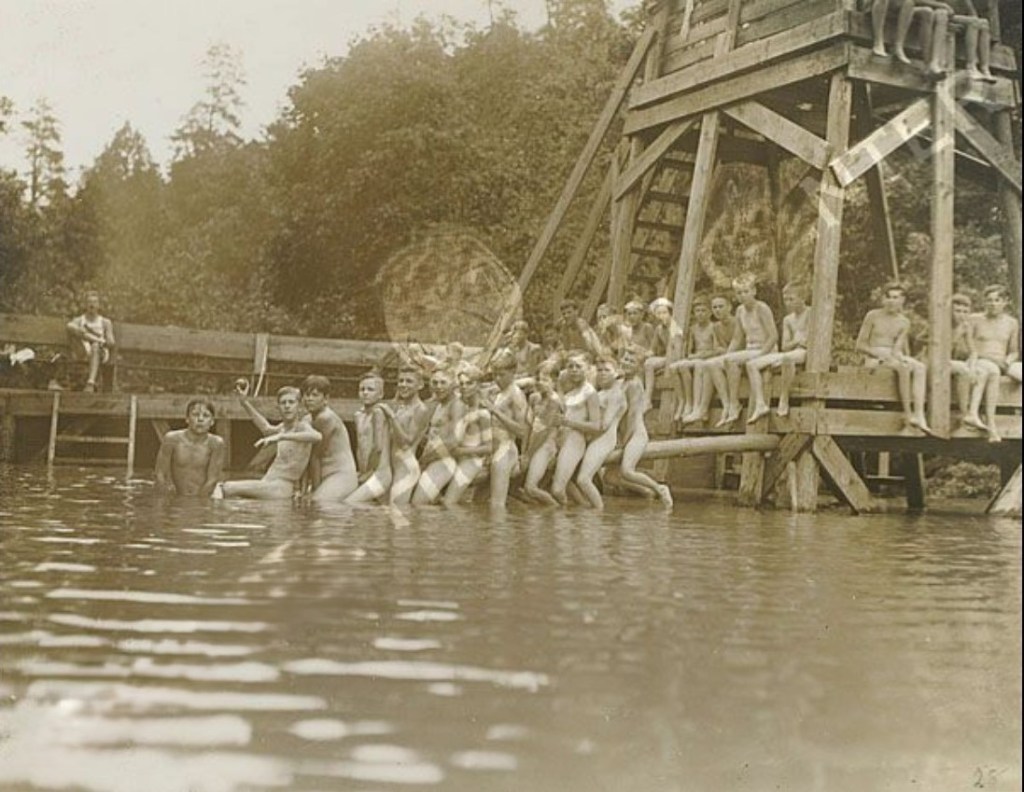
This boys’ camp in Wiley (Clayton County), Georgia began operation in 1914 and closed in 2021. It was on 350 acres located in the Blue Ridge Mountains about 3,000 feet above sea level. Sounds nice. It’s probably condos now.
This image is remarkable not only in the fact that they managed to get this number of boys in the picture, but they got most of them to protect their privates. For the few non-conformists, post production editing in the darkroom managed to fuzz up the offending spots. The repository of this image is the Atlanta History Center whose corner-to-corner watermark I was only partially successful in removing.
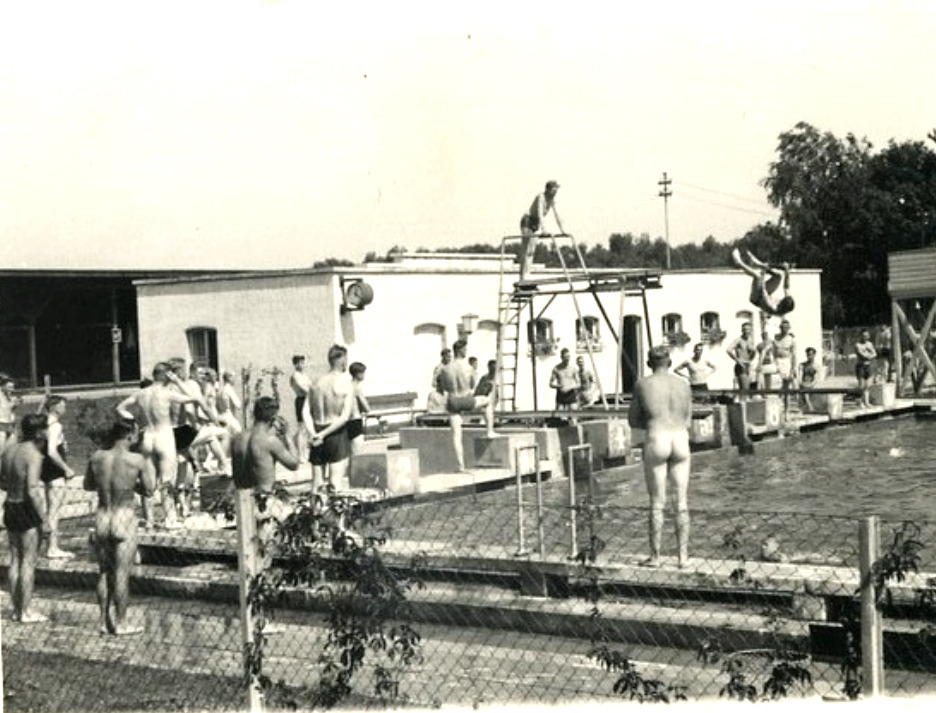
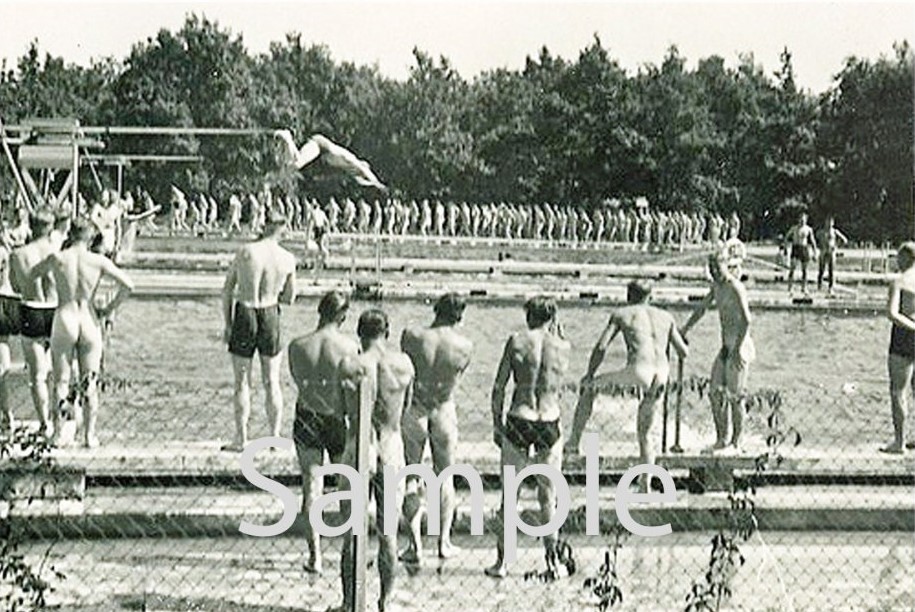
These two pictures of the same event are from different angles.
We seem to be at a club with dual outdoor pools, probably an all-male club. It appears that some of the attendees opted for suits but others did not. The racing starting blocks are concrete and the spring board does not appear to be a modern design. I’m putting this down to the 1940s.
The long line of figures in the background of the second photo is curious. Impossible to tell if they’re nude or suited.
The element that I think best captures the spirit of this event is the two figures on the right about midway down the frame. Two guys on the far side of the pool are standing side-by-side watching the action and facing the camera. One is wearing a suit and the other is wearing just his skin.
The Boys’ Club of New York opened Camp William Carey in 1903. It was located on eastern Long Island where it included about a half mile of beach on Long Island Sound. From the Club location in Manhattan, it was an “easy” four hour bus ride. The Camp operated for about six decades. Here are some battered pictures (courtesy of the New Historical Society archives) from the camp in its heyday.
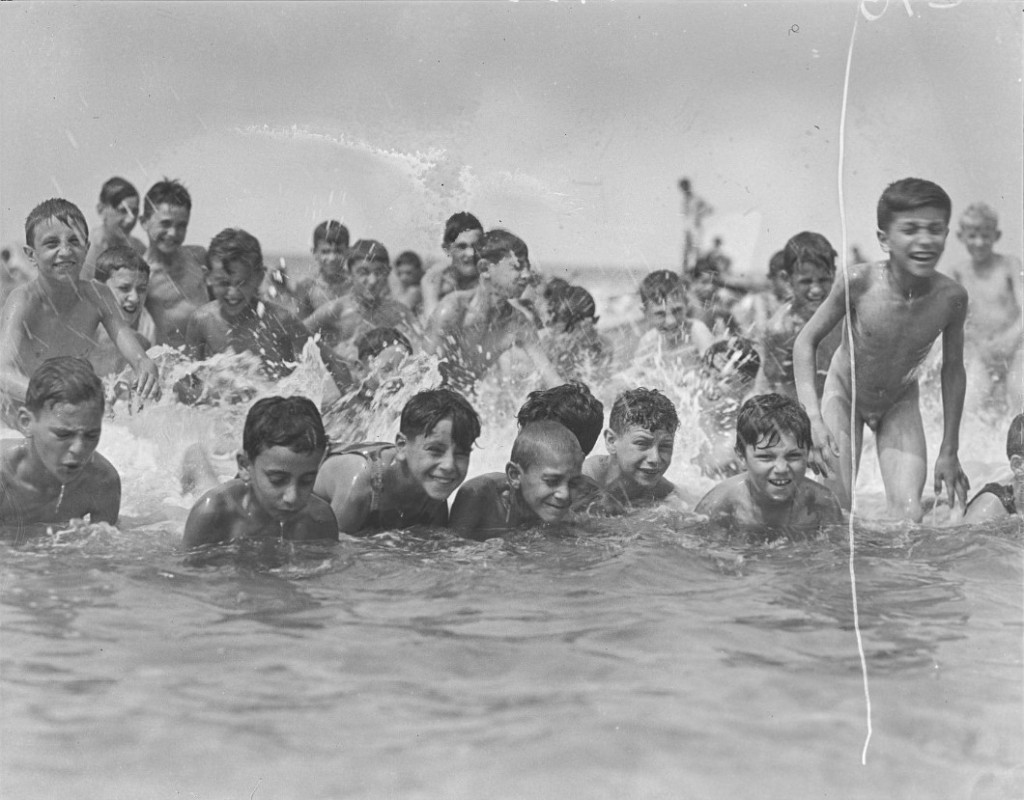
This 1929 image was marked for cropping out the over enthusiastic lad who couldn’t stay down in the surf.
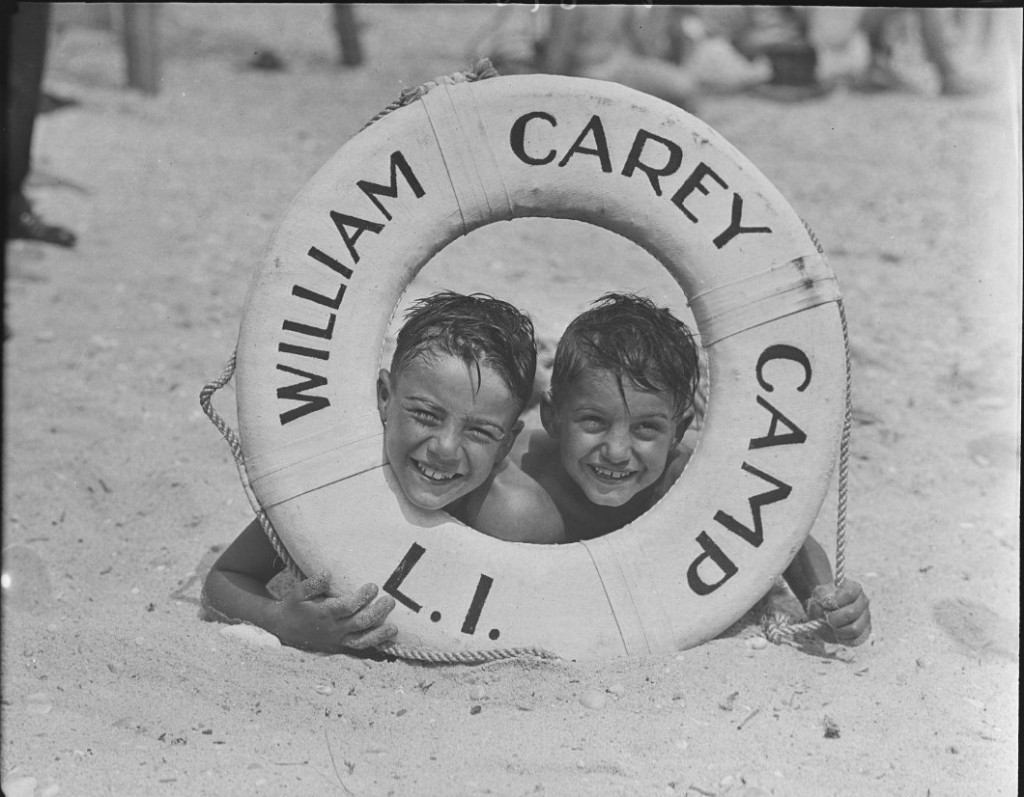
This from approximately 1930. The guy lounging in the sand just above the letter A in “Carey” is fortunately out of focus. What do you think he is/is not wearing?
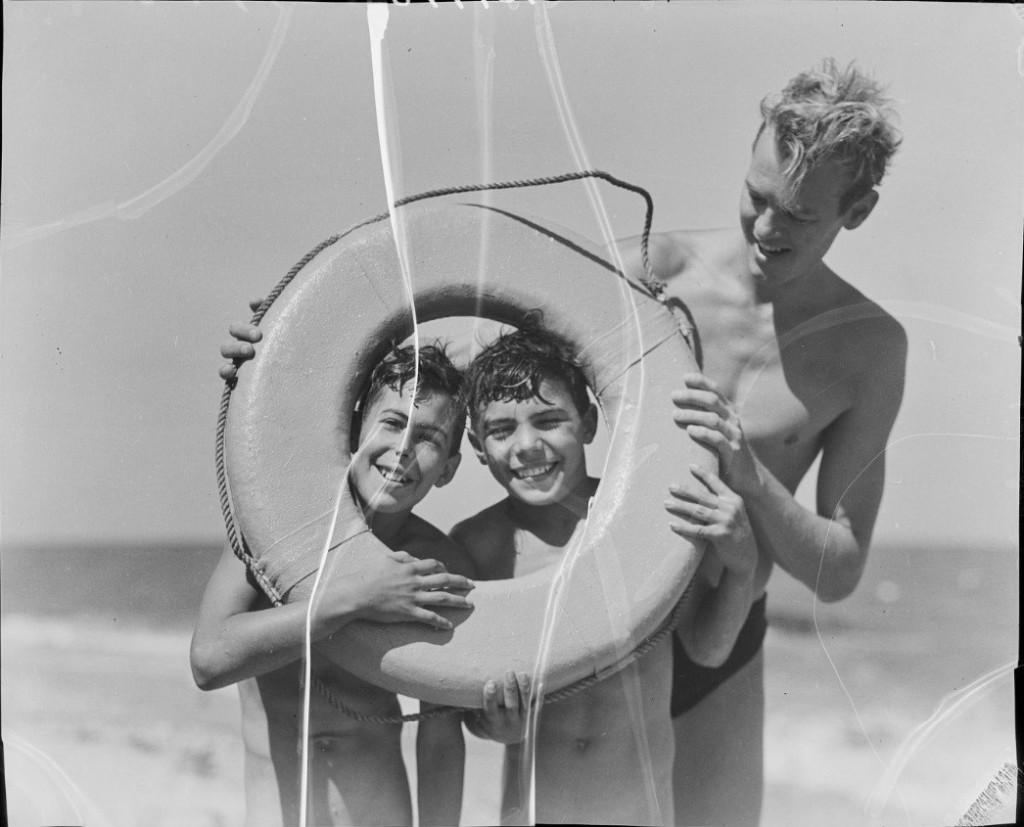
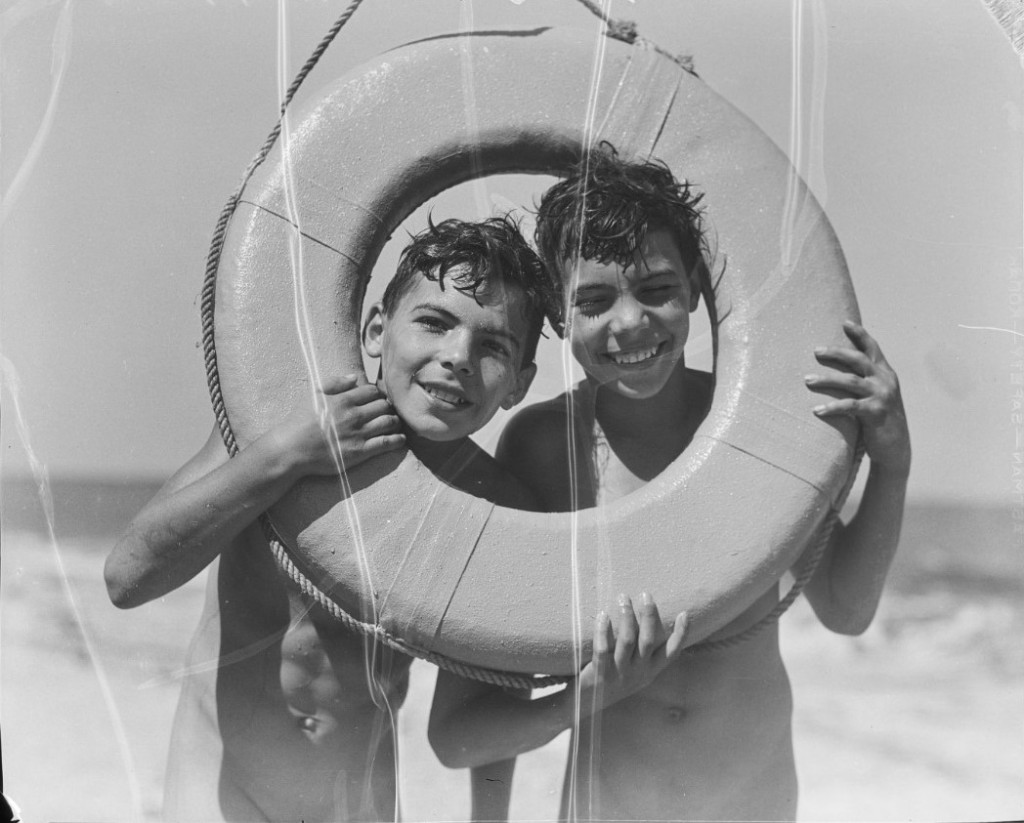
These companion shots were taken in 1933. In both it is quite apparent that the boys are not wearing bathing suits.
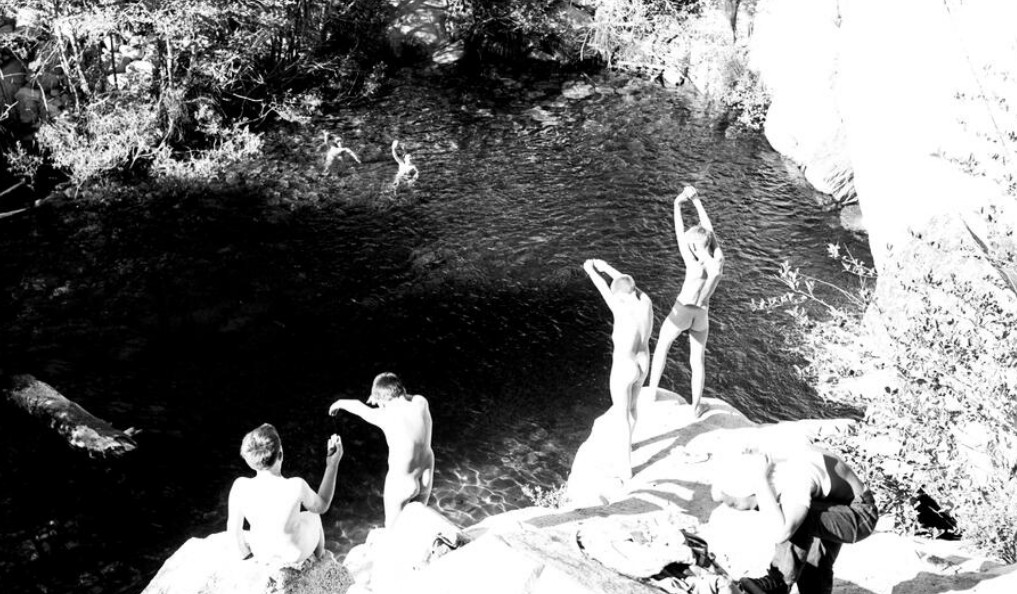
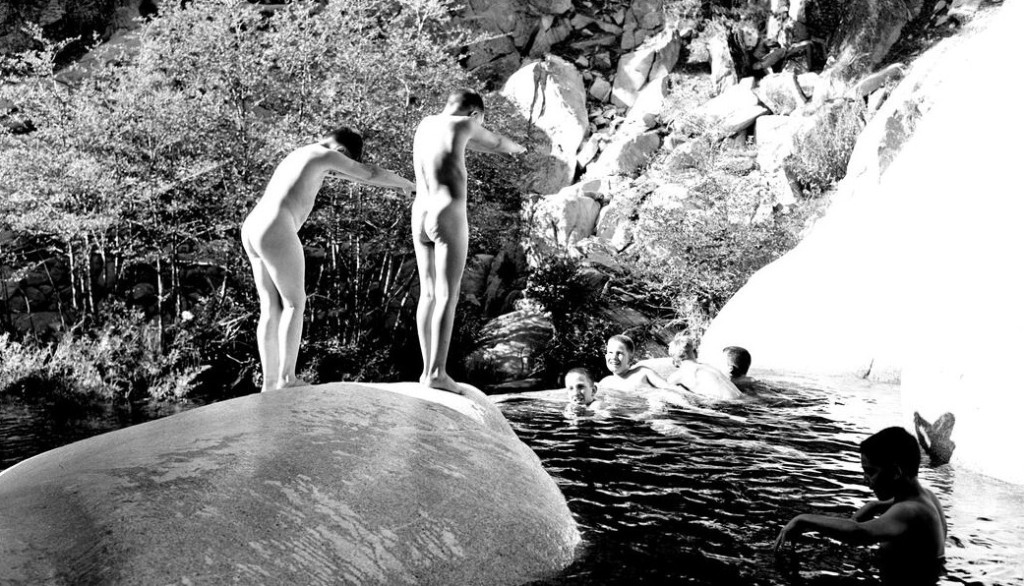
These two images show Boy Scouts at summer camp in 1958. These exquisite settings are probably located in the Huber Eaton Scout Reservation in the San Bernadino Mountains near Lake Arrowhead in southern California. There’s that diving pose again.
The Octorara Creek meanders through southern Pennsylvania and northern Maryland before emptying into the Susquehanna River which in turn flows into the Chesapeake Bay. Along its Maryland course it describes an arc that resembles a horseshoe. It was natural then that when the Boy Scouts set up a reservation that included the creek, it was dubbed Camp Horseshoe. In the early years of operation (1928-30) the swimming facility was the creek itself. Only after a pool was built in 1930 did they discontinue regular use of the natural waterway for swimming. Here are a few pictures from 1928.
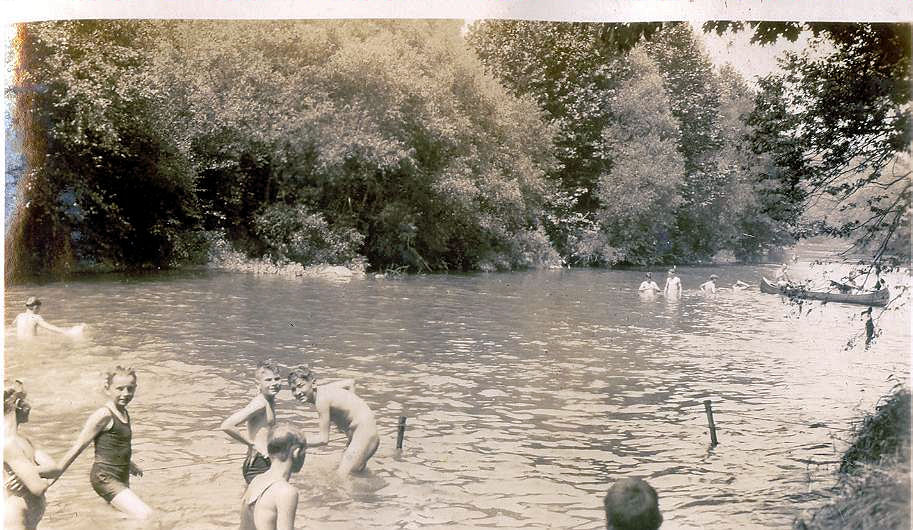
Apparently, the boys had the option of swimming with or without. “With” seems to have entailed the use of a tank suit. Why anyone chose that option will have to remain unanswered. Note that there appear to be adults in the canoe in the background who are not wearing cumbersome tank suits.
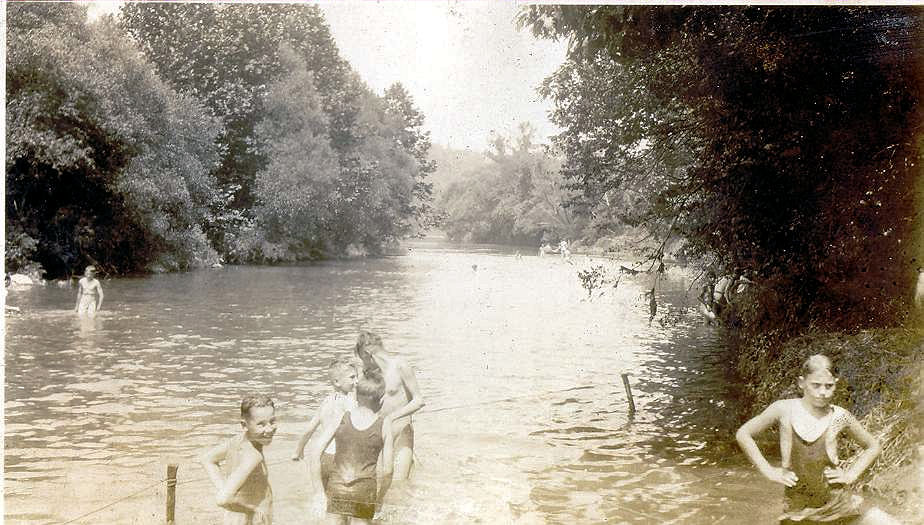
The boy in the center left is offering a frontal view confirming his choice of swimming attire (none). In both this and in the previous image, there appears to be cordoned area in the foreground in which all of the suited participants are located. One might wonder whether those in tank suits were non-swimmers confined to a limited area. All of the figures in the background of both pictures seem to be nude.
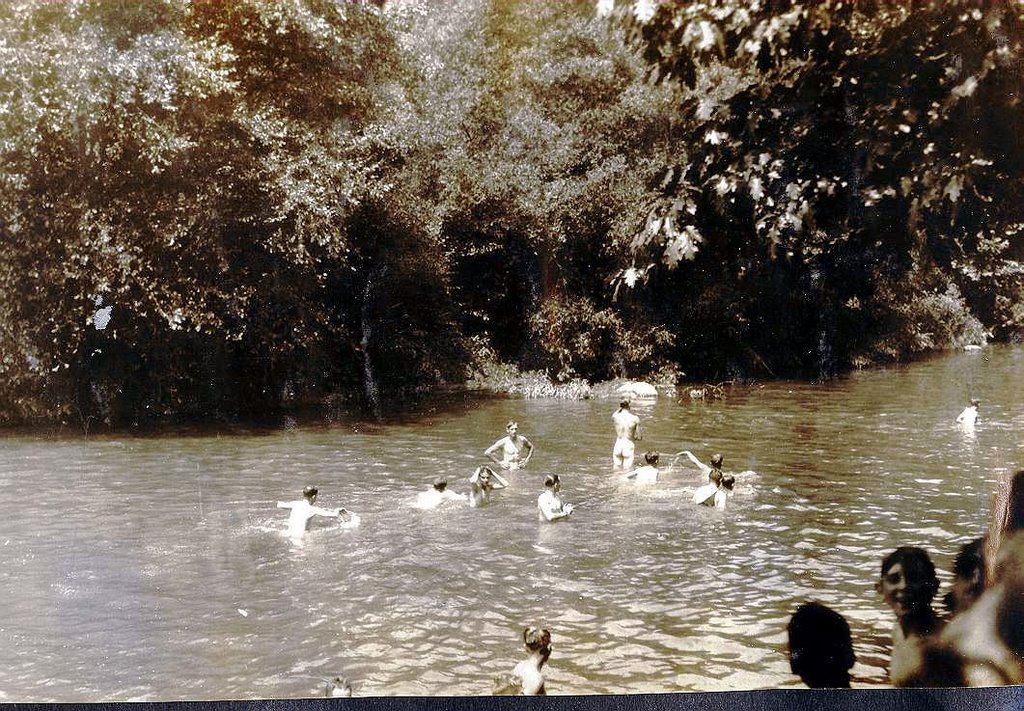
Everyone in this frame seems to be experiencing nature in their own natural state.
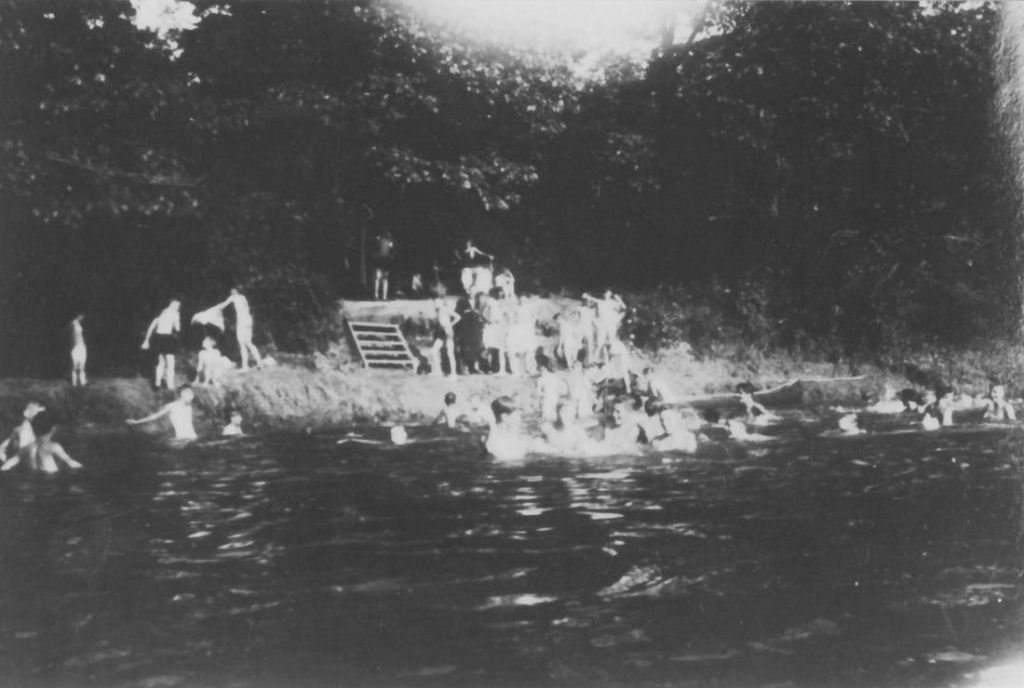
This very indistinct photo seems to show some participants in trunks – no tank suits evident. The lighter figures are likely nude.
As a postscript, I should add that I located one photo of the “new” pool. It is undated but likely from the early years of the pool’s usage. In that image all of the boys in the water and on the deck are in trunks, suggesting a radical change in policy. However, among the many spectators on the deck was a man in a white shirt, tie and a stiff-brimmed straw hat. He was holding a little girl by the hand. This photo may have been taken on family visiting day, so the boys were suited up contrary to normal practice.
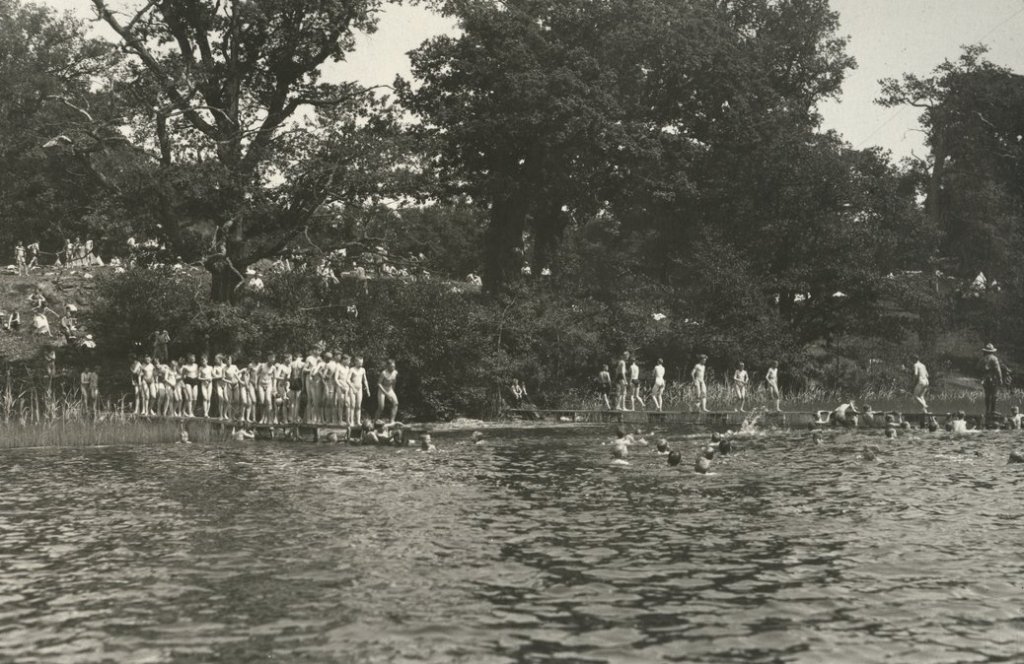
This extremely busy image has no attribution at all. Nevertheless, it contains some points of interest. First off, there are scores of figures in this scene, perhaps approaching a hundred. (In the Boy Scouts of yesteryear, such a large assembly might be due to the participation of several units or “troops” in something called a “camporee.”) Another point is that adult oversight seems nearly absent. The one dressed person on the end of the dock wearing the campaign hat seems to be the only candidate for “person-in-charge.” Apparently, the choice of swimming costume is left to the individual and most opted for “none.” Straining to see the boys in the woods, it appears that some have also chosen their birthday suit as the uniform of the day even though they don’t seem to have an immediate intention of getting into the water.

This entry is from the UK. It has virtually no attribution, but a guess says it dates from the 1920s. What makes this image remarkable is that either the participants are in baggy tank suits or they are completely natural. Moreover, the nude guys are clearly displaying their male parts without attenuation. I won’t mention the boy on the left who seems to availing himself of the access conferred by nudity.
Camps not requiring bathing suits were not limited to the Northern Hemisphere. The following is a set of images from an Australian Boy Scout gathering that was held in the state of South Australia in 1912. These were sourced from the State Library of South Australia archives.
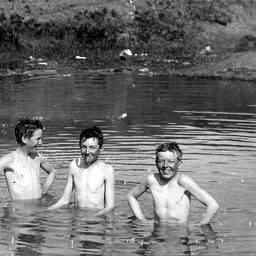
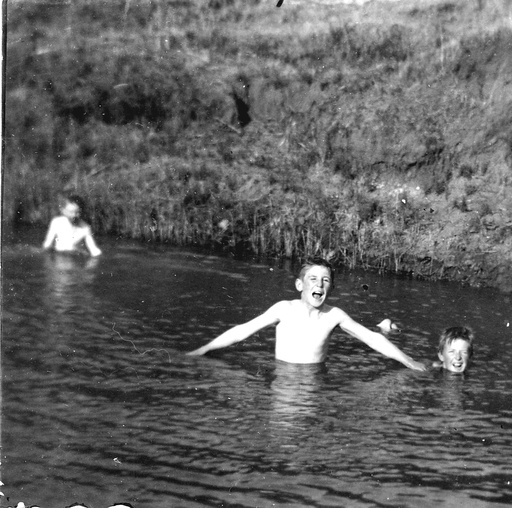
These first two photos keep the boys’ secrets with a high water level. For those who need to know, this body of water is the Gilbert River. The location is near Riverton, SA.
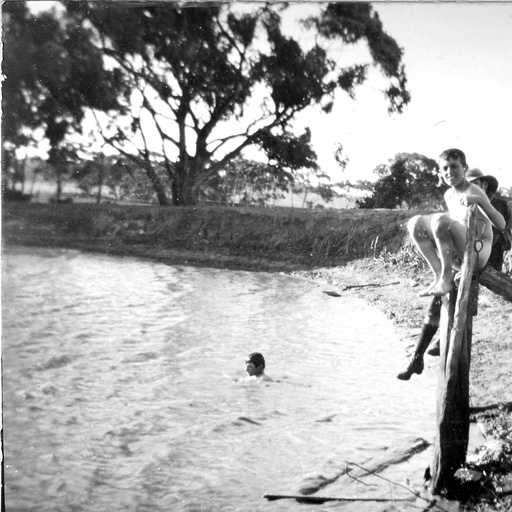
This is the first evidence that the scouts eschewed the use of bathing suits. The naked boy in the foreground largely obscures his fully dressed comrade. It is noteworthy that the exposed lad is pale skinned except for a patch of tan skin right below each of his knees. In other pictures of this group the scout uniform is shown to consist of a long-sleeved shirt and shorts that break at the knees. Long stockings and a broad-brimmed hat complete the ensemble. Consequently, the only areas exposed for tanning are that spot below the knees and the backs of the hands.
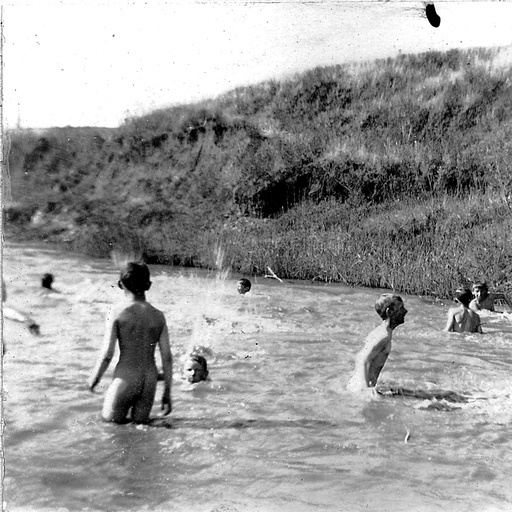
Any lingering doubts about camp swimming practices are dispelled by the two boys in the foreground of this image.
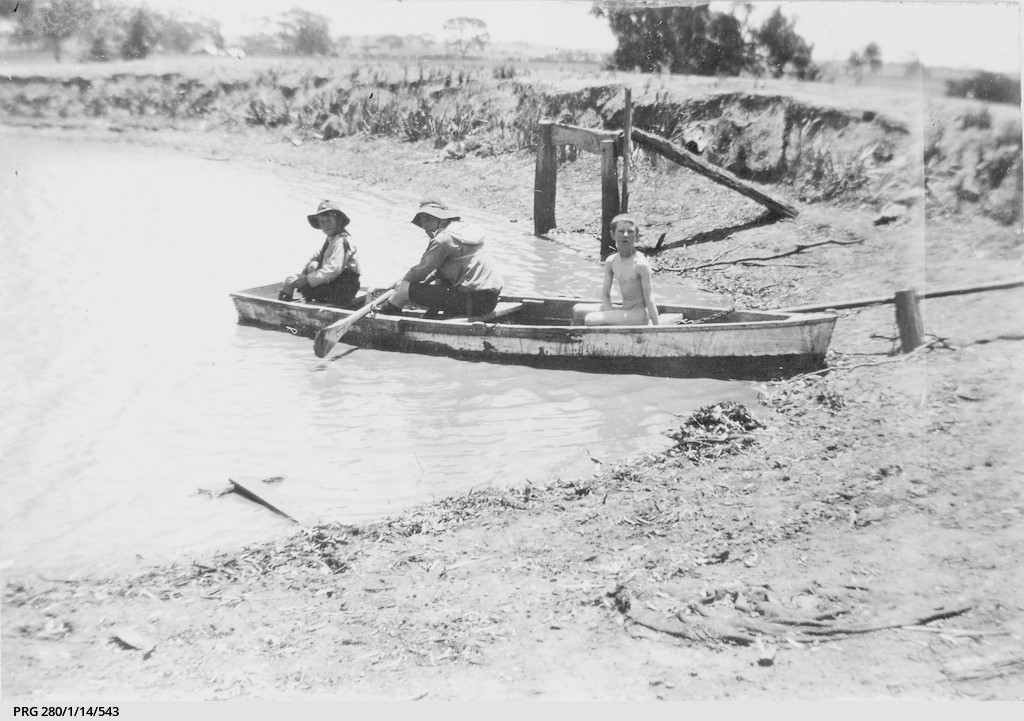
The attire of the boat crew bears out my previous remark on the voluminous costumes of the dressed scouts. Why the naked kid is free of those accouterments and of the responsibility of manning the boat is not apparent.
This low res image cannot establish whether or not the boys are nude while receiving rowing instruction. Based on what I know about the action of rowing, I would suggest that bare bottoms on fixed wooden benches are probably not a good idea.
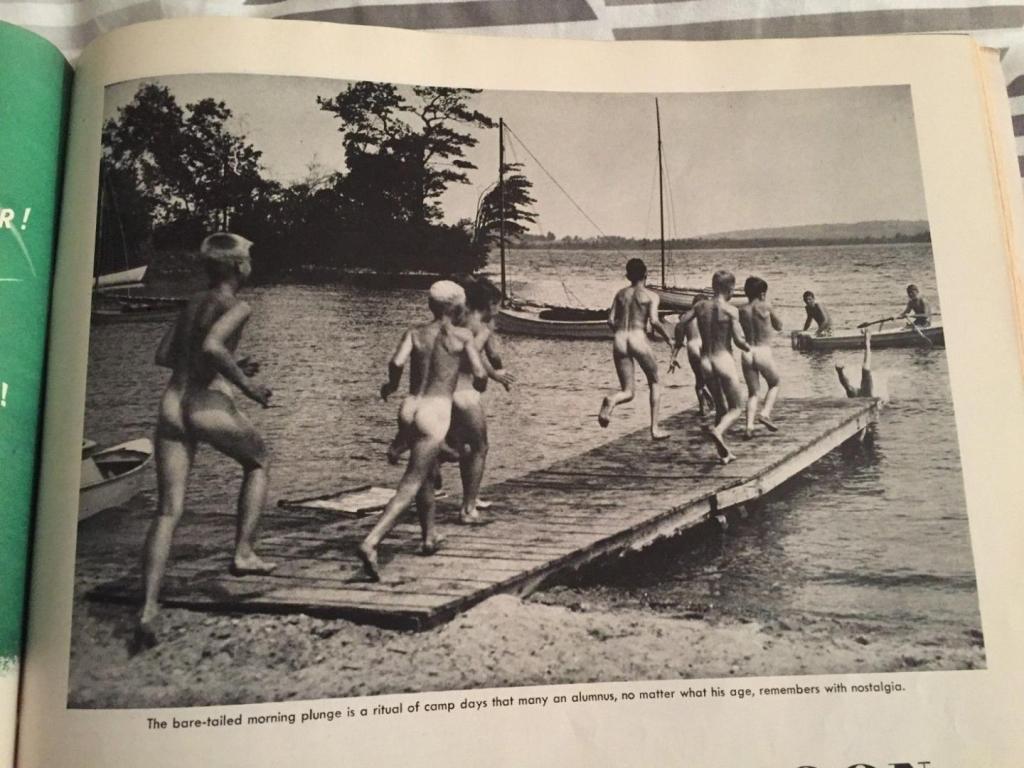
This picture seemed like a good capstone to our camp swimming presentation. It appeared in the June 1950 issue of Holiday magazine. Note the text below the picture extolling the joys of the “bare-tailed morning plunge.” Judging from the trees in the background, there was a pretty stiff breeze on that morning. Stout lads, all.
In our next posting we will return to the well-documented topic of swimming instruction.
 Historical Nude Male Swimming Images