Revised 11/24/25 Added two image to Swedes
It is well known that the modern naturist/nudist movement had its origins in Germany in the 19th century. However, the Germans had nothing to teach their northern neighbors. The Danes, Swedes, Norwegians and Finns all had their particular brand of naturism well entrenched, certainly when it came to aquatic activities. Let’s examine the photographic evidence.
Topic 1 Old Swedes
Early 20th century Swedish photos have been included in these posts right from the start. They have included floating bathhouse and swimming lesson pictures. Sweden’s Central Association for the Promotion of Sports has maintained a picture archive since 1897. The images below are from that collection. They roughly span a period from 1900 to 1920.
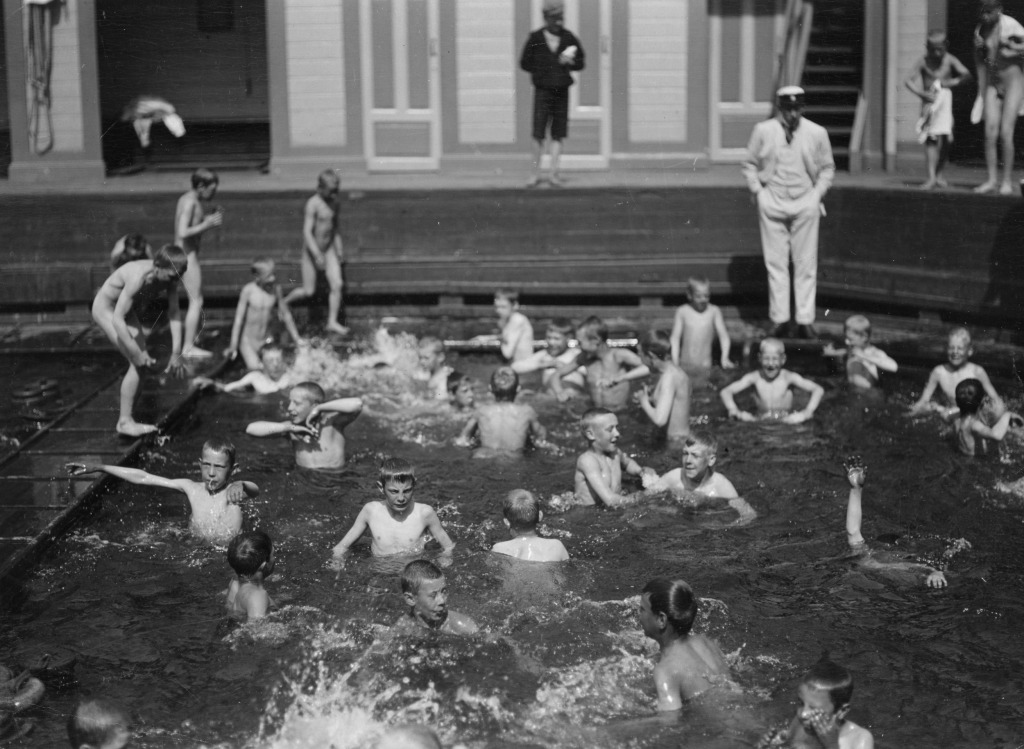
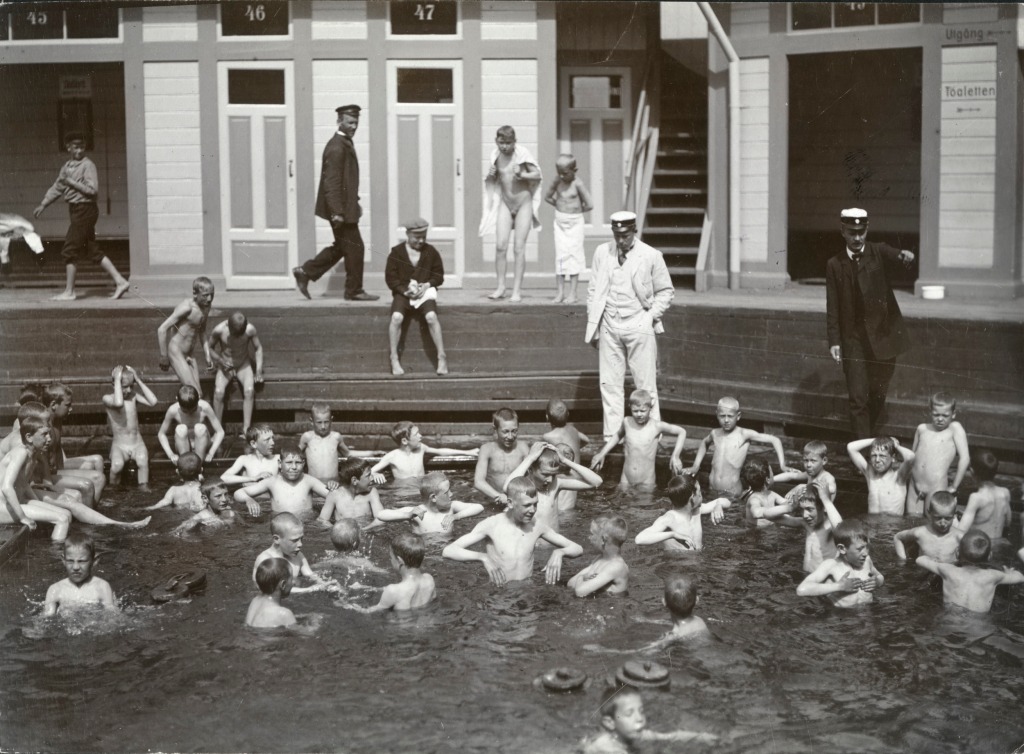
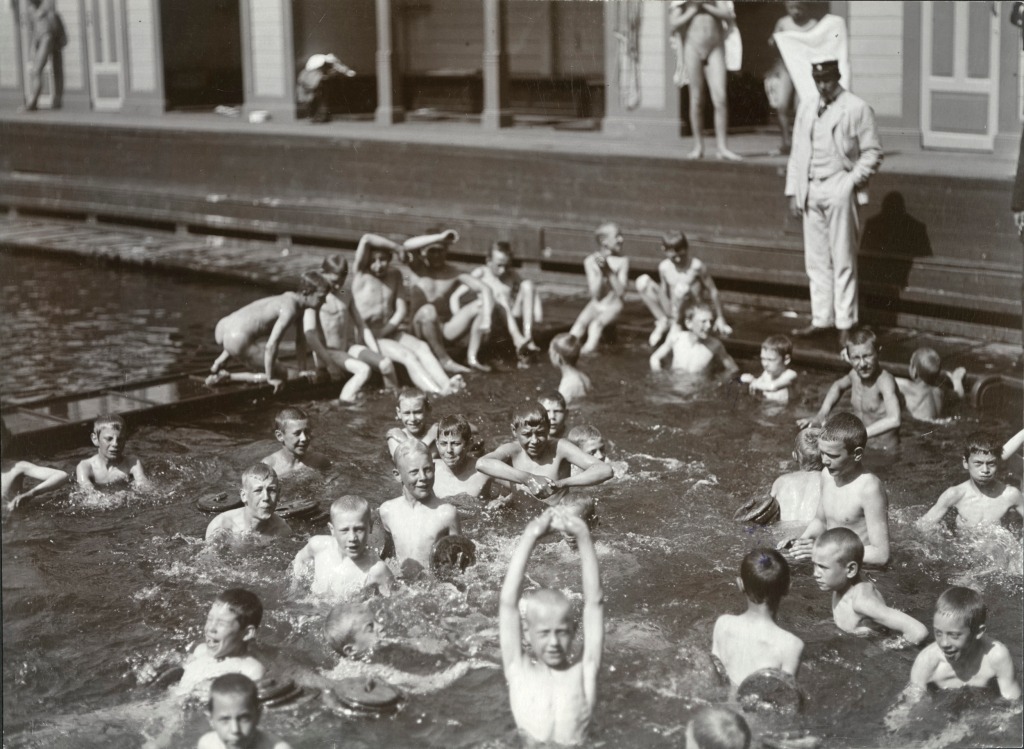
This trio of shots is from 1909 and are clearly labeled as “swimming school” pictures. You will note that the Swedes are considerably less troubled about the prospect of showing pre-pubescent boys as frontal nudes than some of their American counterparts. No attempt is being made to pose the participants to keep the male appointments out of sight.
As an aside, these scenes apparently took place in a rather elaborate floating bathhouse.
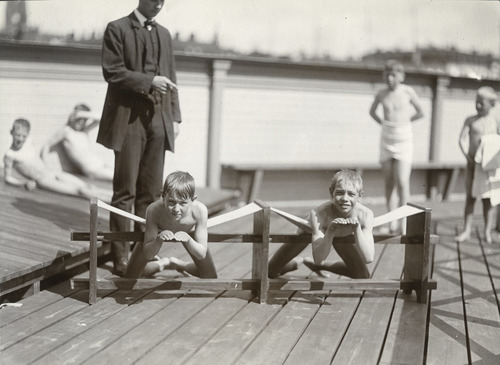
This time-honored method of “dry” swimming instruction was depicted in other postings of this website. For what it’s worth, the instances where it appeared in photographs were exclusively European (more specifically, Swedish).
This is one of a series of similar images from 1909 apparently shot minutes apart. I chose this one because of the obviousness of the nudity of the participants. In the other photos, the two boys on the left are less demonstrative posed.
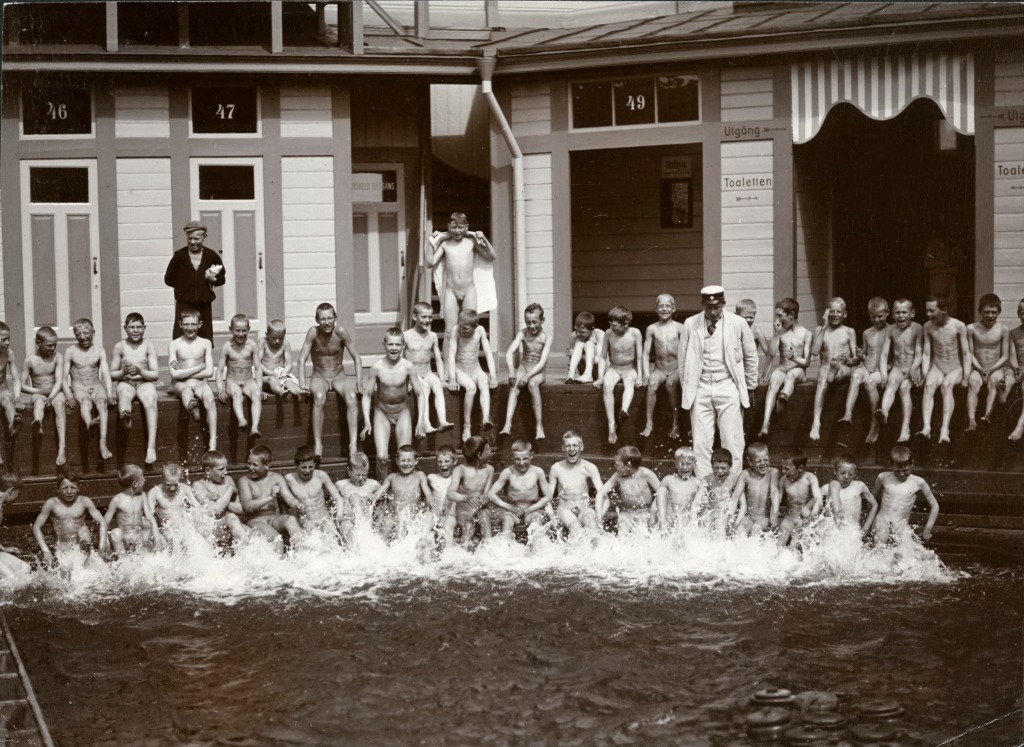
The capstone of the 1909 images is this class pic. Although formal, the participants were allowed to free style their personal presentations. Boys will be boys.
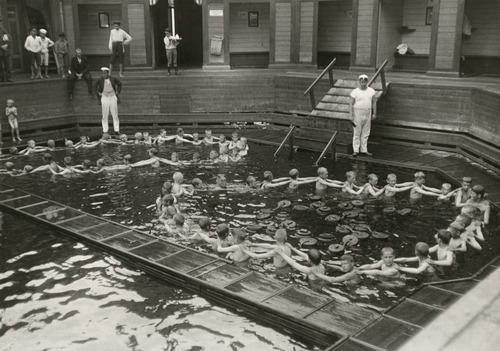
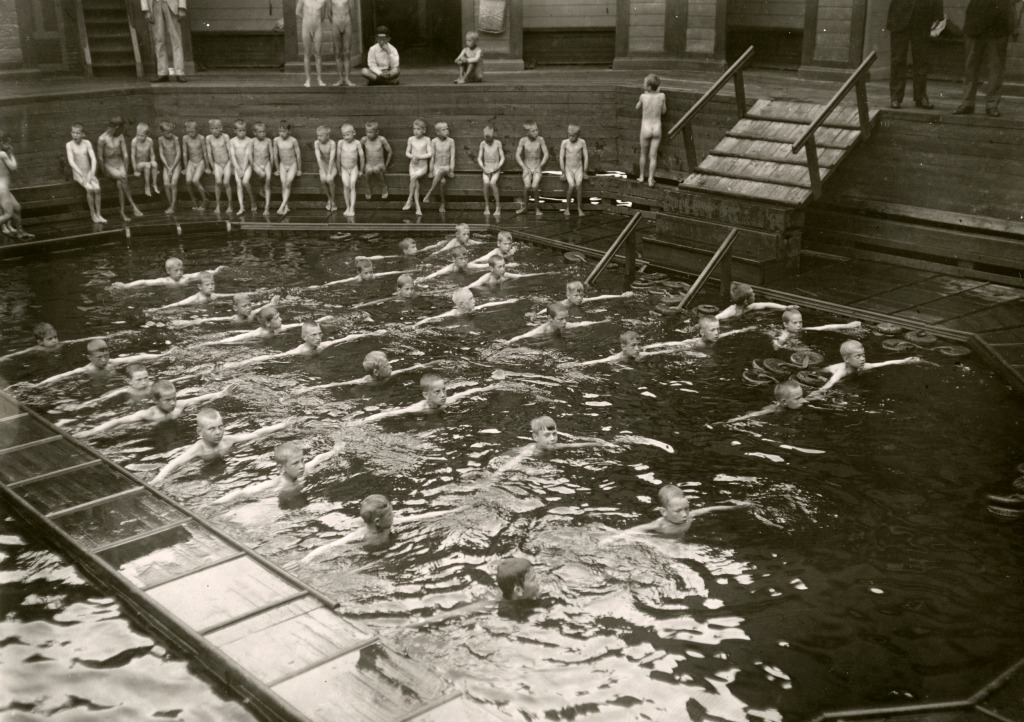
We’ve moved on to 1917 and what appears to be a different venue. The activity seems to be different, too. Is this a water ballet? The one constant is that the kids are unencumbered by suits and the photographer is unflinching in capturing that fact.
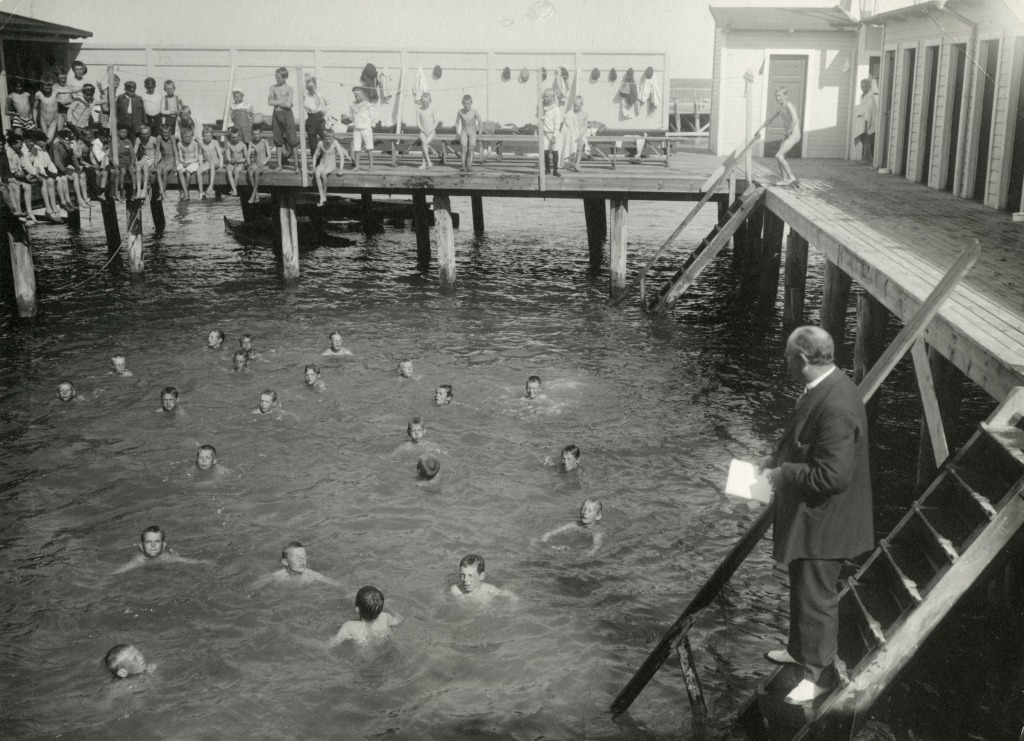
This undated photo shows a still different facility. The well-turned-out adult supervisor seems dressed for success rather than lifesaving. The full frontals on the deck are curiously interspersed with fully dressed on lookers. Cold day?
This next series is from a documentary film dated to 1908. The subject is, yes, you guessed it: swimming lessons. The location is the historic city of Kalmar in southeastern Sweden. The images were collected from a German FKK site.
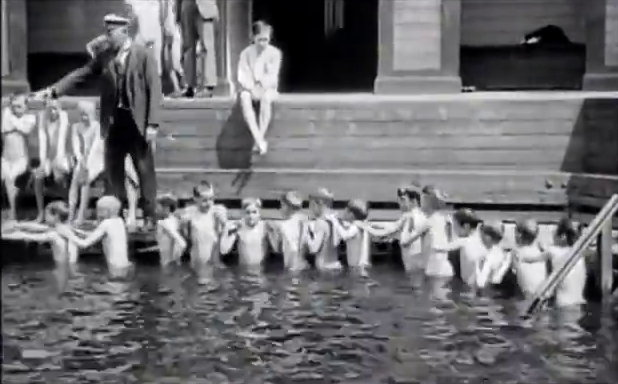
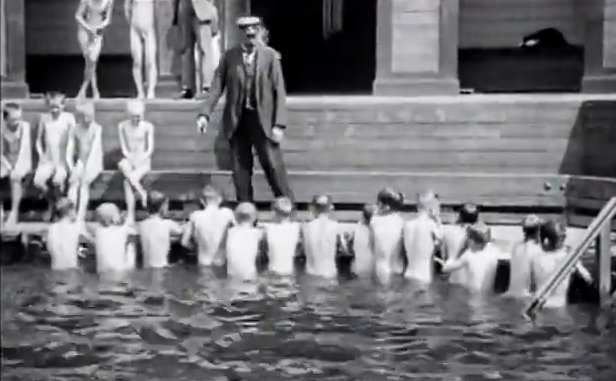
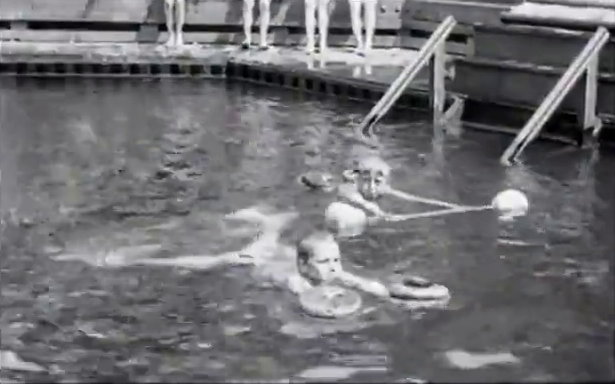
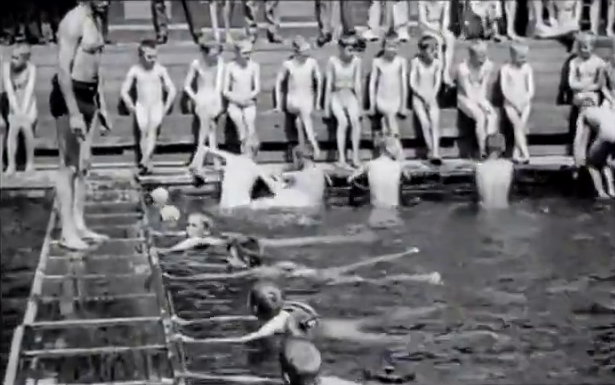
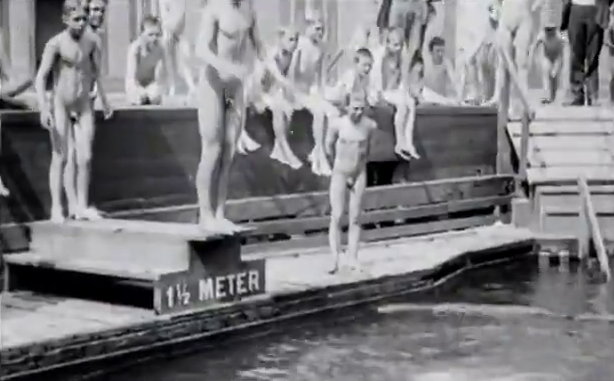
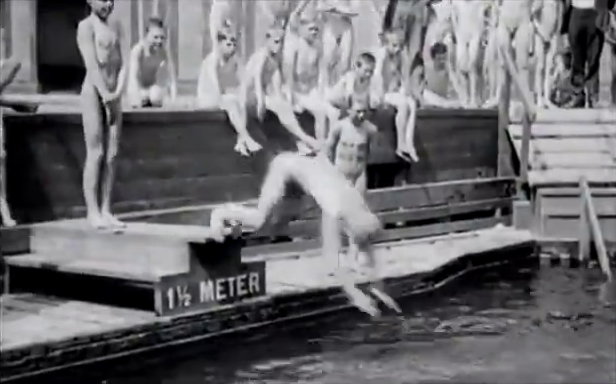
One might wonder whether a meter and a half is a safe diving depth, particularly since the bathhouse is located on a natural body of water whose depth might vary from time to time. Apparently, when the crank-actuated movie camera of the era was positioned to capture this sequence, it was mounted too low, hence the cropped heads of the divers.
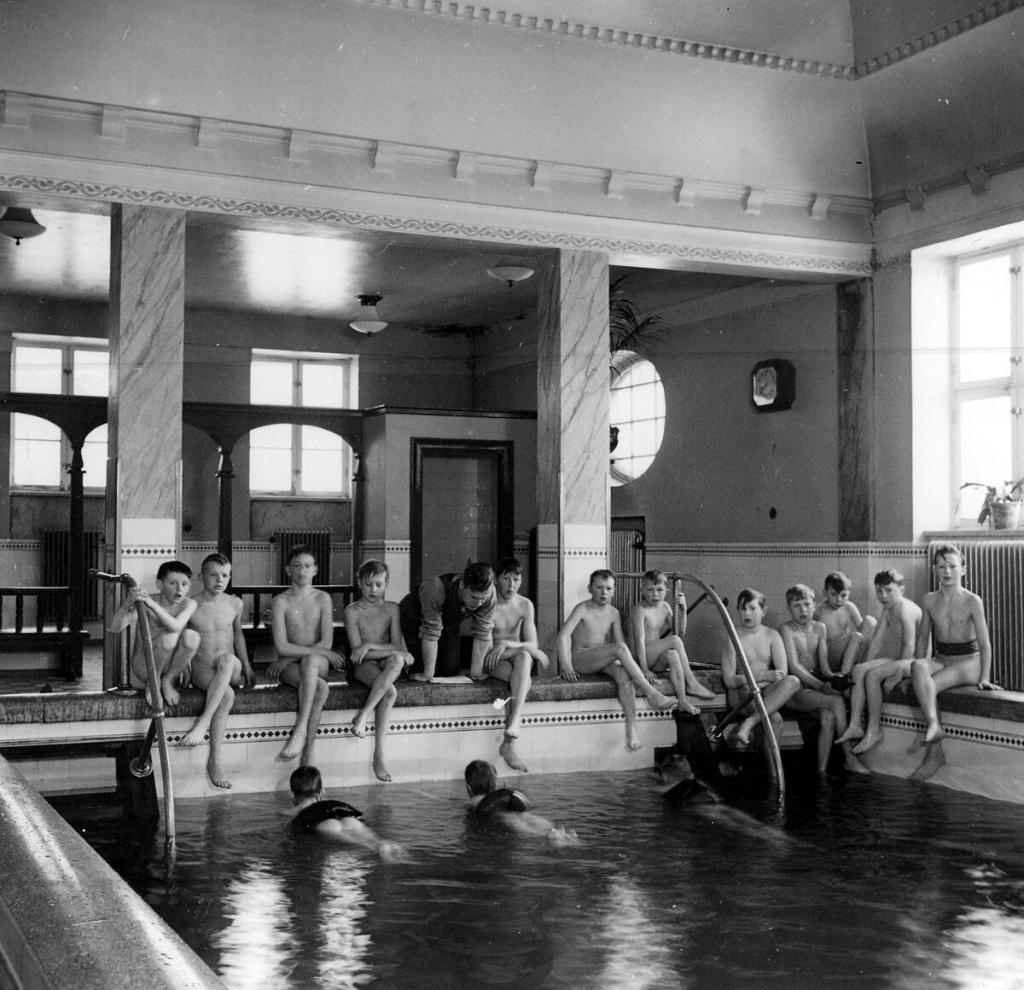
We’ve moved indoors for another undated photo. It is likely that we’re now in the 1930’s. I’ve seen those types of flotation devices used in other images from that period. Note that this a more decorous shot with the boys’ legs primly crossed. Buns are still on the menu, though. You have to love the fully dressed instructor on his hands and knees peering over the edge of the pool at his charges.
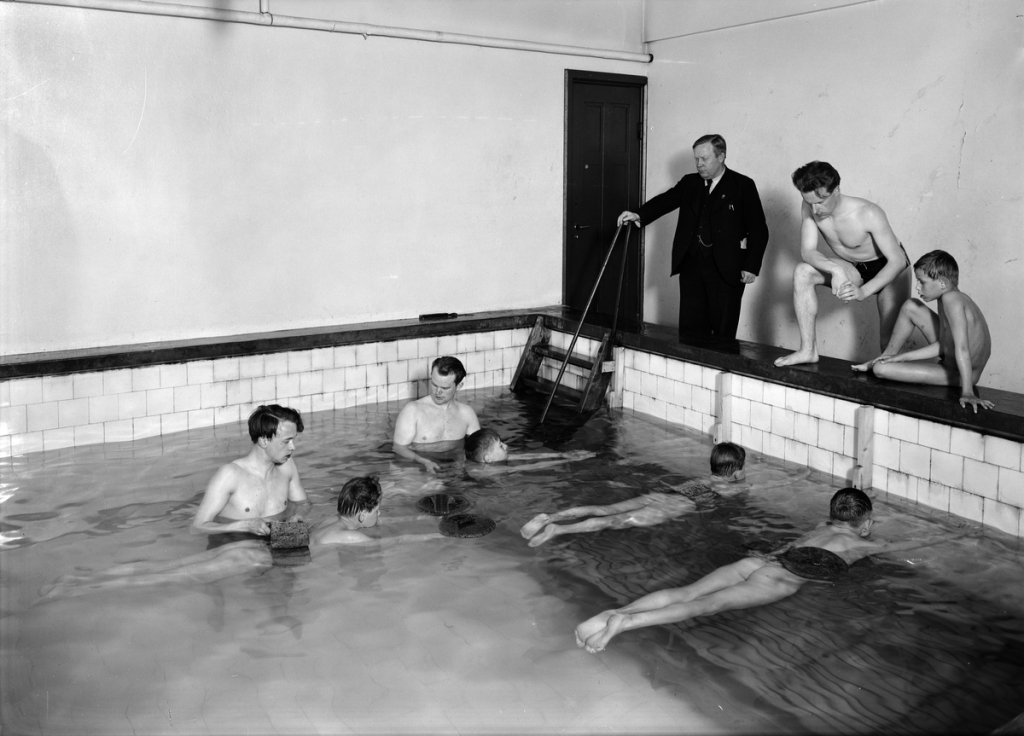
This photo was taken in Uppsala, Sweden in 1939. Here we have more naked boys receiving instruction using flotation belts but the instruction technique seems more hands-on. It’s easy to deduce what the adults in the pool are doing but the guy in the dress suit with the long cane is another matter.
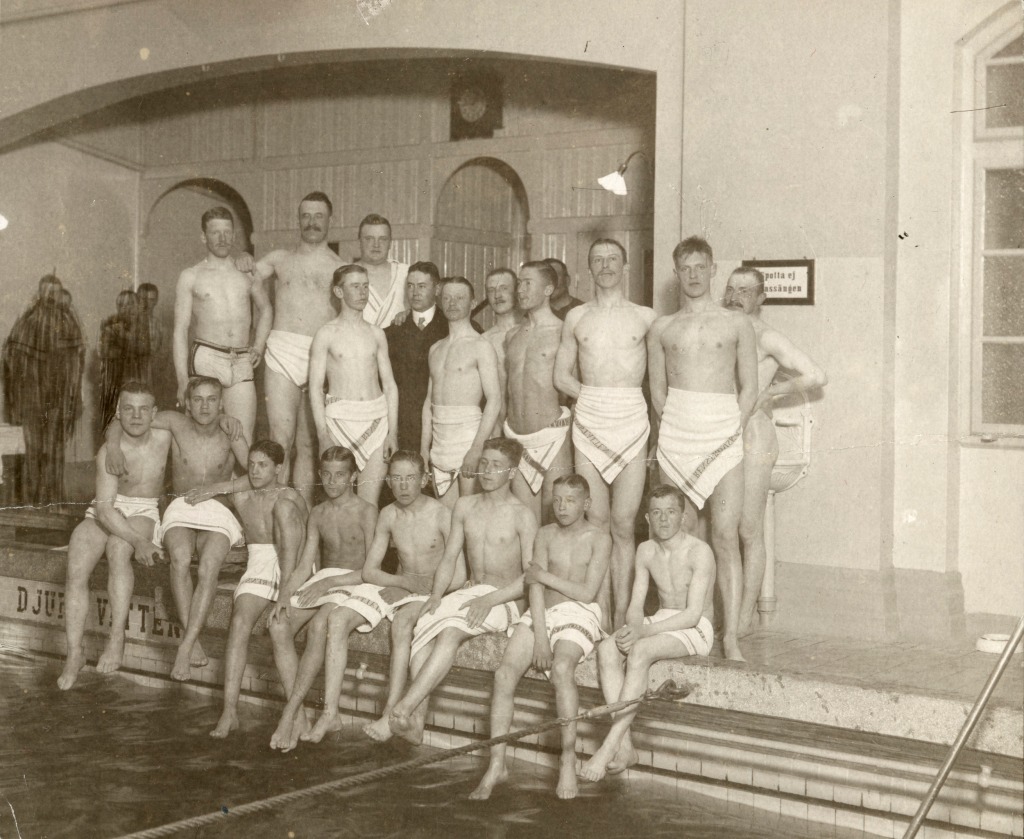
At first glance, this undated photo looks like a formal shot of some young adult club members who donned towels for the occasion (except for the one guy on the far right who simply hid his package behind one of his fellows). However, that does not explain the four or so spectral images on the left side. I’m wondering if they were club members who did not cover up because they thought they were out of range of the shot. Did the photographer attempt a clumsy darkroom alteration to obliterate the offending nudes?
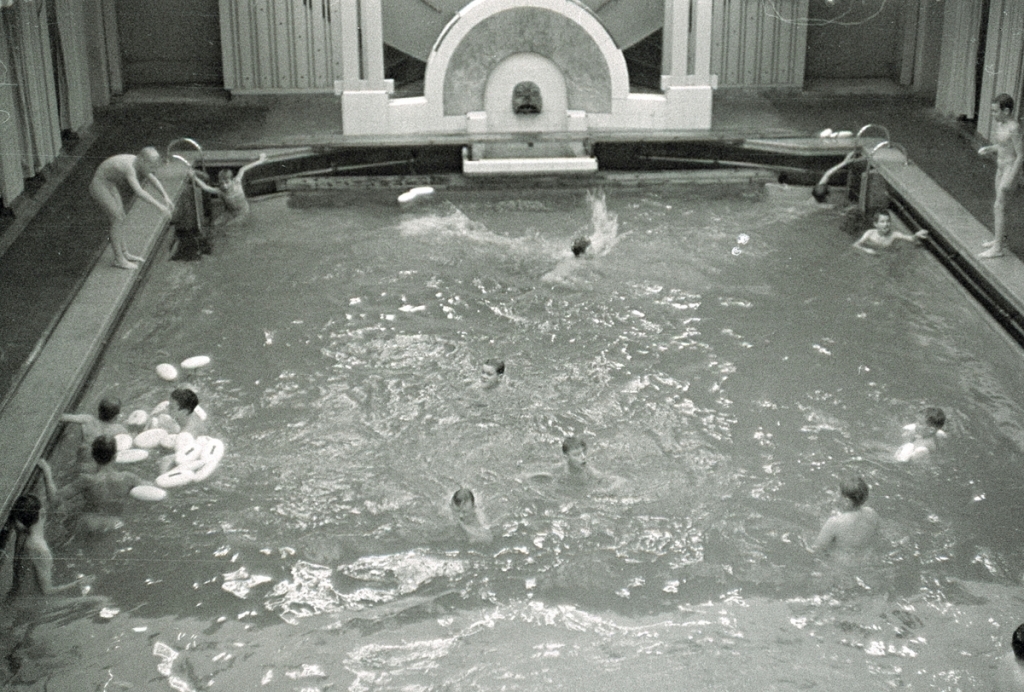
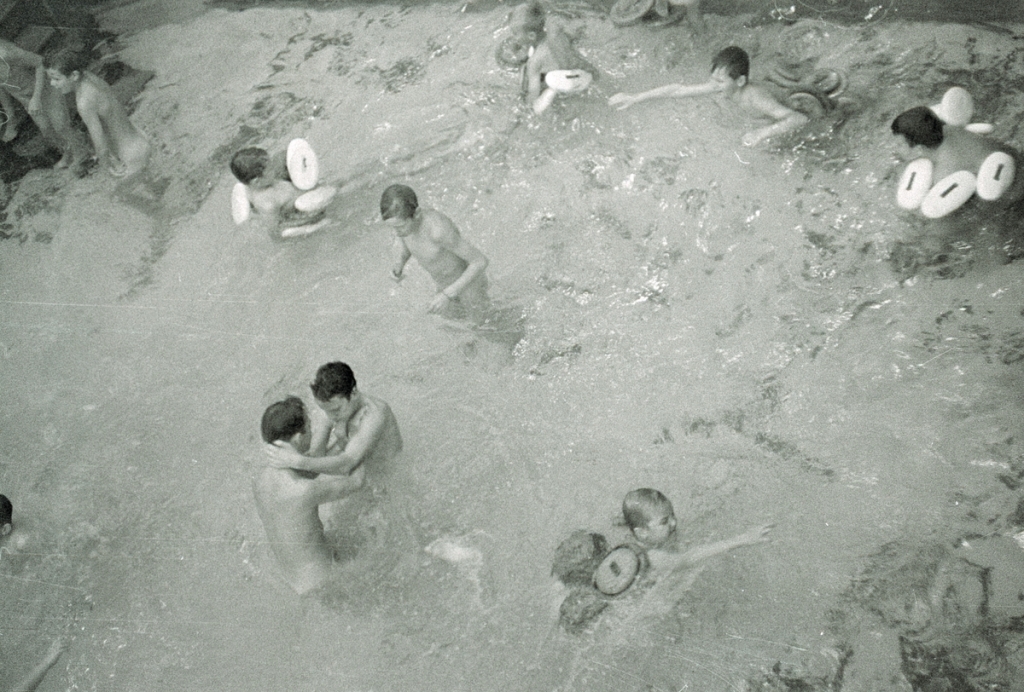
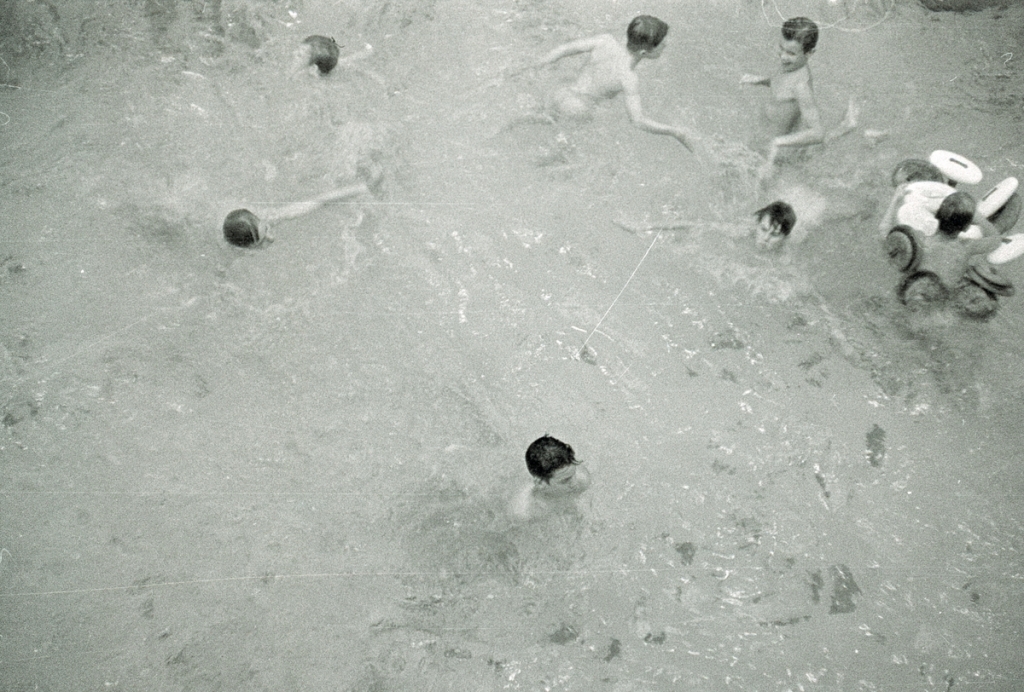
The city of Vasteras, Sweden maintains an archive of historic photos that is made available through Digital Museum (previously cited). These images are from a free swim event that took place in 1956. It is clear that the boys are enjoying their recreation free of swim suits. Based on some contemporary film I saw, the floats that they are sharing the pool with are swimming instructional aids. They can be attached to the hands with elastic bands to keep the front end afloat while the boy propels himself with kicking alone.

This quiet moment occurred in Stockholm in 1951. The name of the facility was Aspuddsbadet. In this period, it was open at alternate times for males and females and nude swimming was permitted. It has since been closed.
Next is a collection of four “school bath” photos whose subject matter is a bit obscure. The only text that accompanied them read “Education, swimming and healthcare.” Nevertheless, to modern eyes the scenes are not obviously hygienic, instructional nor recreational. No locations are given and only one is dated.

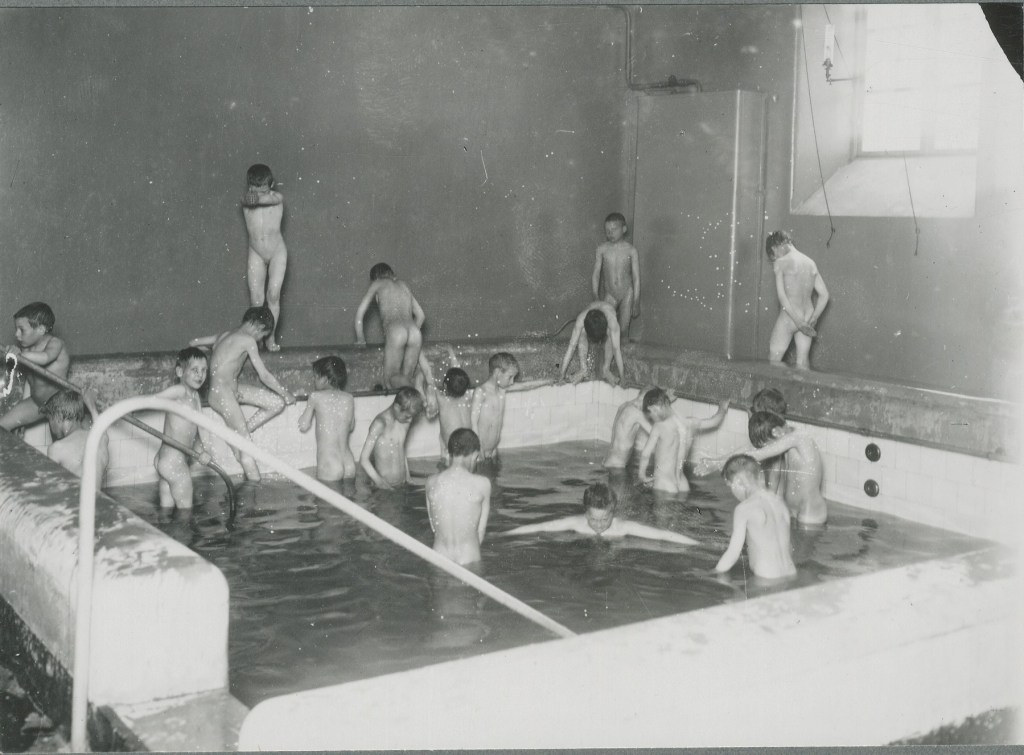
These two unidentified photos are weird to the point of being disturbing. Most of the boys have their heads down, are turned away from the camera, or both. Assuming that this is not a mind-control experiment, the boys must be responding to instructions to keep their faces out of sight. The size of the pool is also a point to ponder. It looks suitable only for a soaking tub.
The date of these two is unknown, but the lighting fixture in the extreme upper right looks ancient. Any chance it’s a gas light?
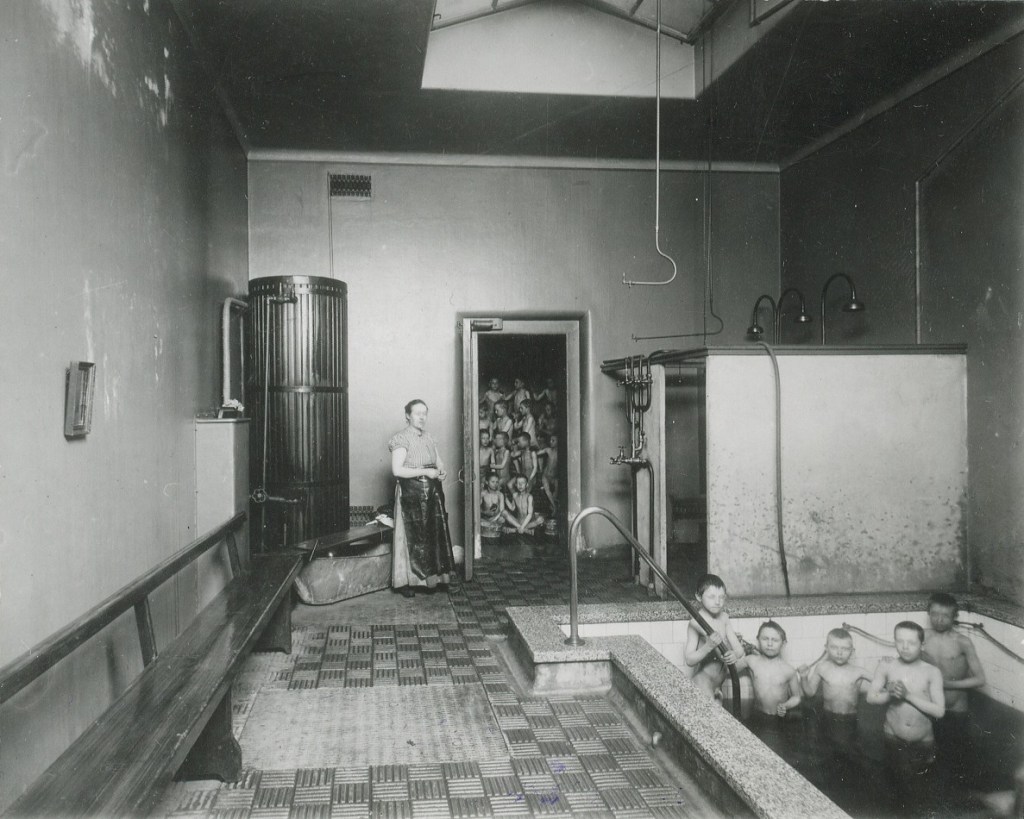
The only thing known about this image is that it dates from 1903. The matron-moderated activity seems to be proceeding in batch fashion, with a few boys at a time taking the dip. A group of boys are waiting for their turn beyond the open door. Apparently, they are perched on the steps of a staircase, tier fashion.
Other features of this scene include the showers in a separate enclosure. There is also the cylindrical device in the left corner which is likely a water heater/storage tank. Ventilation seems to be provided by openable skylights that are manipulated by the cranks hanging down. Gotta believe that that arrangement didn’t do much to discourage mold. Finally, there is the pool itself, a long narrow affair whose utility seems questionable.

This last scene seems to suggest swimming instruction. It features the street-clothed instructor overseeing his charges’ activities. Although small, the utility of a pool this size for instruction or recreation is clear. The boys obediently wait their turn unselfconsciously clad in their birthday suits.

Malmö, located near the southernmost point of Sweden, is the third largest city in that country. In June of 1944 it was the site of this busy swimming school, apparently set in a version of a floating bathhouse. Besides the large number of juvenile tushies, the other remarkable feature of this image is the prevalence of the flotation belts. The belt design is unlike any others I’ve seen.
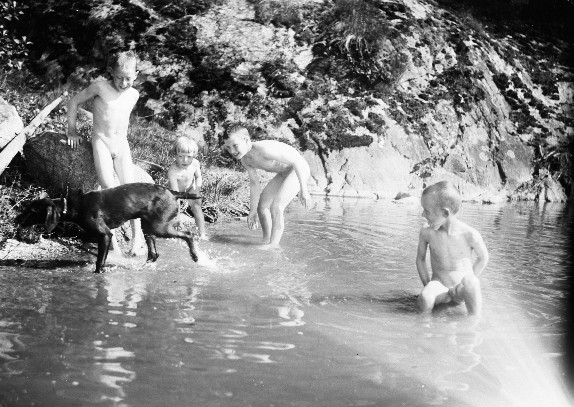
But the Swedes can be found swimming in nature as well. Here is an unattributed skinny-dipping scene.

This is a change of pace. This rustic scene includes a large assortment of boys – some naked, some not – being observed by at least three little girls. The picture has an approximate date of 1930 but the location is unknown. I entertained the notion that the identical black bathing suits being worn by the three males just to the right of center were painted on in post-production as some sort of modesty concession to more developed boys, but I can’t support that with the observable evidence.

Here is another type of skinny-dipping scene from ‘way back. The attribution on this is Kristineberg, Stockholm 1886. Following that trail of breadcrumbs locates a residential neighborhood in a district of modern Stockholm that adjoins a body of water called Tranebergssund. That is likely the setting for this photo.
There is a rich variety of swim costuming here as well as a range of ages among participants. Some youngsters are wearing suits while others go bare. Examining the background figures, that seems to apply to the adult participants as well. The structure on the right seems to be an amenity for changing and entering the water via stairs. The plank is probably a diving board.
Now that we’ve considered boys’ swimming lessons, informal skinny-dipping and the posh indoor club pools, let’s look at another side of the Swedish aquatic scene of yesteryear: the Skeppsholmen bathhouse. It was located on Skeppsholmen island just offshore of Stockholm that was used as a naval shipyard for over a century. Around 1840 (right, quite a while back) they built a floating bathhouse on the eastern shore because Swedish sailors were required to bathe regularly. Given Sweden’s climate, this must have been a bracing experience for much of the year. In 1870 they added a warm (indoor) bathhouse.
The pictures below are from around 1905.
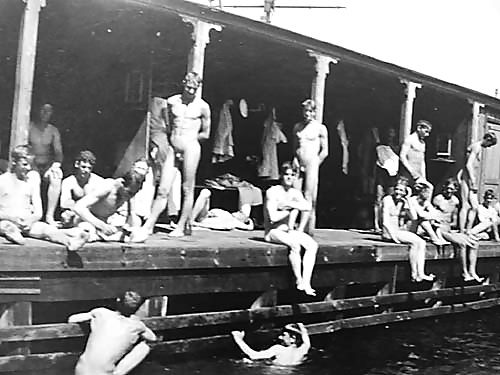
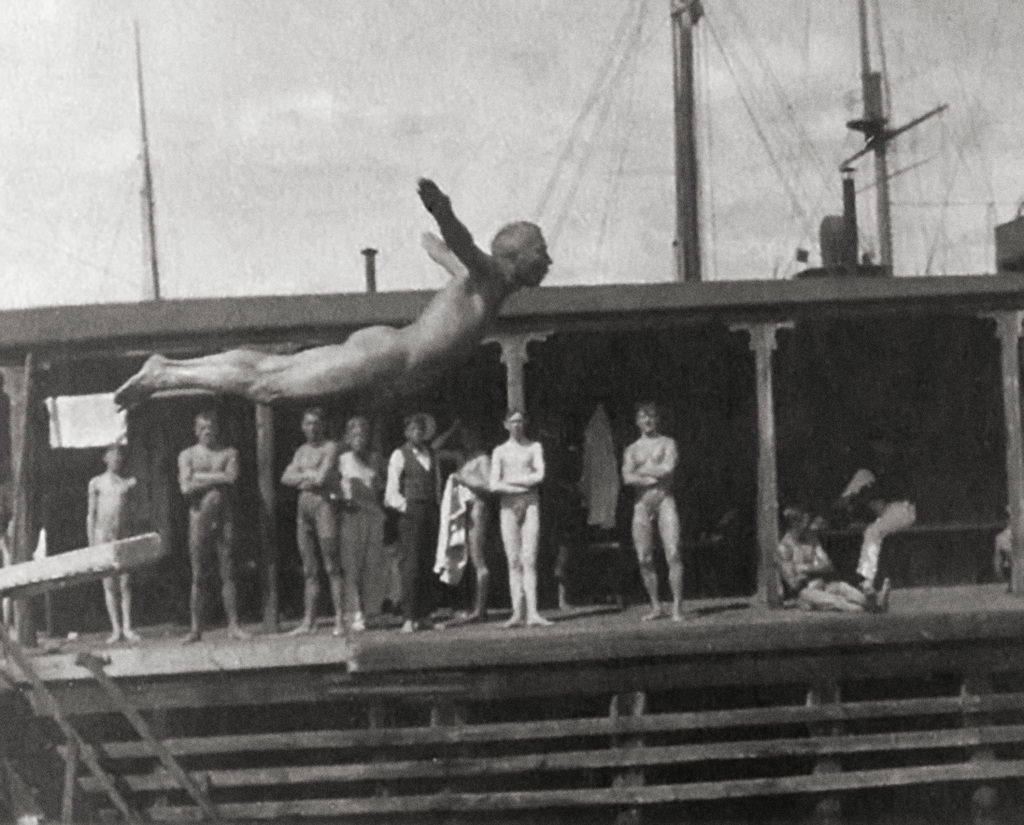
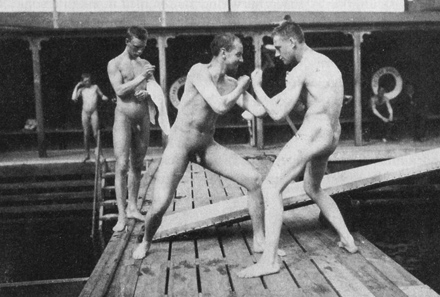
As can be seen from the presence of ships’ masts in the background, the bathhouse was proximate to the naval operations with the attendant downsides to that. The outdoor bath was closed in 1923 because of persistent water contamination.
Around 1904, a Swedish painter named Eugene Jansson gained permission to use the bathing facility for his on-going health issues. He found the presence of so much naked male flesh inspiring and commenced doing a series of paintings of what he saw. One is shown below.
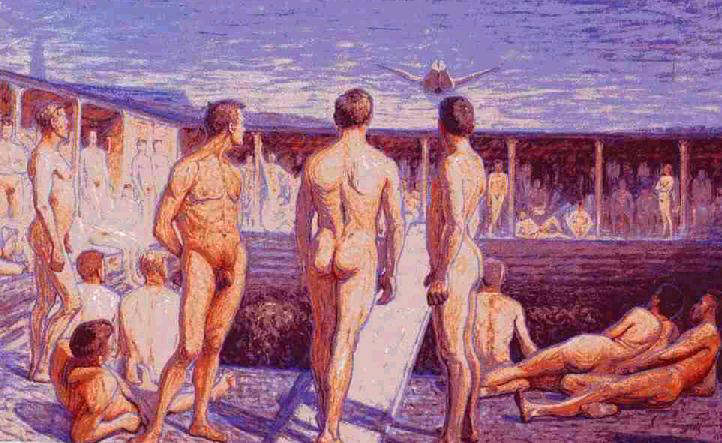
Leaving aside the idealized depictions of the Swedish sailors’ bodies, I find the slanted diving board, which appears in a couple of the photos above, interesting. Modern spring boards were still several decades into the future. I suggest that upward slanted mounting of this board probably provided a lot of flexure. It probably required some practice to use it without courting injury.


These two images come to us from the Digital Museum, the source of many of our photos in this section. The scene is from 1906 and the location is on the river outside the city of Gävle. The hats worn by three of the figures identify them as college students. These must be hearty fellows. Gävle is located at 60 degrees latitude and as a result, the typical daily high temperature during the short summer is 20C (68F). Most people would regard that as shirtsleeve weather but not swimming weather. And that’s before you consider the water temperature which is likely quite brisk.
Topic 2 Little Danes
Boys’ aquatic recreation in Denmark much the same as elsewhere. From the photographic evidence in hand, the boys of Denmark made use of in-town waterways and weren’t too fussed about who might be around when they did their skinny dipping.
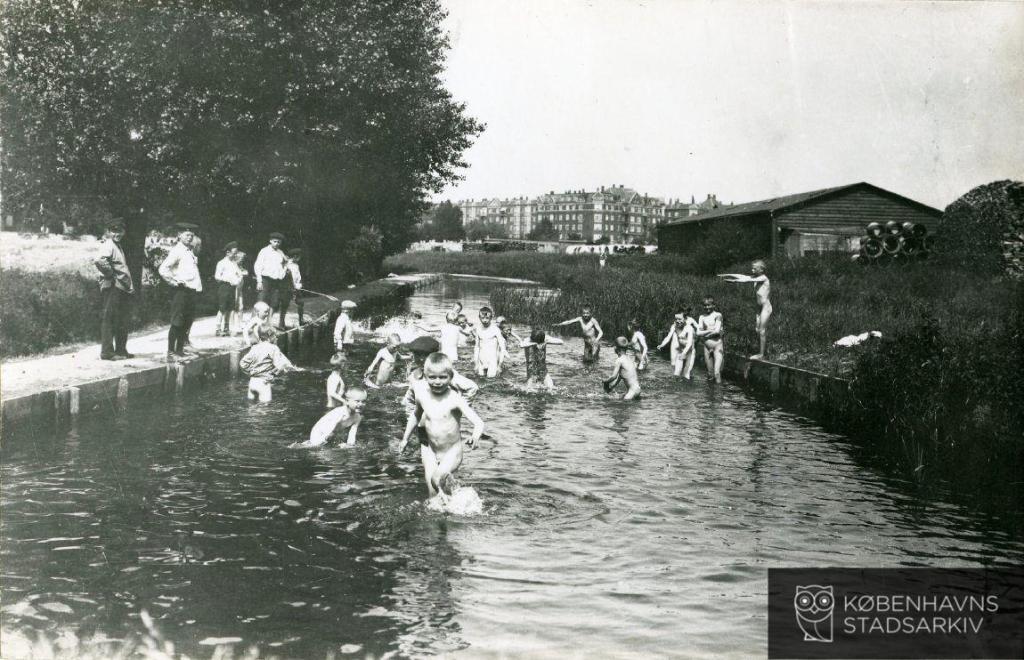
This 1910 image is from the city archive of Copenhagen, as shown by the label in the lower right. The proximity of occupied buildings and a public footpath is no deterrent to the boys’ getting naked and having a little fun.

Based on the appearance of the buildings in the background, this undated image seems to show the same location as the previous photo. The stream was identified as Ladegårdsåen.
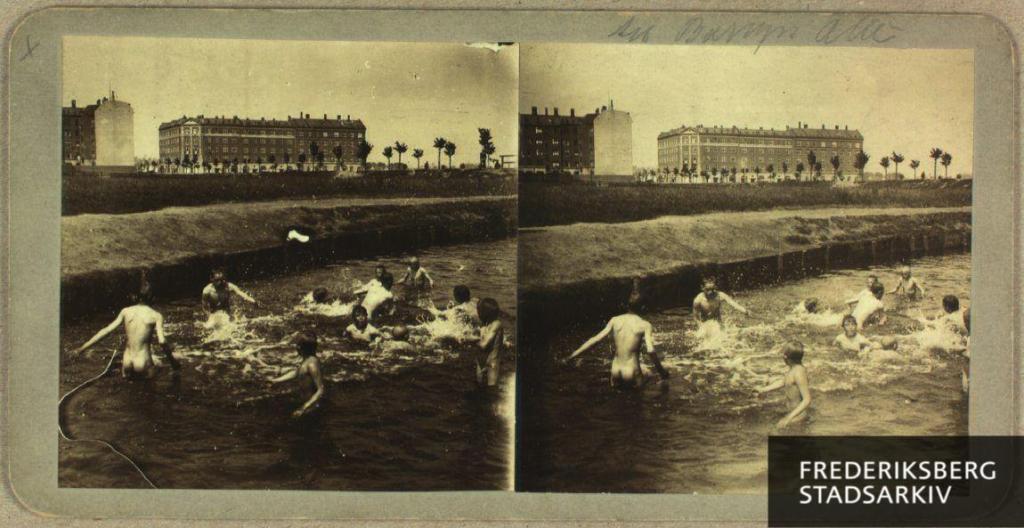
This 1906 image is from Frederiksberg, a neighboring municipality to Copenhagen.
These twin images are slightly damaged and are not identical. The one on the right is cropped a little closer, squeezing out the standing figure. I believe these are the remnants of a stereo viewer slide. Without getting too detailed, pictures are taken with a binocular camera, yielding two images slightly offset from one another. When printed on heavy stock and viewed with a binocular device, the scene appears in 3D. These types of devices were popular beginning in the late 19th century. It was the ancestor of many stereo picture devices down through the years.
Again, the boys are utilizing a stream with confined banks in proximity to frequented areas.
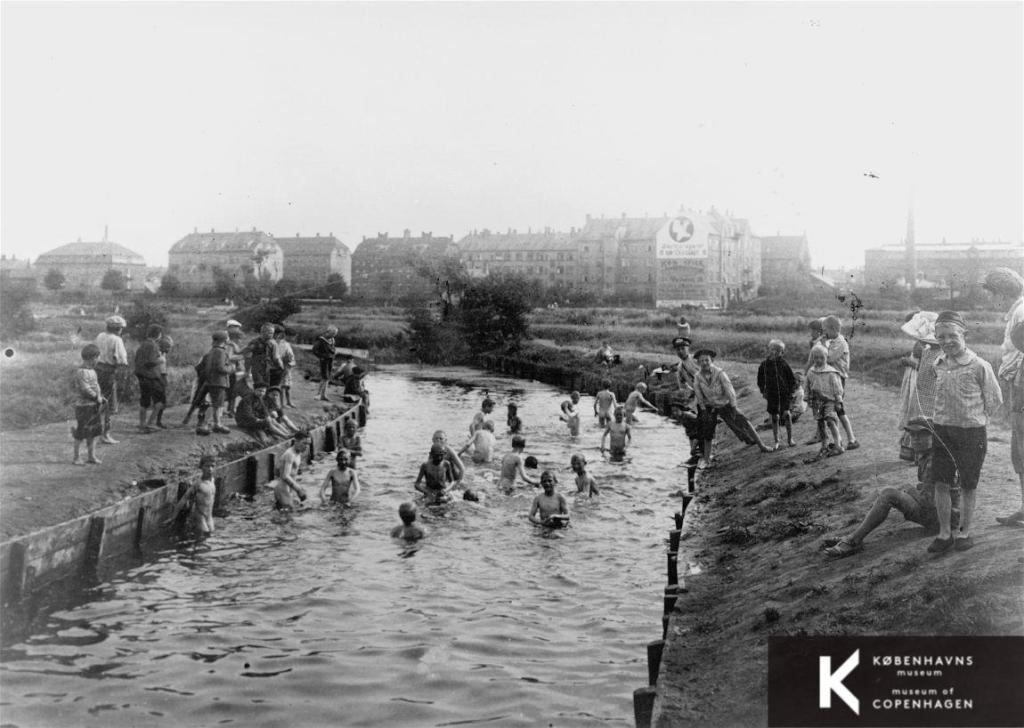
This undated image from the Copenhagen Museum shows what happens when you skinny dip in a populated area – you draw an audience. Besides the boy spectators on the right who are reacting to the camera, there appears to be at least two females taking in the sights. Everyone seems to be enjoying themselves.

This photo from 1910 looks like it may have been taken in the same location as the previous scene. The waterway is identified as Ladegårdsåen, which we have come across previously. As it turns out, the people and the elements of this scene have passed into history in more ways than one. In 1925 this stream was redirected through an underground conduit, so it no longer runs on the surface.

As this busy frame shows, Danish kids did not confine their aquatic pursuits to canals. This photo captures a scene in a seaside floating bathhouse in Copenhagen in 1902. It comes to us courtesy of The Workers’ Museum in Denmark.
The fully dressed adult males are overseeing the proceedings which include launching off the diving board (note the boy in flight in the upper portion of the image) and taking a turn in the swimming sling being manipulated by the man with the long pole. Disrobing seems to be an informal procedure in which one merely drops one’s clothes on the deck.
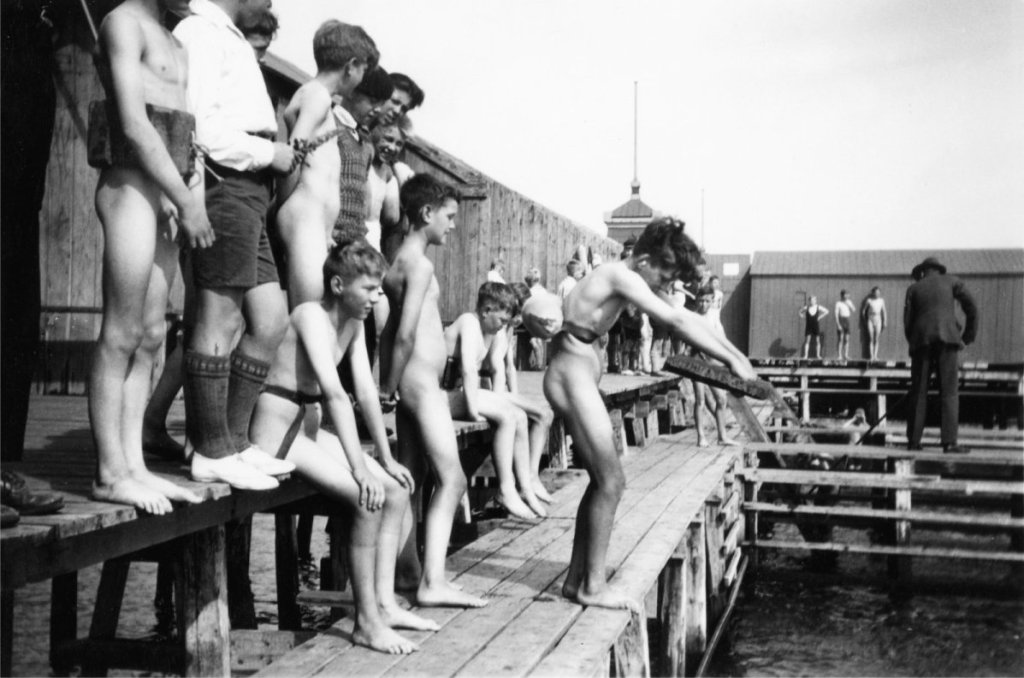
This unattributed photo shows swimming lessons underway at another floating bathhouse – probably around the turn of the 20th century. Unusual for this setting, there appears to be a nude adult male in the background.
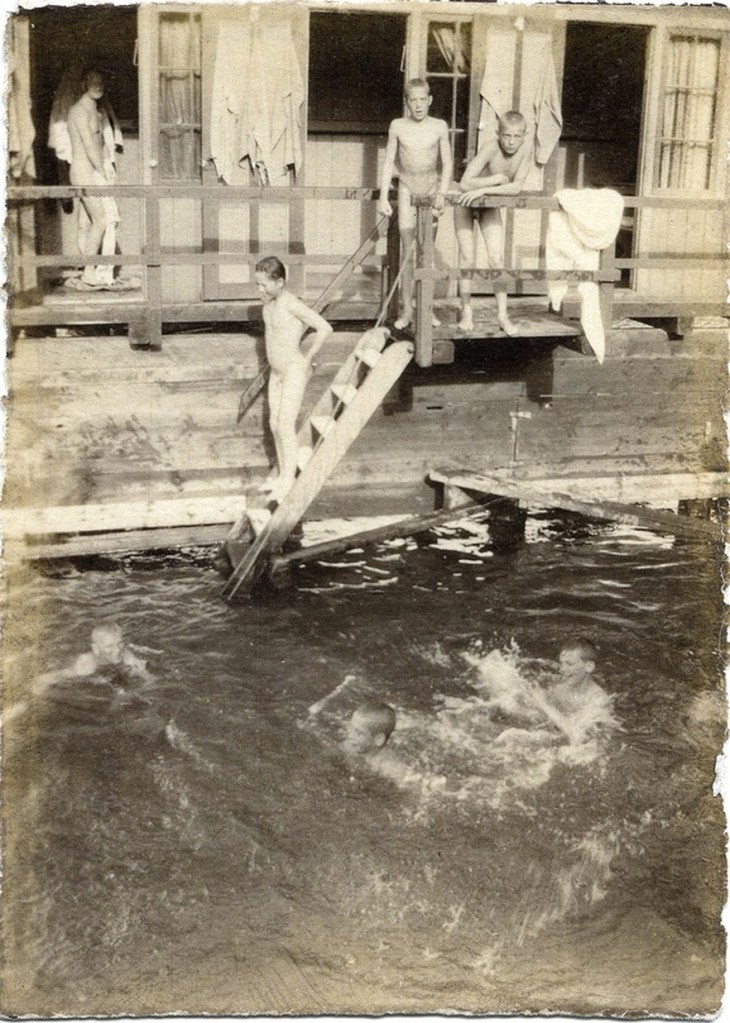


In the Baltic Sea, the Danish island of Bornholm lies well off the coast of the mainland. The largest town on that island is Rønne whose principal feature is a natural harbor. Rønne, which is situated on the west coast of the island, is the scene of these three images from 1914. According to the accompanying text, the activity they capture is a swimming school.
The structure from which the boys depart for the sea contains multiple changing rooms, which seems superfluous since all of the participants are nude anyway. It could be that the facility was used by adults at other times, so modesty might have been in order.

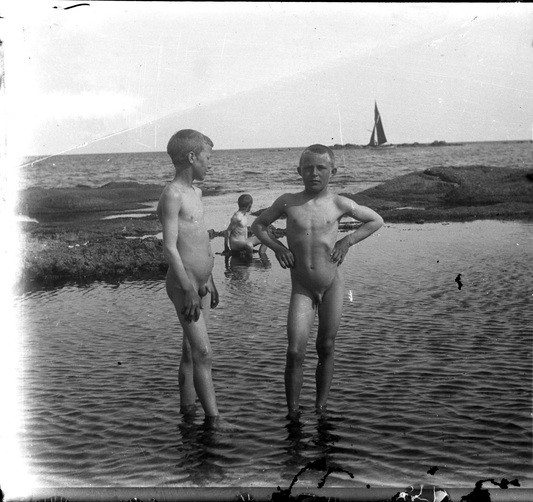
The island of Bornholm is not just the town of Rønne. On the east coast is the fishing village of Aarsdale. Around the turn of the 20th century, it was home to a professional photographer named Savenke. One day he apparently did a commercial shoot there using three young boys. He took various photos of them as they capered in the shallows. The two images above are representative of the collection of photos that resulted from that session. These are cropped out of pairs of stereo views that may have been offered commercially. One wonders whether the boys were paid for their participation. And did they sign modeling releases?
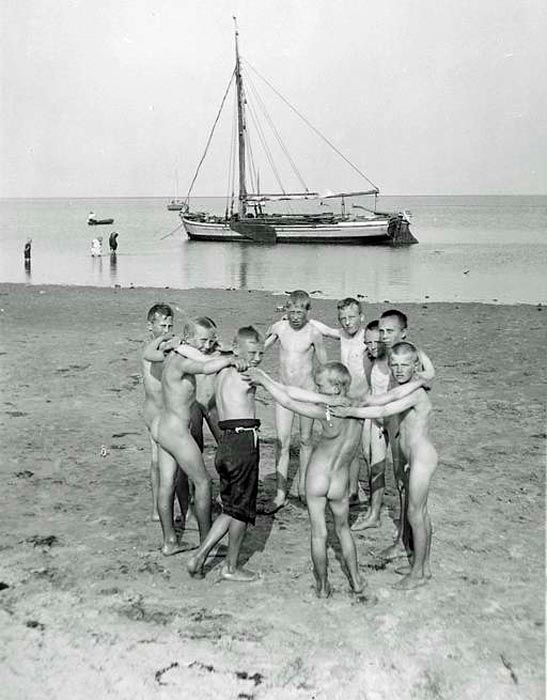
This well-composed photo suffers from a lack of commitment on the part of the models. Some of them seem to be saying “Is it over yet?” And of course, the kid in the trousers is not helping the cause at all. This failed attempt at artistic immortality took place in the tiny, historic village of Sønderho, which is located on an island off the west coast of the Danish mainland. The date is given as 1901-08.

In contrast to the rather placid scenes so far, is this melee. The location is Begtrup Cove, a family-friendly beach on the east side of the Danish mainland in the Aarhus region. The year is 1934. The subjects appear to be a collection of tank-suited mothers and their nude sons frolicking in the water. The activity seems to be centered around a tethered boat or raft on which some of the mothers are perched.
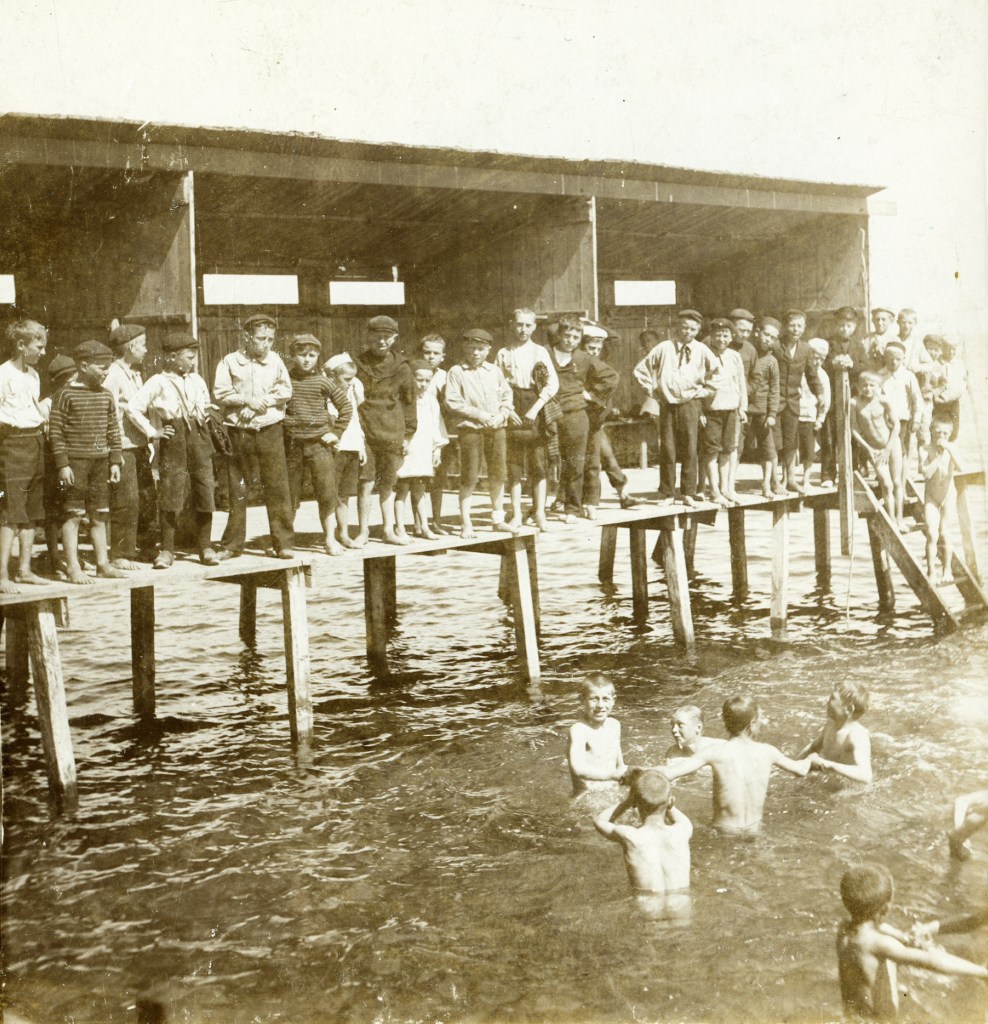
Also in the Aarhus coastal region, this swim class conducted in 1905 – in a rather flimsy-looking bathhouse. It looks as though the boys are patiently waiting for their turn in the water. Although there is no adult visible, his/their presence is felt by the orderliness of this assembly. Of course, the uniform of the day is … nothing.
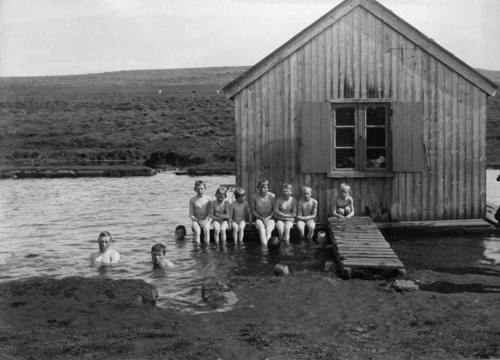
This image comes to us from Iceland. The name of the country notwithstanding, the Gulf Stream keeps the climate moderate. The price they pay for that exemption from polar weather is overcast and rain throughout most of the year. But the Icelanders were dealt one other ace by Mother Nature. The continual geologic activity under the island produces many hot springs that make outdoor bathing quite practical all year long. This scene is likely made possible by that very condition.
The date of this photograph is 1905 when Iceland was part of Denmark. The purpose of the structure in this narrow, shallow stream is not known. What is certain is that the participants are nude. The seated boy third from the left confirmed that by not taking the crotch-covering precautions adopted by his fellows.
Topic 3: Norway
We continue our survey of old Nordic (nude) swimming practices with these images.
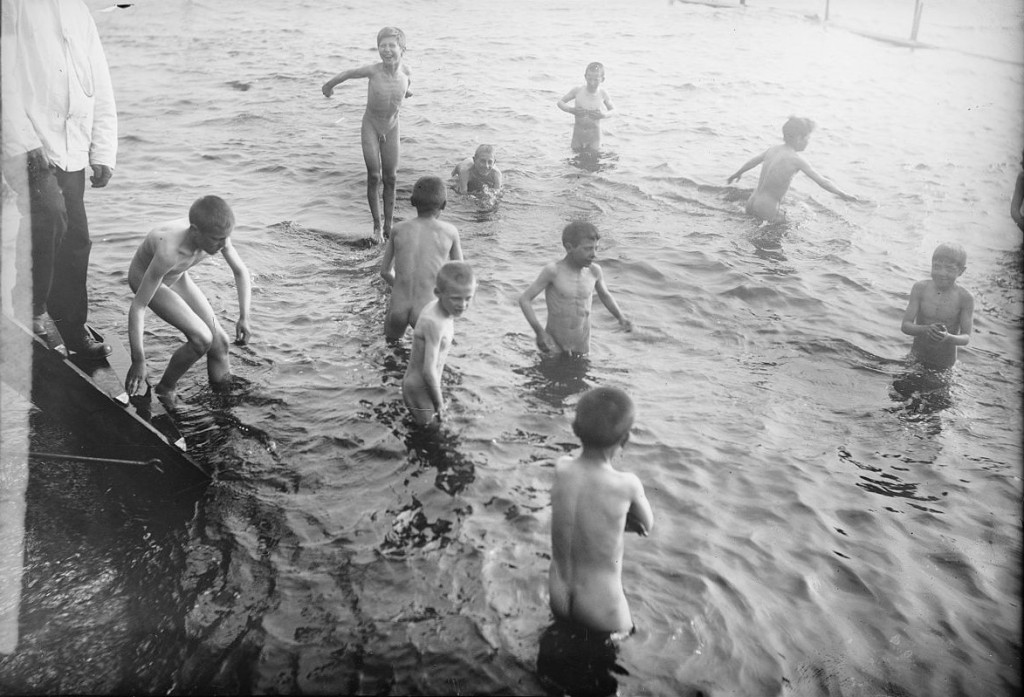
One of the boys appears to be performing a miracle by walking on the water. He seems to appreciate the uniqueness of his situation as he displays a full frontal. This undated (some indications suggest it could be as late as 1930) photo is from the National Museum of Norway in Oslo. This outdoor venue is called Hovedøen bad.
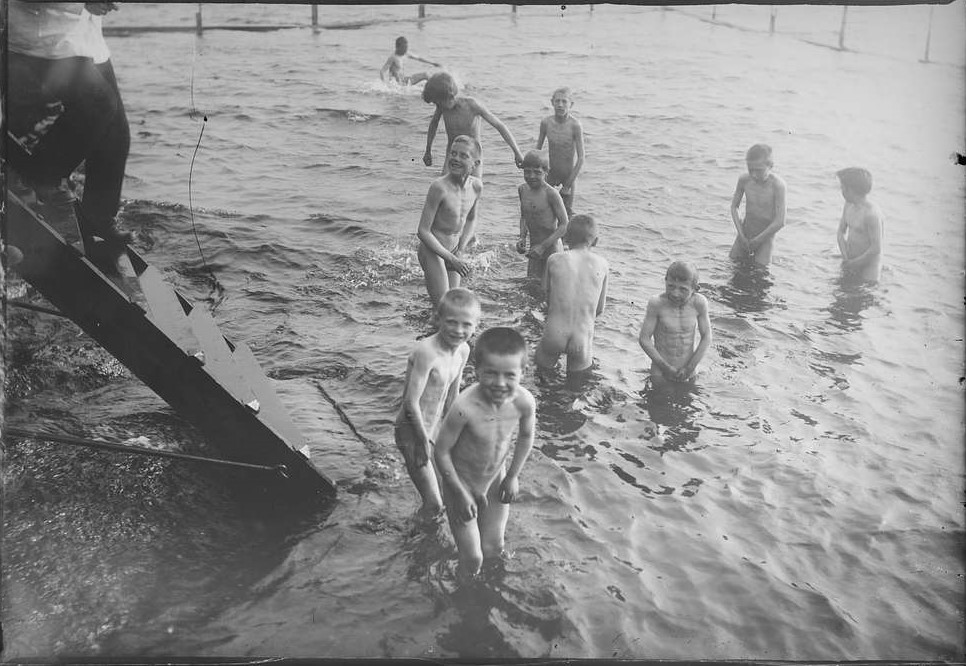
Same incident recorded within a minute or so of the previous image.
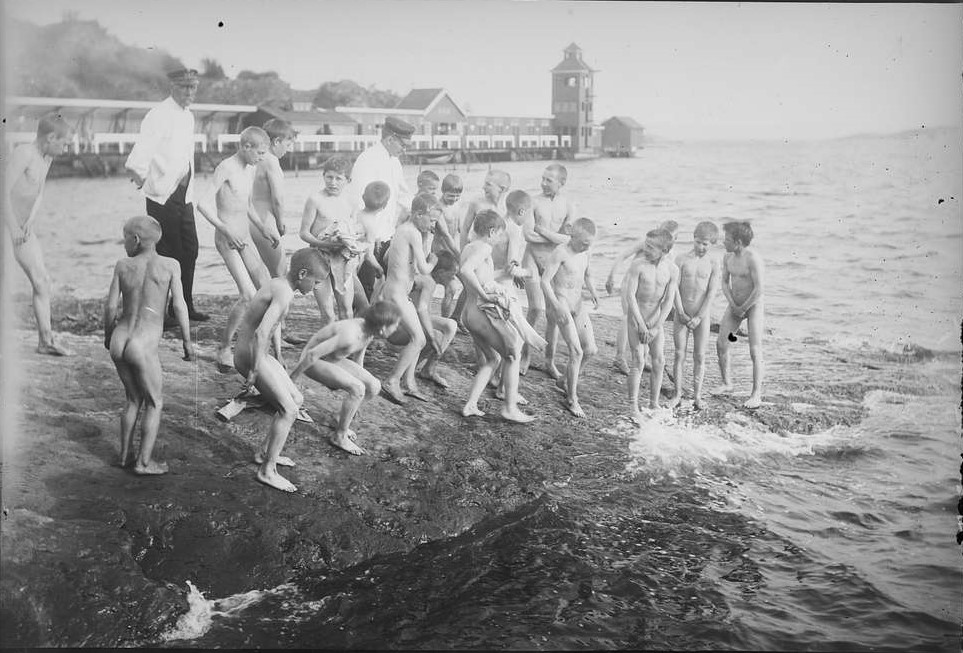
This image carries a date range of 1917-25. It also is from Hovedøen, but does not have the designation “bad” (bath). I suspect the structure in the background is the site of the previous two photos. This is apparently an undeveloped spot near the facility.
The city of Oslo includes some offshore islands in its jurisdiction. The closest to downtown Oslo is Hovedøya island which hosts various recreational activities such as hiking and swimming. The following two images are some scenes from one of the swimming facilities during the 1930s and 40s.
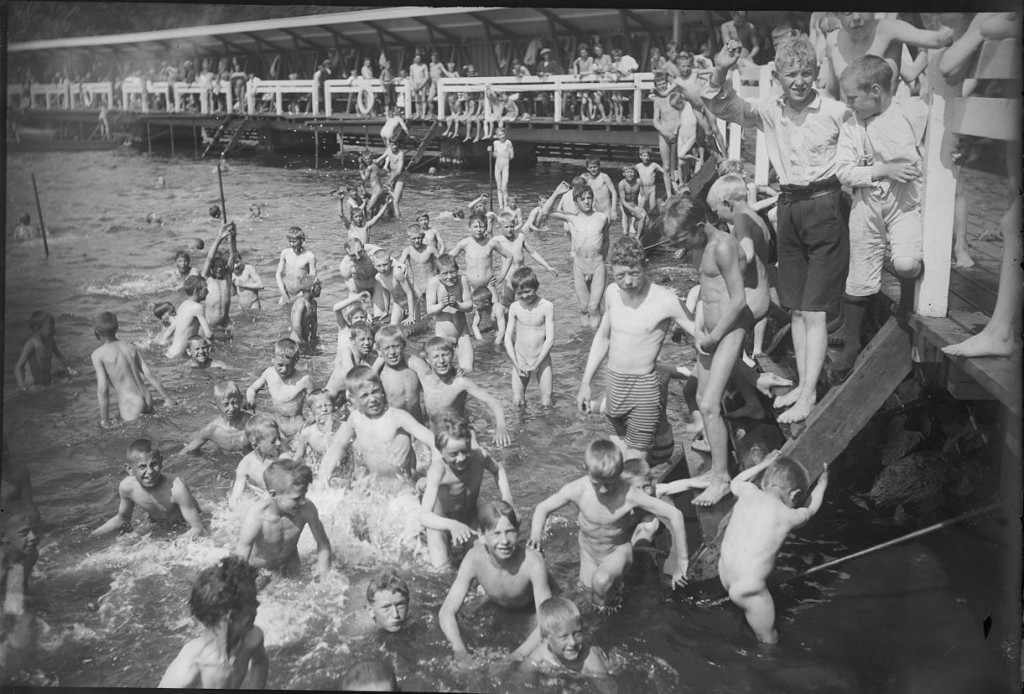
This image is from the Museum of Norway and captures the activity at Hovedøya bad. This one carries a date of 1930. Two unusual features are the one boy in a baggy bathing suit that suggests he may be developed beyond his years and the presence of an adult slightly to the left of center. The latter appears to be leaning over a boy in some mode of assistance. The question is: is he wearing a suit or not?
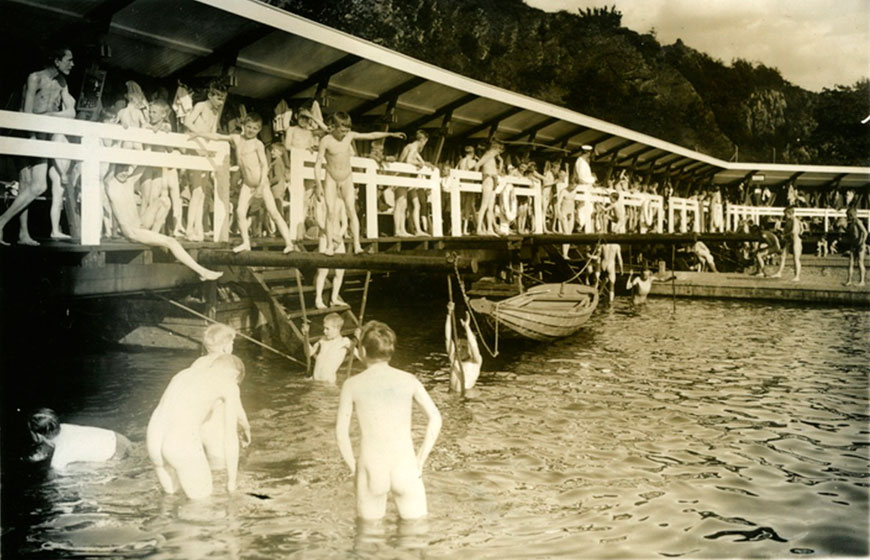
This scene is also from the Hovedøya bad in about the same time period.
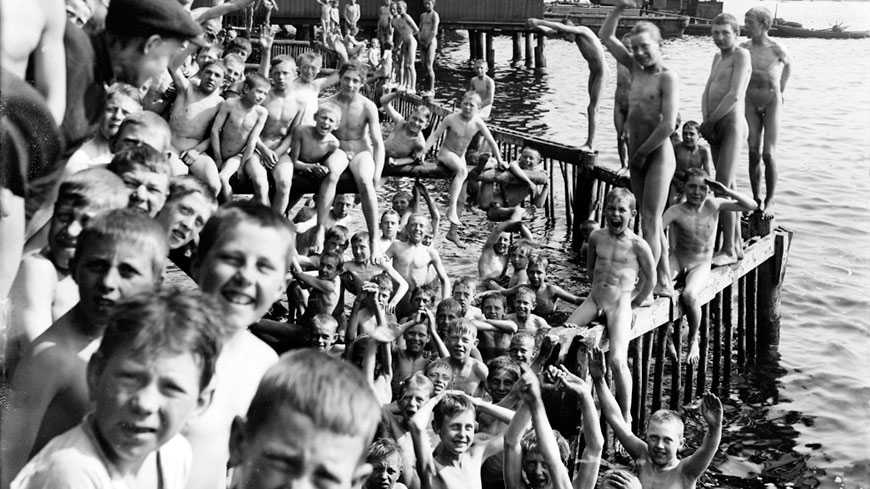
Moving off Hovedøya, this busy scene was acted out in 1915. The location was Akershusstranda, a beach along Oslo Fjord within the city itself. Everyone was happy to be in the picture.

The archives of the Oslo Museum also yielded this little enigma. Aside from the date of 1904, no data is available for this image. It differs from the previous photos in that there does not appear to be any adults monitoring this large gathering. Moreover, the venue does not seem to be a formal facility. Just a couple of planks stretched over some beams give access to the water. The only visible means of returning to the deck are a few ropes. Finally, the dressed boys are mingled with the naked swimmers and would-be swimmers with no hint of purpose or organization. Obviously, there is a lot more story to this image.
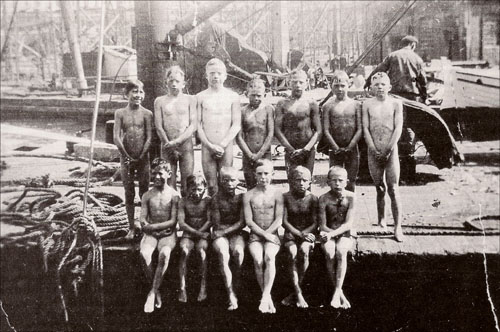
This setting is a bit more rugged. It is a dock in the port city of Stavanger in 1925. Interesting to speculate how the photographer recruited his subjects and secured their cooperation. Everyone has their junk under tight control. They actually look tense in their poses.

This picture from 1921 had only snippets of text associated with it. The image’s origin is shown as Oslo, but that may be the repository of the photo, not the location of the scene. The other phrases were “public bath” and “outdoor bath” – obvious. That does not detract from the impressiveness of the image. Aside from the huge number of nude boys, it is noteworthy that this seems to be an actual pool rather than a seafront bathhouse. The tower is also attention-getting with its three diving levels. Overall, an impressive installation.
Lest we conclude that Norwegian boys only swim in the great outdoors, here are a few indoor pool pics from a little later time period.

This image from the city of Stavanger archives shows a scene of that includes a line of nude boys in a pool called St. Svithun. That is the name of the cathedral in that town that was assumed by various nearby places and facilities. The date is given as 1930-40.

These very young lads are enjoying the Sagene bath (pool) in Oslo. The date is 1947. Except for the one boy hanging on the side rail, it is not clear that they are pursuing their recreation without the encumbrance of swim suits.
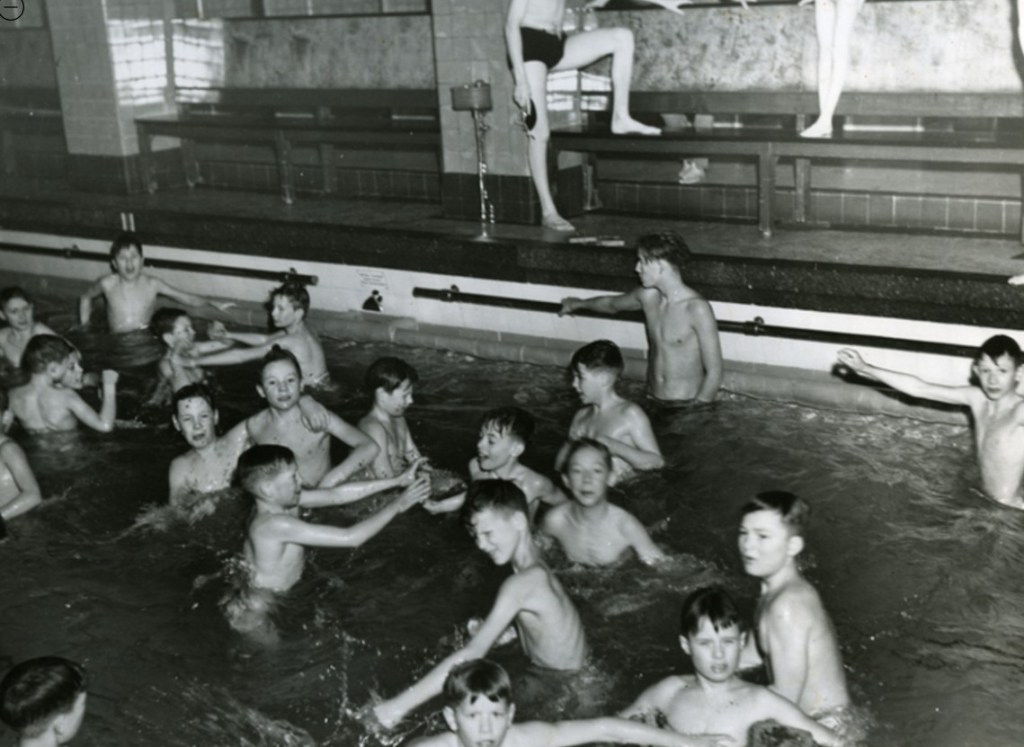


The above three images are from the Torggata pool, also in Oslo. The first photo is undated but the last two carry a date of December 1946. In each there is evidence of nudity because the water level is below the hip of some figures, revealing the absence of textiles. In case more definitive evidence is required, note the boy in the middle image hugging himself. A male appendage is visible below the water.
Ruseløkka skole (school) is located in Oslo. It appears to be a private, all-boys institution. The following photos were taken in the pool in 1950. As can be seen through the crystal clear water, the standard student swimming attire was … well, nothing.

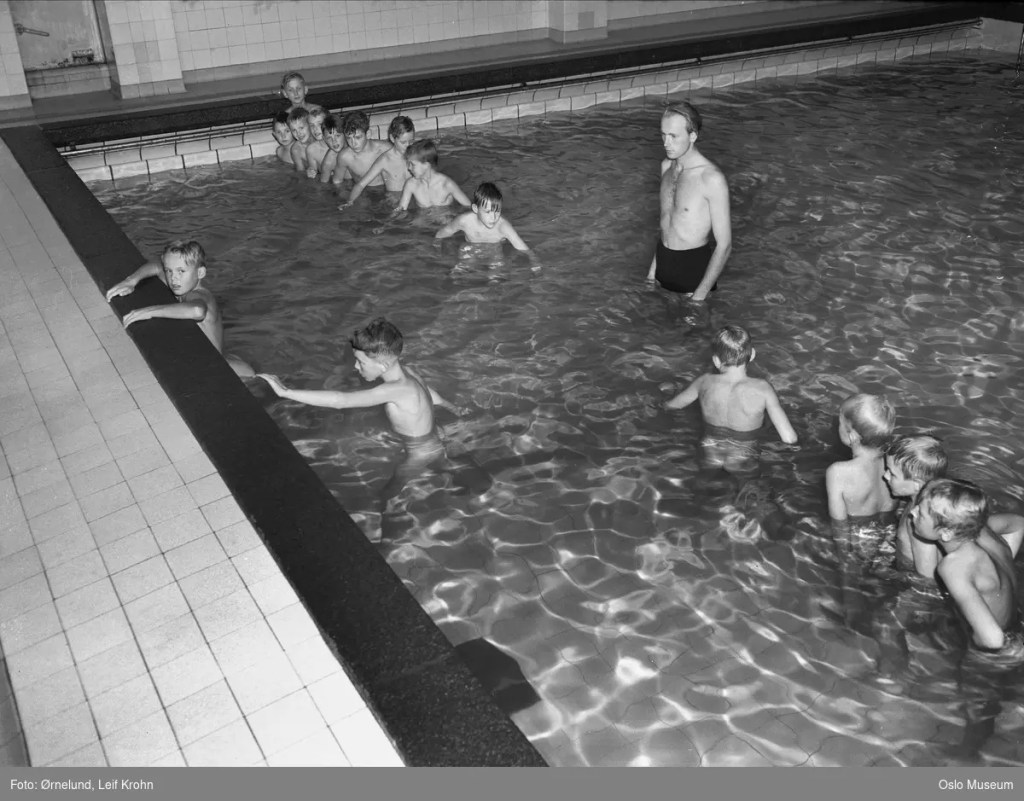


The above images are held by the Olso Museum.
Once out of Oslo, aquatic recreation is pursued in fjords and lakes against the backdrop of the spectacular Norwegian outdoors. These images are from the DigitaltMuseum, Norway, the source of many of the previous photos on this page.
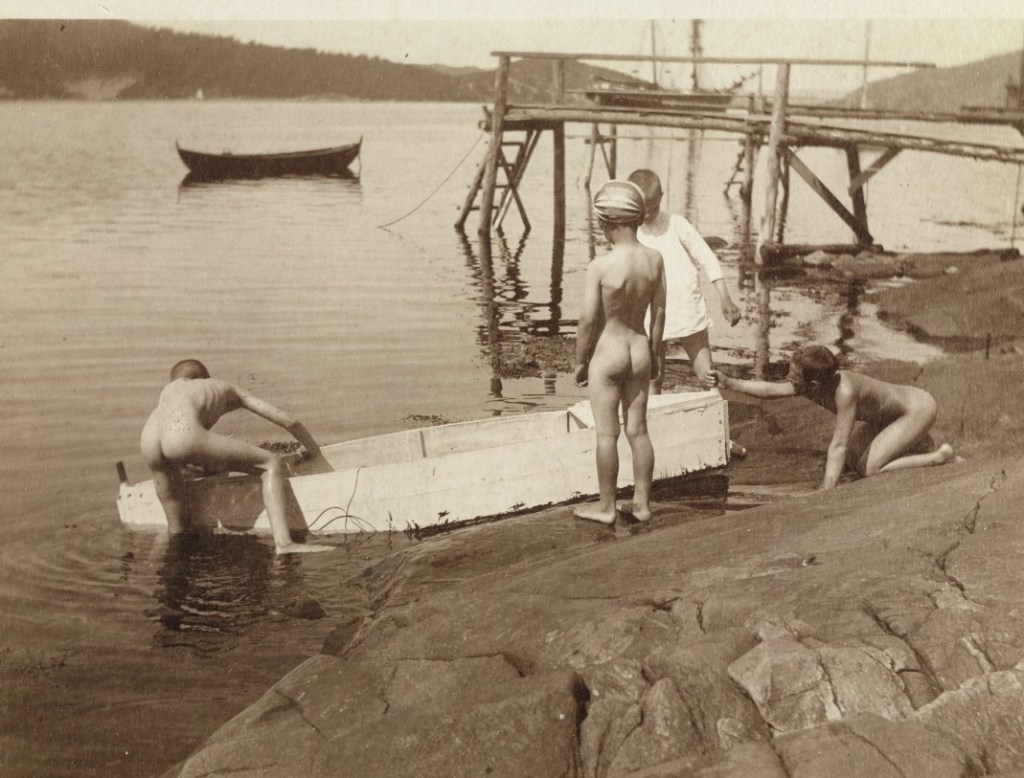
This scene took place in 1903 in a location believed to be Kroken, Vestland on Lustrafjord. I have no idea what the one boy is wearing on his head.

This boating photo is from 1906, location unknown. I surmise that because the summers are so short in Norway, the boy boaters can not spare the time to put on clothes. In both of these images, homemade boats seem to be featured. It looks as though they are propelled by double-ended kayak style paddles wielded by naked boys.

This signed photo carries a Latin inscription that means “in pure nature.” Like the previous image, it is also from 1906, but it is not clear if the two are related.

All of this nude fun took place in Lillesanden which is located near the southern tip of Norway. This image is an oldie – 1890.
And now for something completely different …
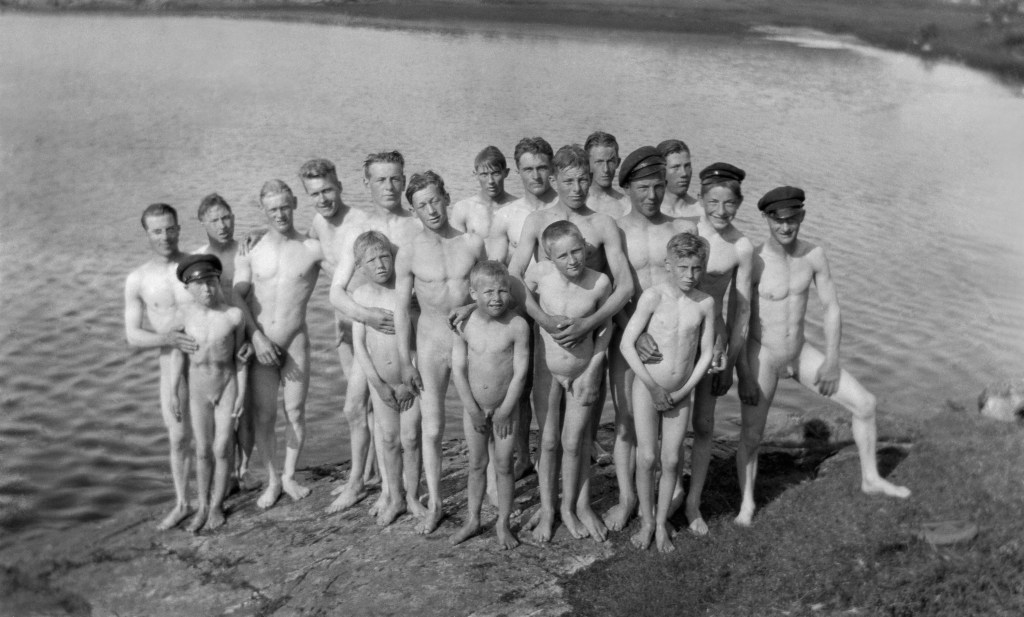
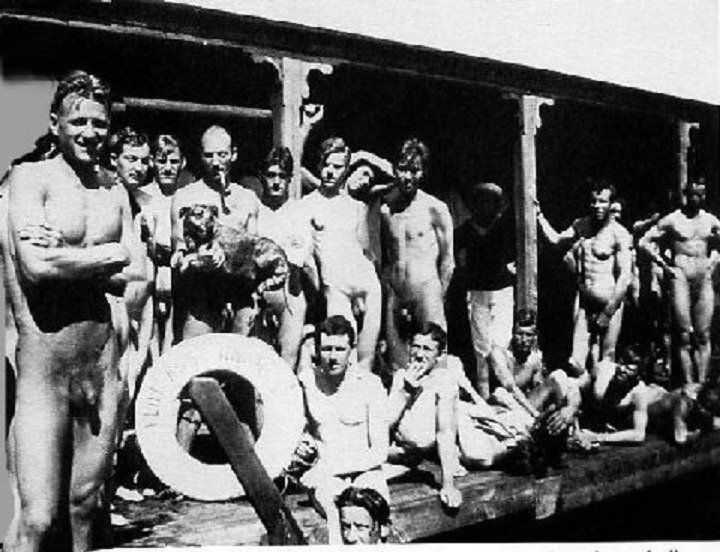
Unlike the previous images, this is a photo of adult males enjoying nature’s aquatic offerings au naturel. The two remarkable features of this image are the presence of five boys being held by the adults and the (matching?) caps being worn by some of the participants. The latter may be a clue to what brought this group together.
The text accompanying this picture states that this is a group of men emerging from a summer swim in a place called Stavsengvannet. A search suggests that this place is located on an offshore island just a smidge below the Arctic Circle. If so, this must be hearty crew. The temperature of the water of this lake must be on the very brisk side.
Two other documentary facts associated with this find is that all of the participants are named as is the photographer, but the date is given as somewhere between 1920 and 1940. The original image is held by the Helgeland Museum, which is located in sub-Arctic Norway.
Topic 4: Finns, the other Nordics
Although Finland is counted in the Scandinavian fold, they are quite different from the closely-connected Norwegians, Swedes and Danes. Their language, culture and customs are quite distinct. We extensively examined the historic Yrjönkatu Swimming Hall with its continuing practice of nude male swimming in Special Topics. Indeed, in the present day, the Finns seem more casual about recreational nudity than any of their neighbors.
Here is our historic photographic record of the Finns.
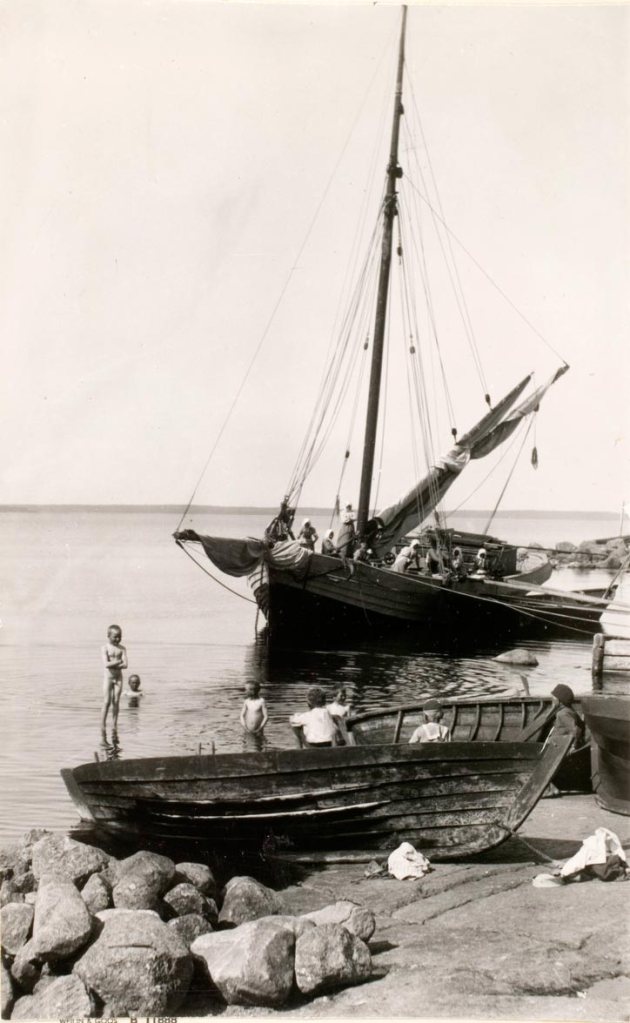
Starting with an oldie, this image is from 1899. The location is given as Vehkalahti, Tammio, Suomi-Finland which seems to be in a picturesque part of southeastern Finland. At the time of this photo, it was apparently a fine place to skinny-dip. The source of this photo is the Finnish Heritage Agency.

The matter-of-fact innocence of Finnish swimming practices is represented in this undocumented image. It is noteworthy that the presence of girls was not considered an impediment to boys swimming nude.

I’m not sure how to characterize this swimming venue, since it has elements of the floating bathhouse, beach front and competition stadium. The users seem to also defy categorization. Anything from bath robes to swim trunks to nudity seems to be on the table. The only information available is that this image dates from 1920.

This undated scene supposedly takes place at the “Korkeakoski Passage.” A search on that name comes up with a famous Finnish falls that is a tourist attraction and therefore does not comport with the contents of this photo. Examining this image further shows a tangle of logs that appear to be the product of a commercial logging operation. I can’t put all of that together, but one more item is that the figure third from the left appears to be a girl – among the naked boy swimmers.
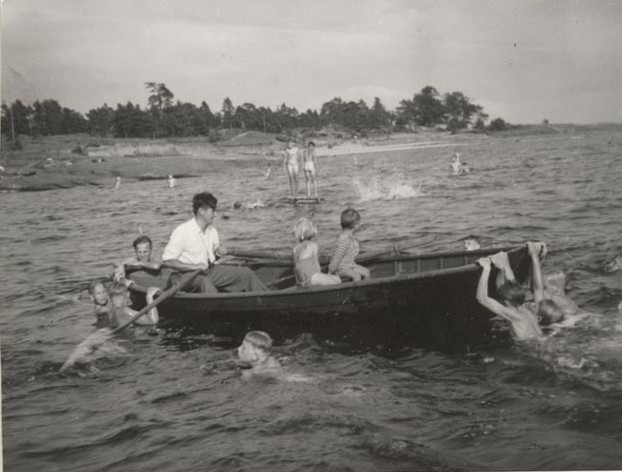
This amazing lake image from 1950 seems to tell a story. The two young children in the boat are craning to take in the bountiful sights of the naked boys while some of the latter cling to the boat.
 Historical Nude Male Swimming Images