Revised 10/9/2025 Relocated Skinny-Dipping to new page
Having presented the interesting Special Topics, we should probably address the less interesting. With apologies, here they are.
Topic 1: Good But Not Good Enough
Here are some on-topic, genuine, relevant photos that just didn’t seem to be good enough to post. This is my attempt to give these orphans their day to let the reader pass on their merit.
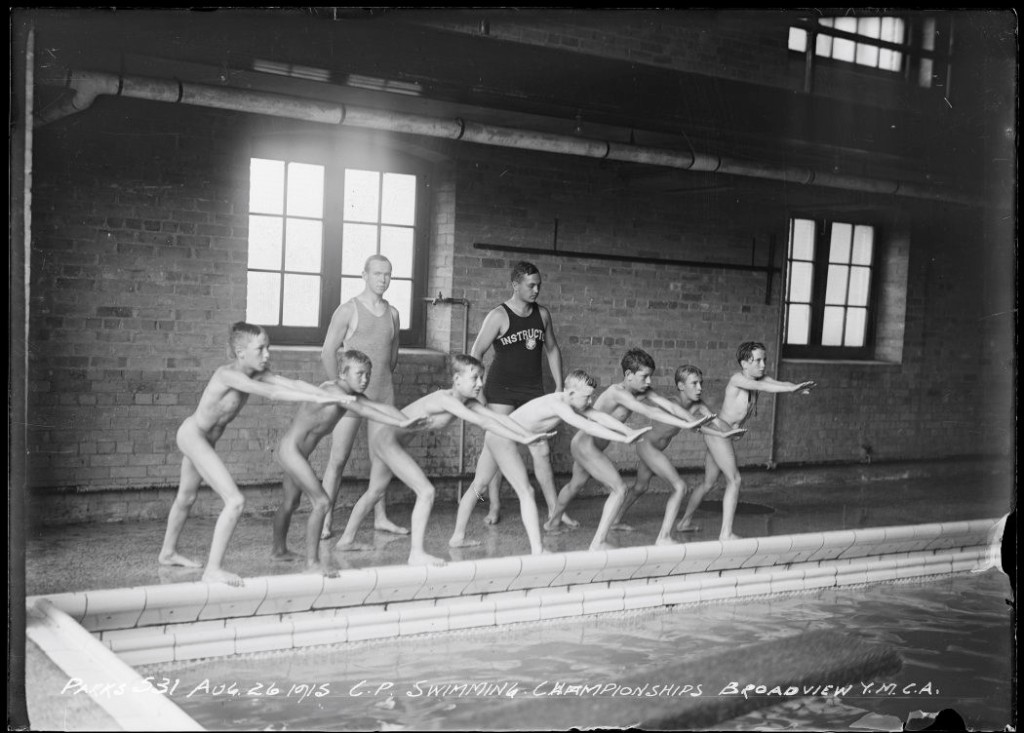
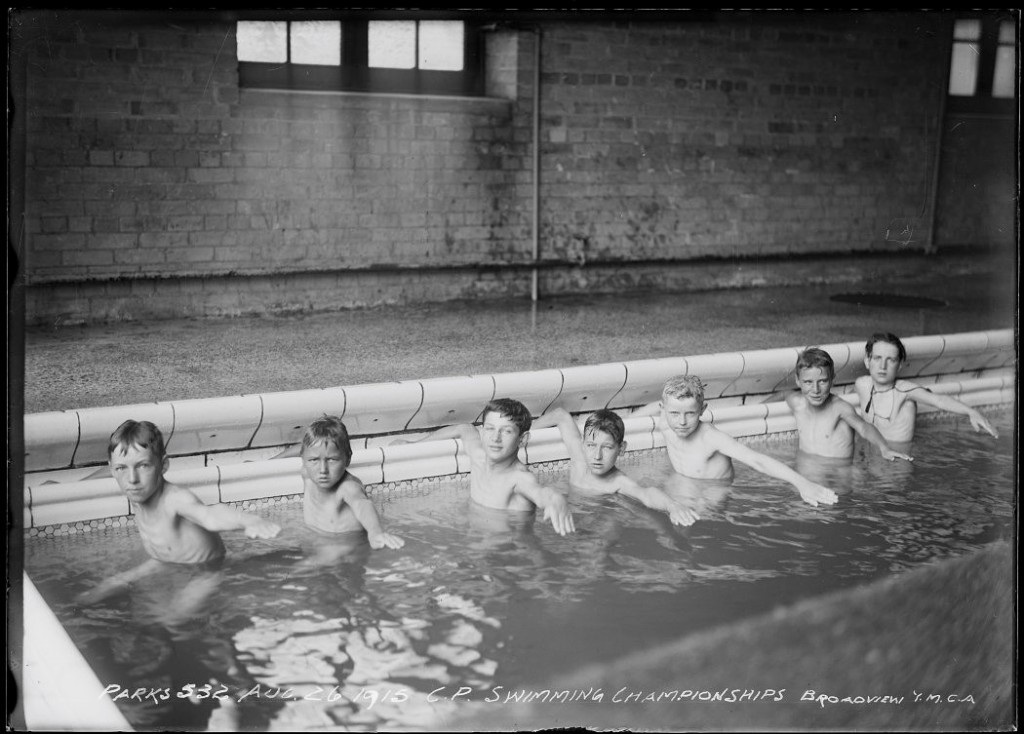
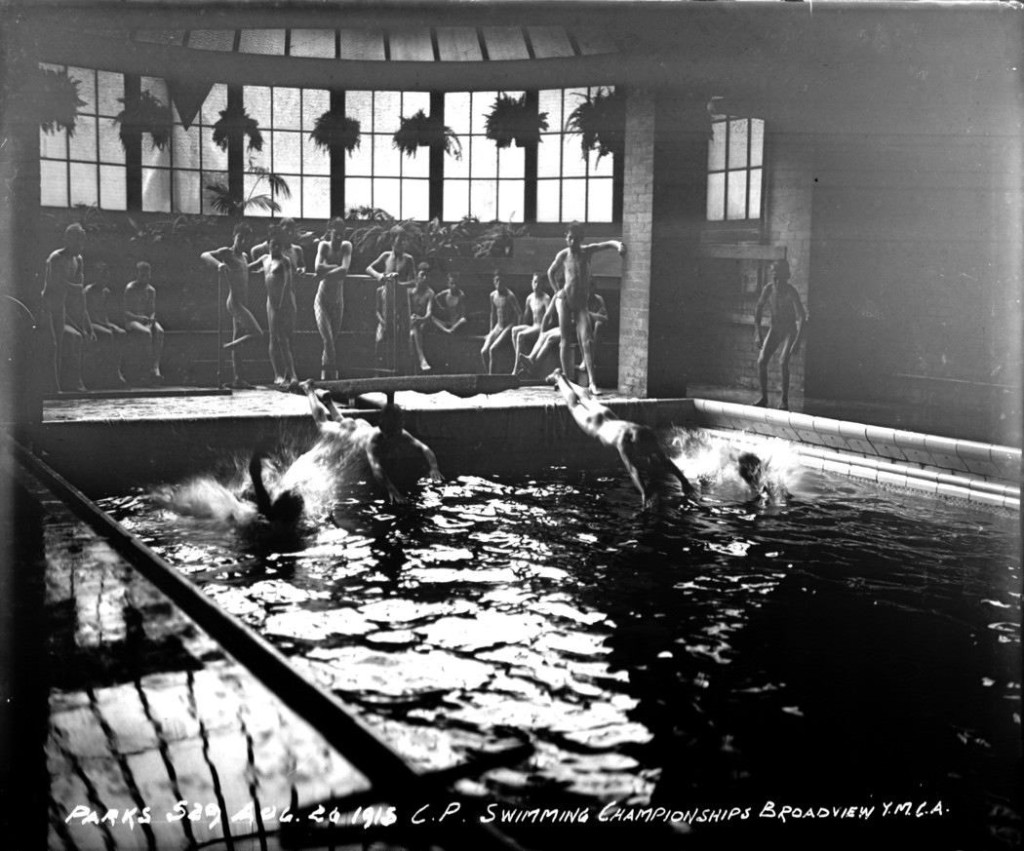
This is a trio of companion shots from the Toronto YMCA in 1915 that led off the “Are They or Aren’t They (Nude)?” topic of the Special Topics posting. As with those predecessor photos, the photographer as striven to hide those pesky penises, despite the obvious nudity of his subjects.
In the first two posed shots, he has achieved that, but then he decided to go for broke with an unscripted action shot. The guy behind the lens relied on the dense shadows of this back-lit image to keep him out of trouble. Alas, the boy second from the right on the deck confounded his attempts by a clear display of precocious penile development. Moreover, the sparse light seems to glint off the bare glans of a circumcised member! As they said in Jurassic Park: “Nature finds a way.”
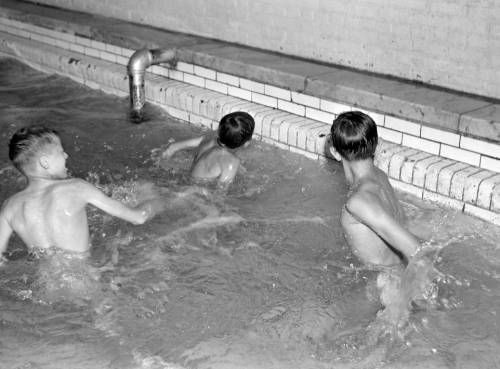
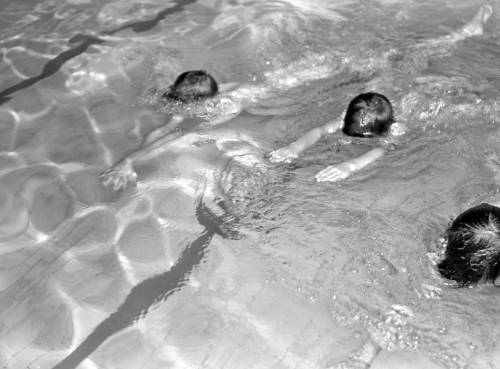
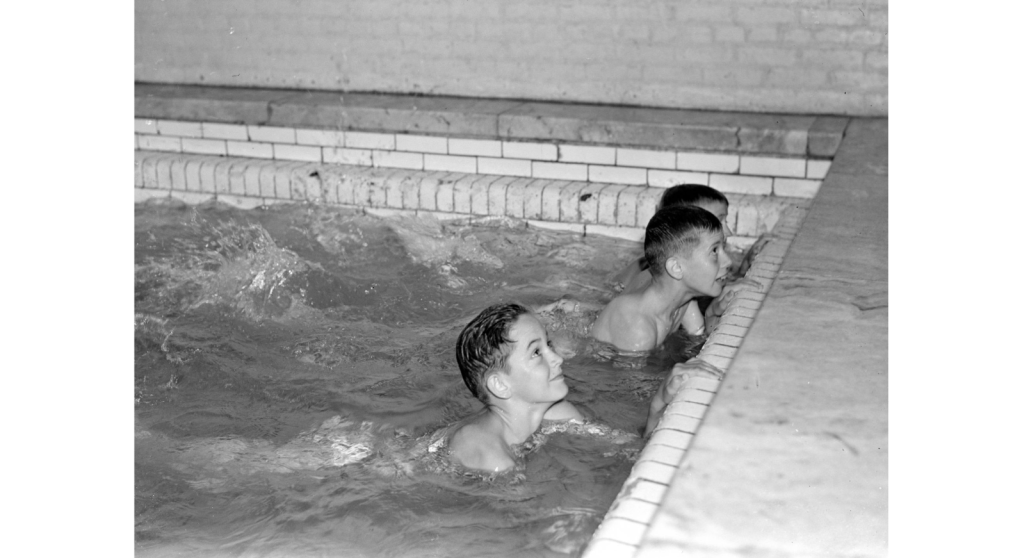
We’re back in the Bloomington, IL YMCA for a swimming lesson. You will recall that this institution was prominently and extensively featured in the Swimming Lessons posting. These are more of the same, dated 1944. The composition of these images is not as interesting as their previously-posted companions – hence their initial exclusion. The nudity of the participants is not in question based on previous data. In these offerings it is clear that the skin tones above and below the water are consistent, reaffirming that nude swimming was being practiced here as well.
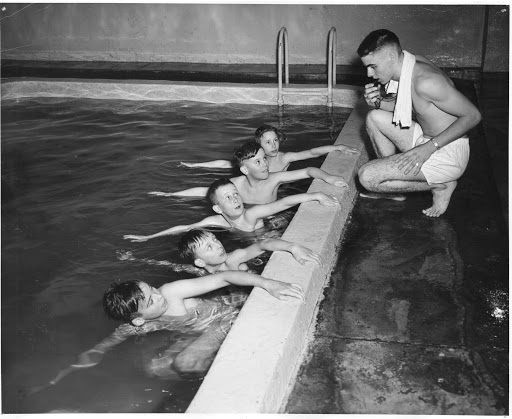
One of my correspondents tells me that he recalled this picture from an article reviewing the history of the Sioux City, IA YMCA. His recollection is that it dates from the 1940s. This scene is pretty typical of the YMCA swimming lessons of our era of interest: suited instructor overseeing a klatch of boys. Based on the subsurface appearance of the nearest student, there is no evidence that the class is turned out in other than their skins.
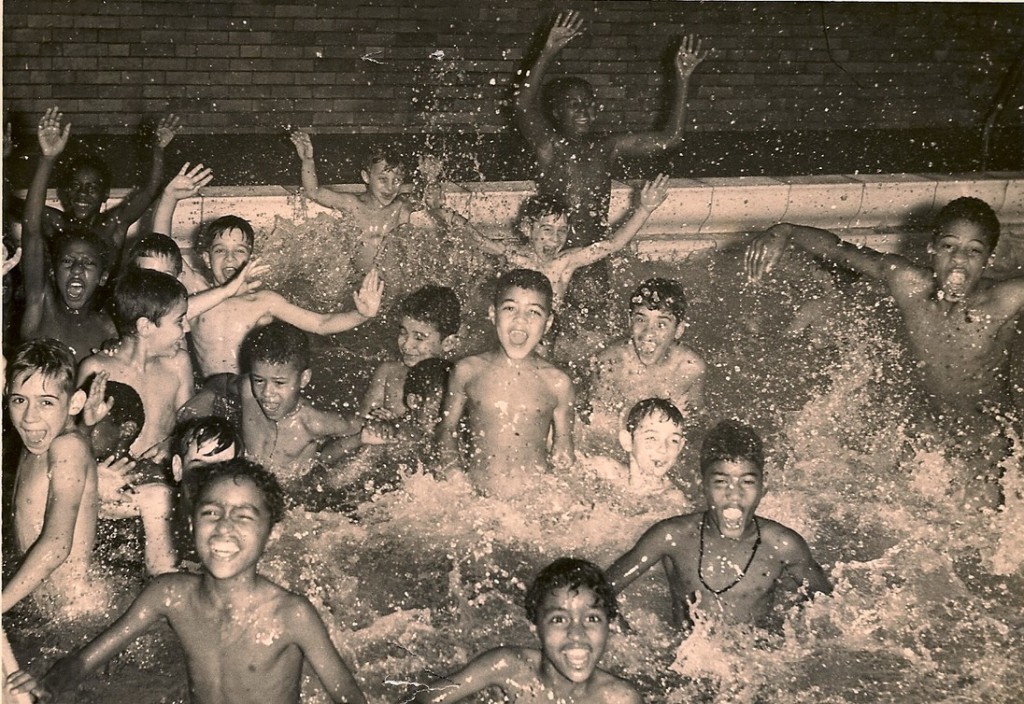
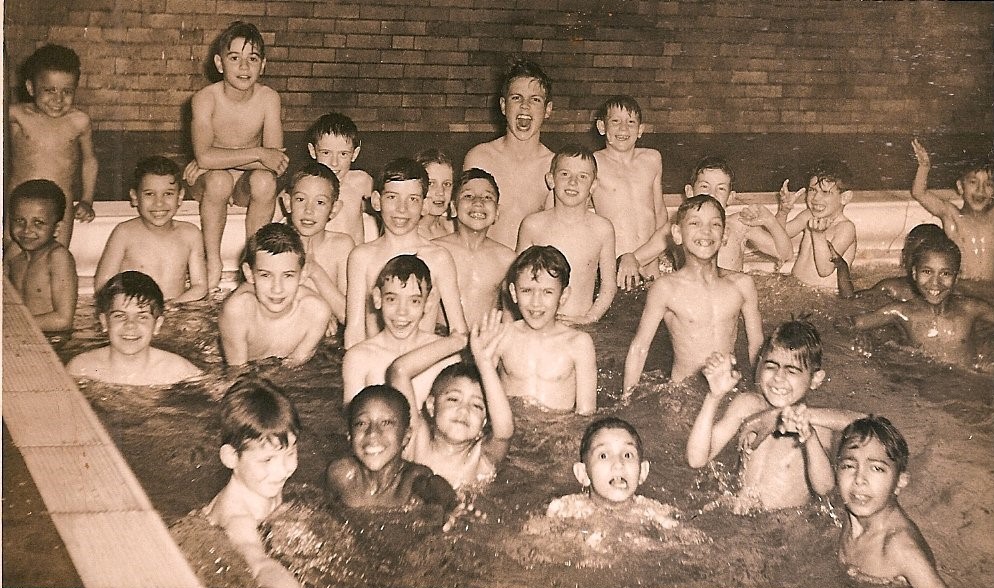
We’re back at the Fox Point Boys’ Club in Providence, RI. These two undated photos are companions to the one presented in The Good posting. These images of multi-racial groups of boys enjoying the same swimming accommodations may have captured an oasis of inclusiveness in a generally more segregated society at the time. For our purposes, however, it makes it clear that institutionalized nude male swimming was alive and well in this era. Any doubts can be dispelled by referring to the boy in the second photo who is perched on the edge of the pool (second from the left) leaning on his knees. That which pertains to his boyhood is visible between his incompletely closed legs.
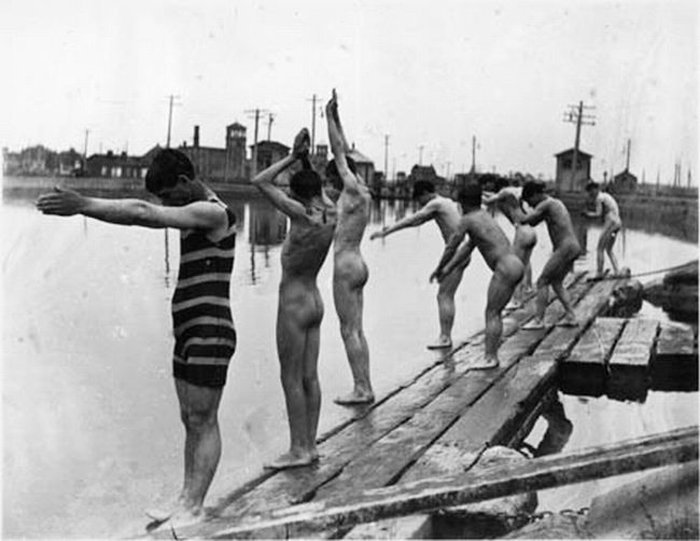
If you’ve searched for images of vintage nude male swimming, you probably ran into this photo multiple times. I initially dismissed it as an example of informal skinny dipping in shabby circumstances. Revisiting it, I realize that the scene is posed and that the poses are reminiscent of the swimming instruction images of the early 20th century. We might be looking in on an organized instruction session, perhaps under some organization’s auspices. The absence of an instructor might indicate that he is the photographer.
For reference, we have a documented example of swimming instruction held in a river in the Swimming Lessons posting.
Topic 2: Dear Old Boston
Through the first half of the 20th century, Boston was known as the bastion of officially enforced public morality. The local censors regularly banned “obscene” printed material, movies and performances from being purveyed there. The phrase “Banned in Boston” was so familiar that it became a punch-line for some and a badge of honor for others.
Relating to our topic, all of the YMCA photos that I’ve seen from that region during that era show everyone suited up – a marked deviation from other parts of the country. Surviving outdoor pictures, though, tell a quirky story.
The following images are from Digital Commonwealth of Massachusetts, an organization that coordinates material dissemination from that state’s libraries.
Let’s start with some skinny dipping.
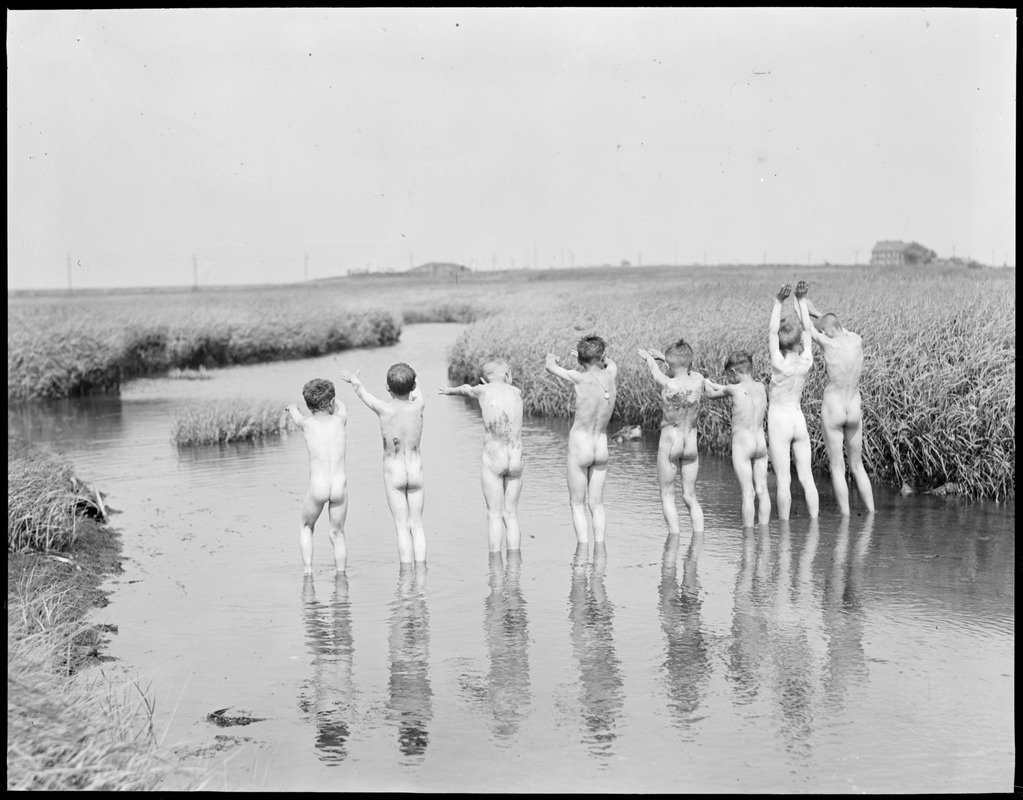
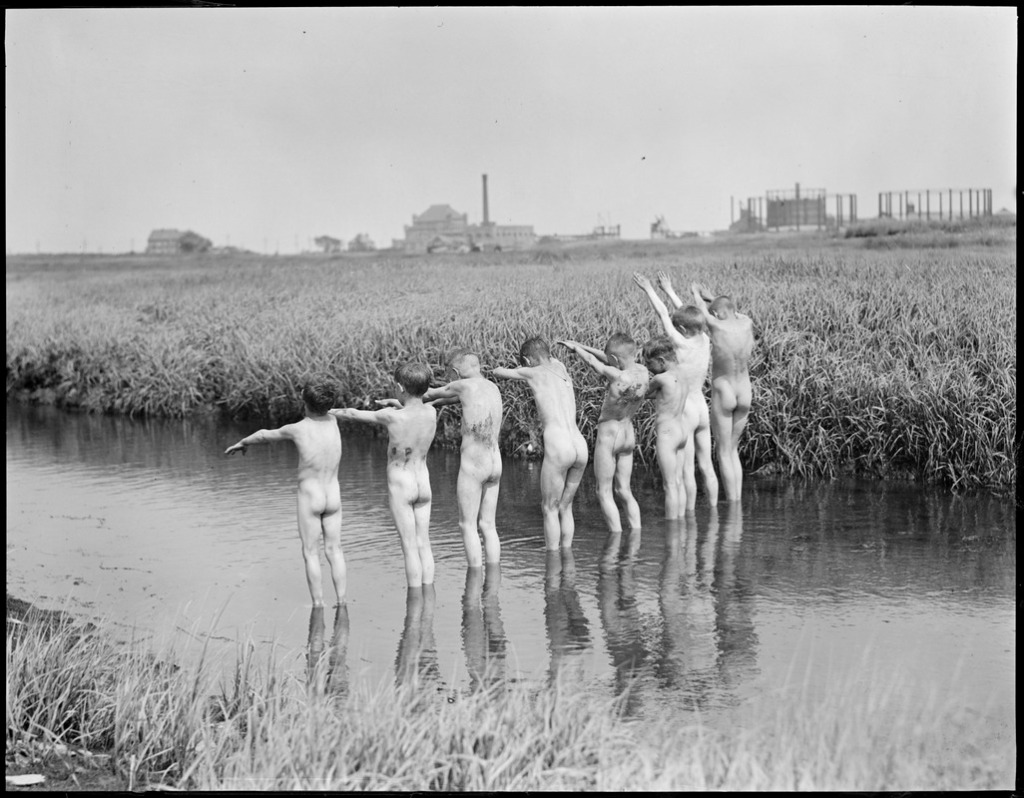
Here we are at the Dorchester mud flats south of Boston. The year is 1918. And there’s that pose again. No clue what prompted the taking of these photos.

This image is from the Boston Public Library archives and dates to the 1930s. The location is unknown but it is obviously in a tidal water area (see the rollers washing the far shore). Those columns next to the figures are not trees but old pilings that probably supported a dock or pier that stood well above the water level that these naked boys are wading through. The typical tidal cycle in the Boston area is 10 feet from low to high tide.
The boys don’t seem to be wildly enthusiastic about the activity they’re engaged in. I’m guessing that the photographer (a parent?) staged this thinking it would make a “cute” picture.
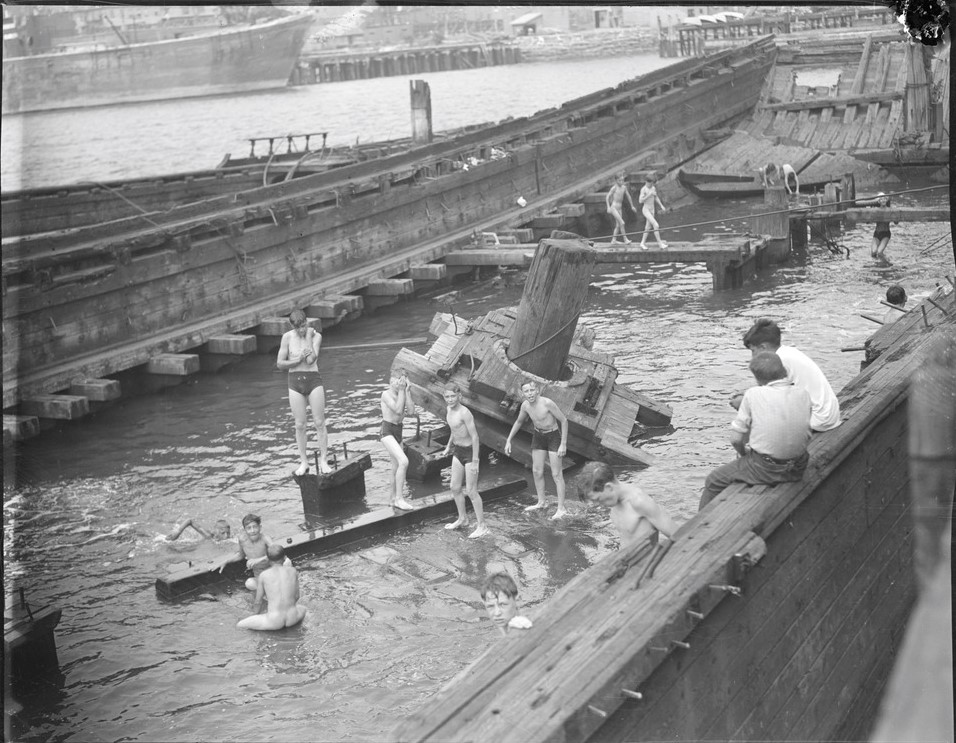
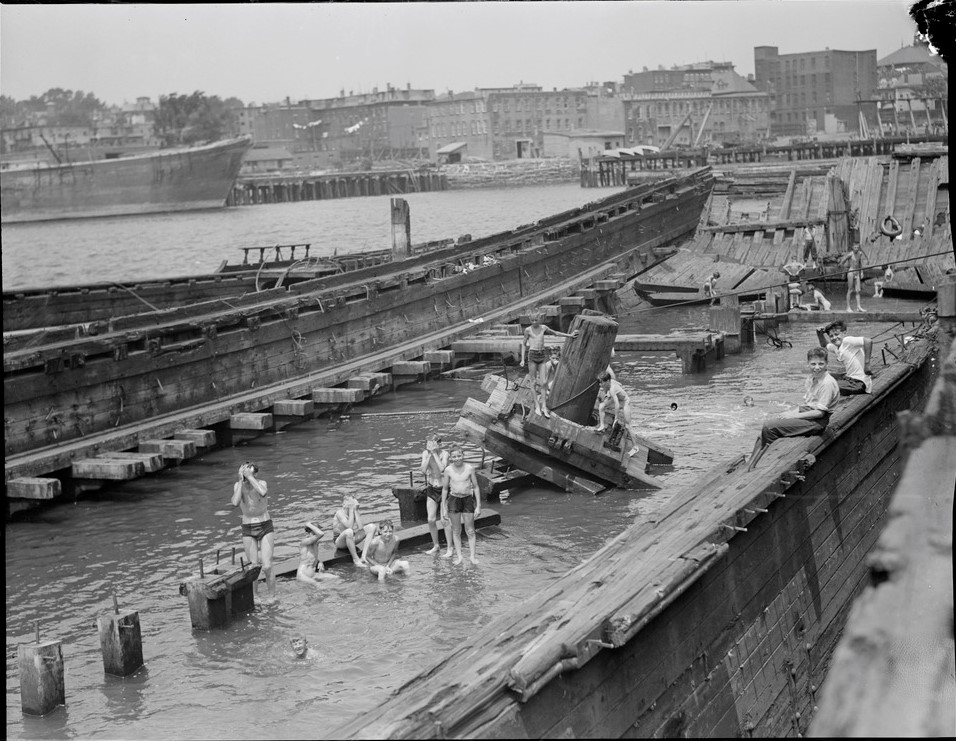
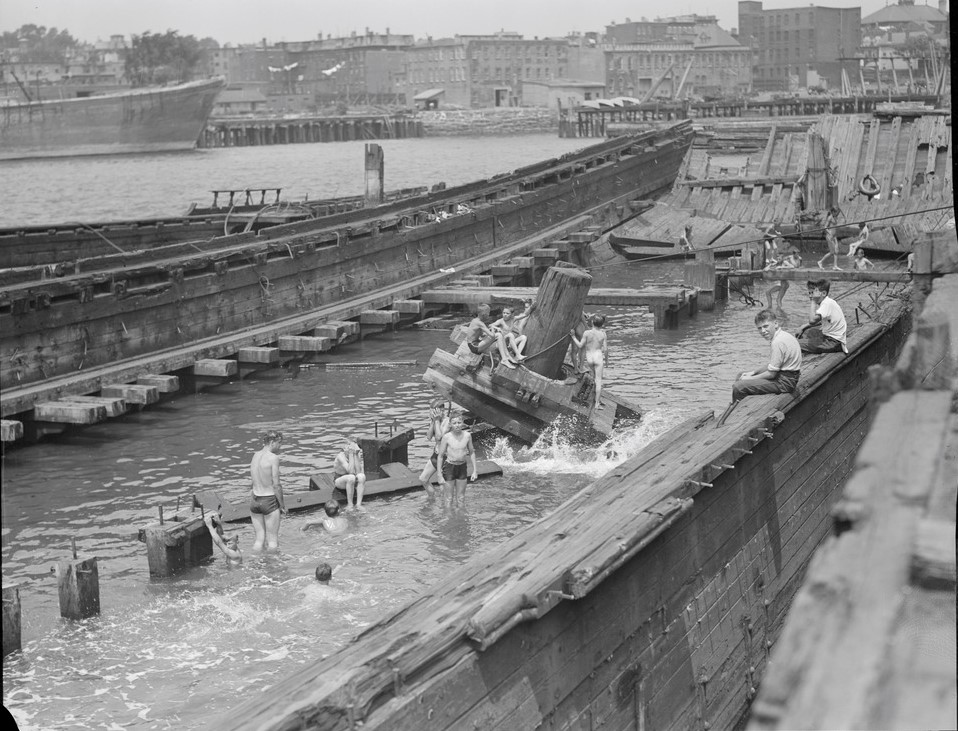
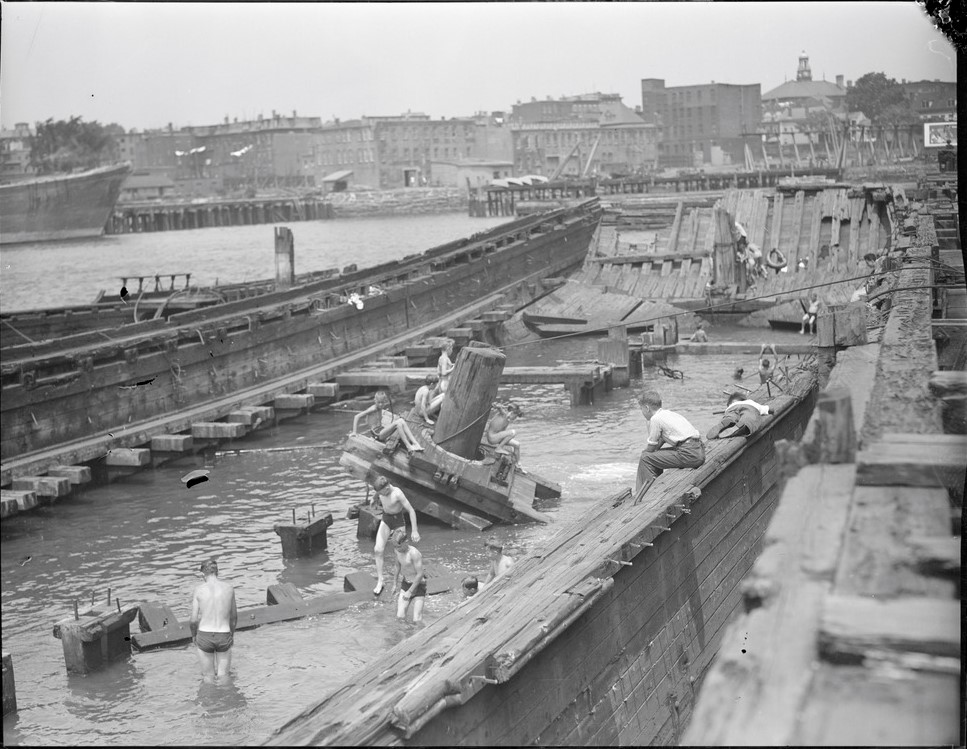
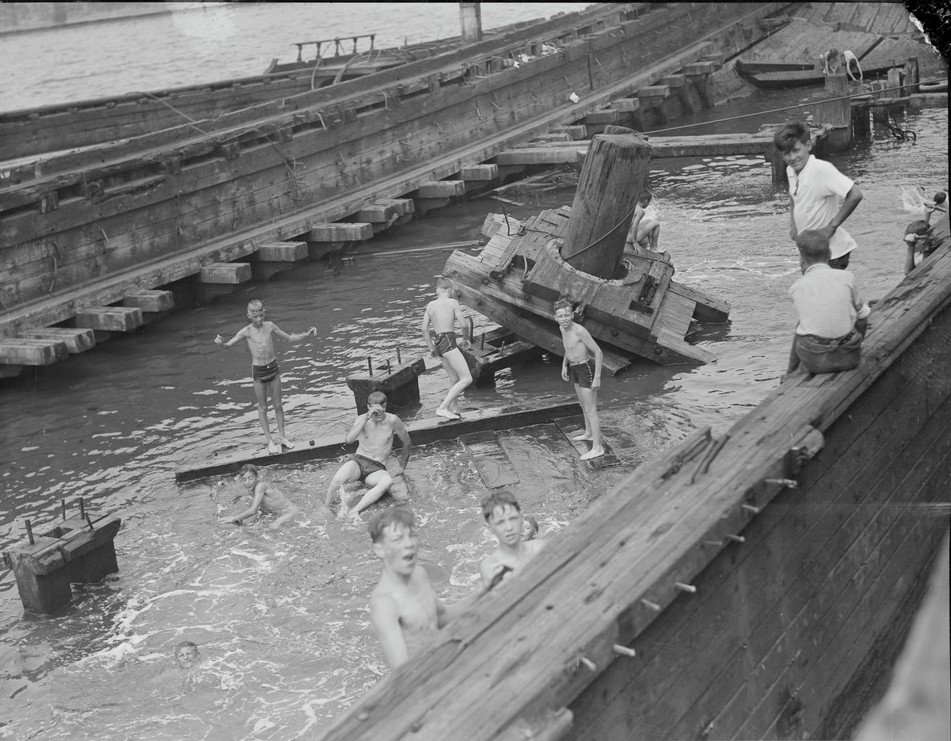
These guys are bathing in a water filled hulk of an old sailing ship in Chelsea Creek north of Boston. We’re now in 1938. Despite its name, the “creek” was a navigable waterway that had active piers back in the day.
The remarkable aspect of this scene is the mix of raiment chosen by the participants in this informal aquatic recreation: some are fully clothed, some are in swimming trunks and some are nude. Remarkable enough? Wait, the naked guy in the lower left has a bald head.
Here are a few more photos from that same occasion.
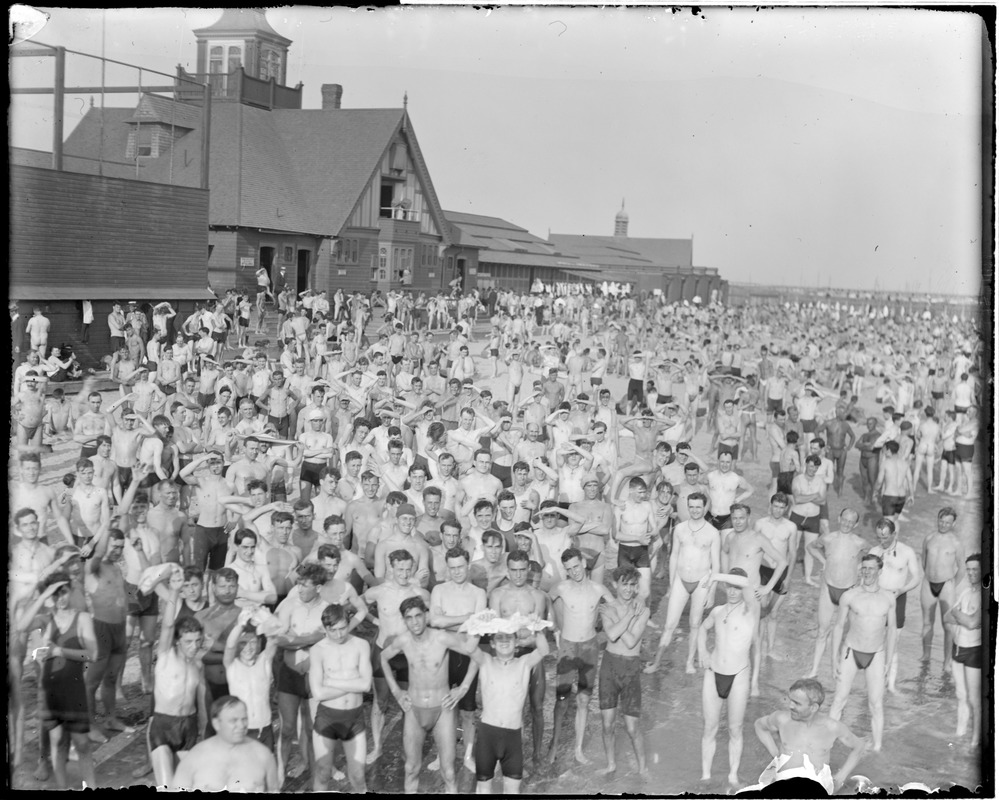
The bathhouses of New York City were treated extensively in previous postings. Boston had their own version of these public accommodations. While New York is located on two flowing rivers, the Boston area fronts on bays with beaches.
This is an image of the South Boston Bath House on a hot September day in 1915. The second most amazing fact about this photo (after getting over the photographer’s ability to get such a huge throng to “watch the birdie”) is the costumes of the participants. There is a guy in the lower left in a tank suite and several who are in various versions of trunks but there are many more who are in much briefer attire. Further back in the crowd, some men are turned back to camera showing bare buttocks. These suits are apparently an early version of string bikinis. Although this is an all-adult male crowd, some sort of cover up was apparently required.
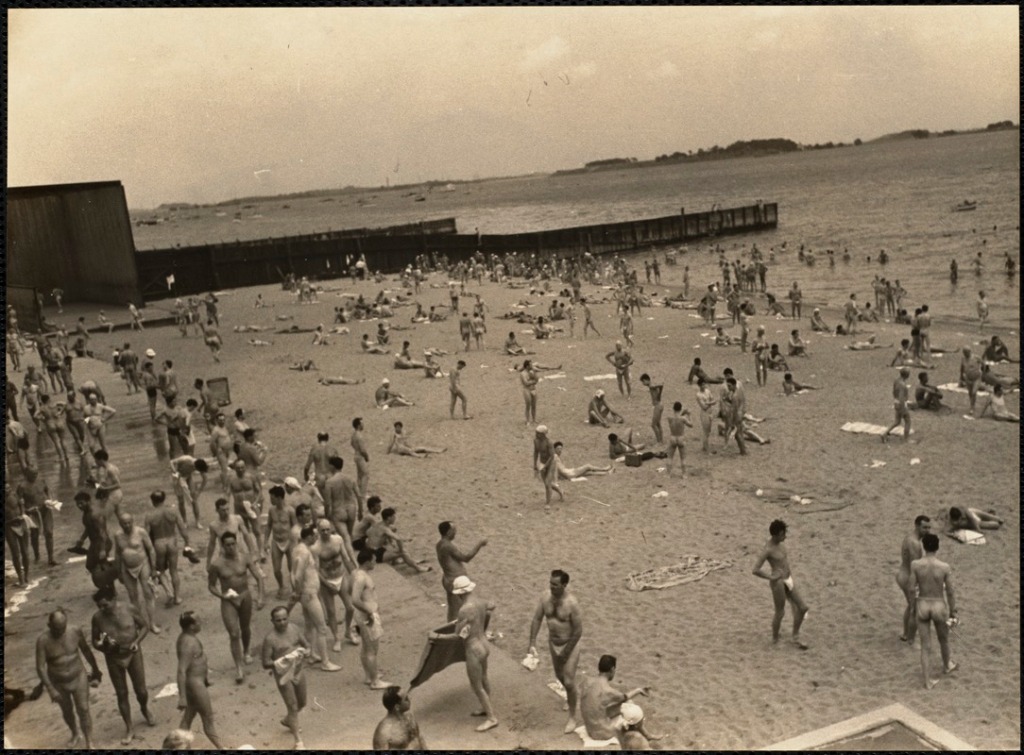
This is a view of the beach of the L Street Bath House in South Boston. This iconic institution dates back to 1866 and is still in use today – albeit in a family friendly form. The period of this photo is between 1935 and 1975. At this time, the bath house facilities were divided into men’s, women’s and boys’ (right, no girls’) sections. The stout rampart that is visible in the background of this shot shows how serious the authorities were about segregating the sexes – either that or they were concerned about a possible assault by a squadron of battle tanks.
On the men’s side, the universal uniform of the day is clearly the proto-string bikini introduced in the previous image. No trunks for this crowd. Bare buttocks all the way.
The following images are all from the L Street facility in this same time period.
UPDATE: I found this in an old Topix forum from November, 2007. It contradicts the photographic evidence, so take it for what it’s worth.
You all might be interested to know that nudity is not dead. I just returned from L Street bath house/Curley Recreation center in South Boston, Massachusetts. Nudity is still the norm on the beach. Most of the guys still sunbathe and swim there nude, as they have since the 1920s.
The L Street rec ctr. is segregated, with a big fence between the women’s side and men’s side. So the beach is treated like part of the locker room.
I have been going there to sun bathe all summer, and have quite a nice full body tan.
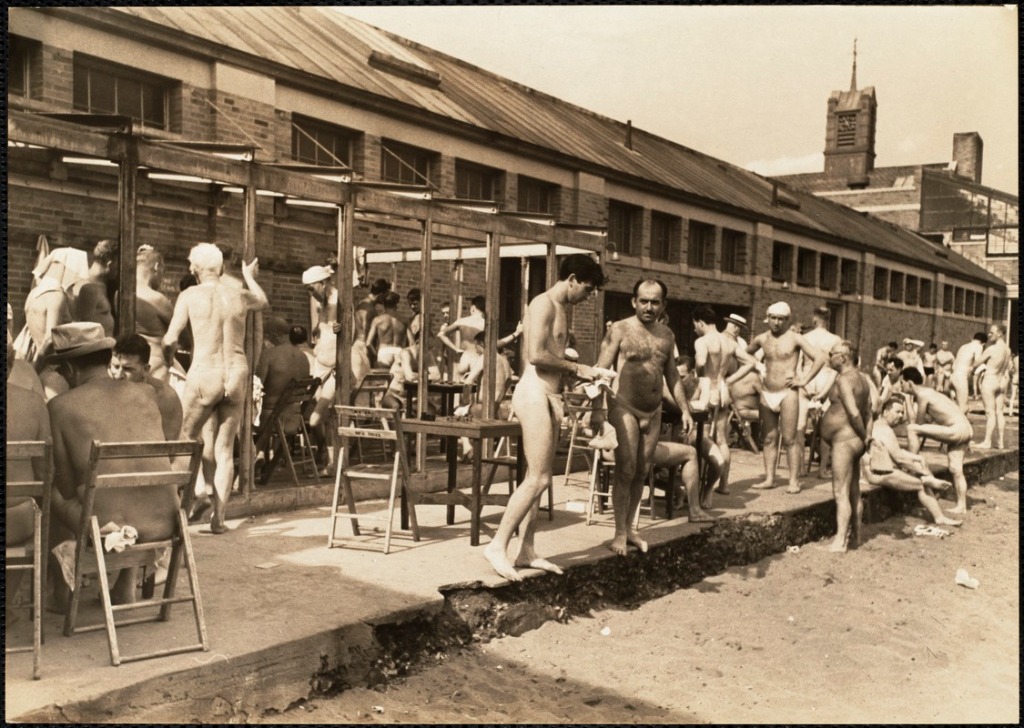
This image captures the activity taking place on the patio of the bath house. Apparently, table games are in progress. The participants certainly have some skin in the game. Sorry, I couldn’t resist.
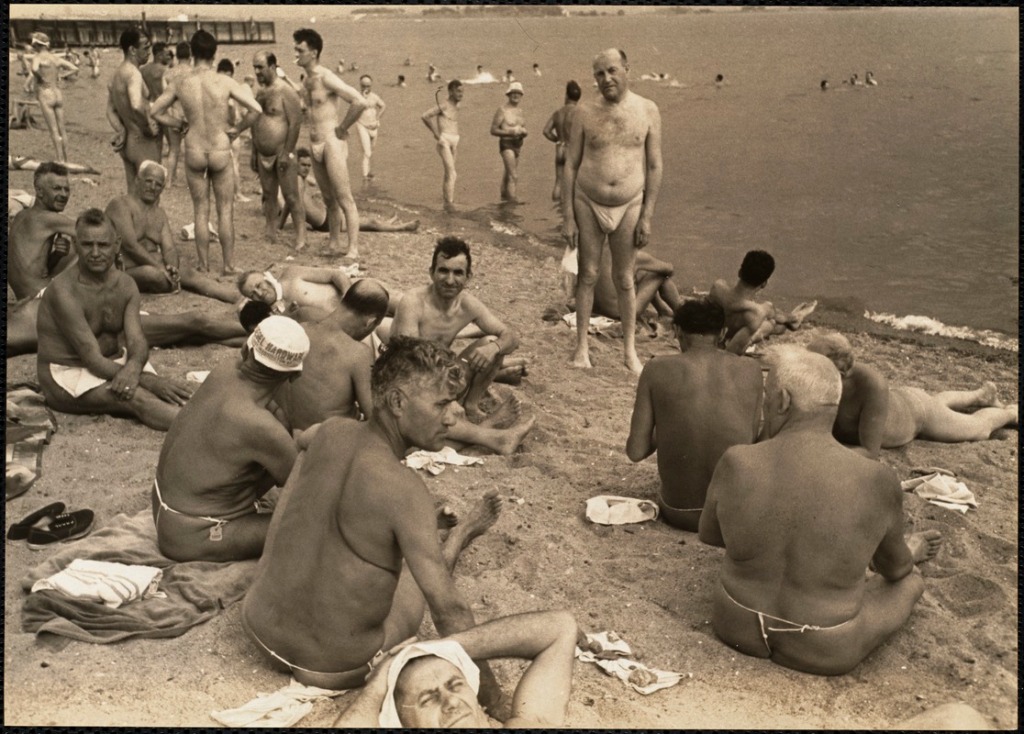
These are the sights looking toward the water’s edge. From this angle, those bikinis are not very flattering. I guess they’re not right for every body type.
By the way, each of these cute little bikinis has a numbered metal tag. They were issued by the bath house. One has to wonder about the hygienic issues involved in reissuing these loin rags from user to user. How do you insure that genital maladies are not passed on from one patron to another?
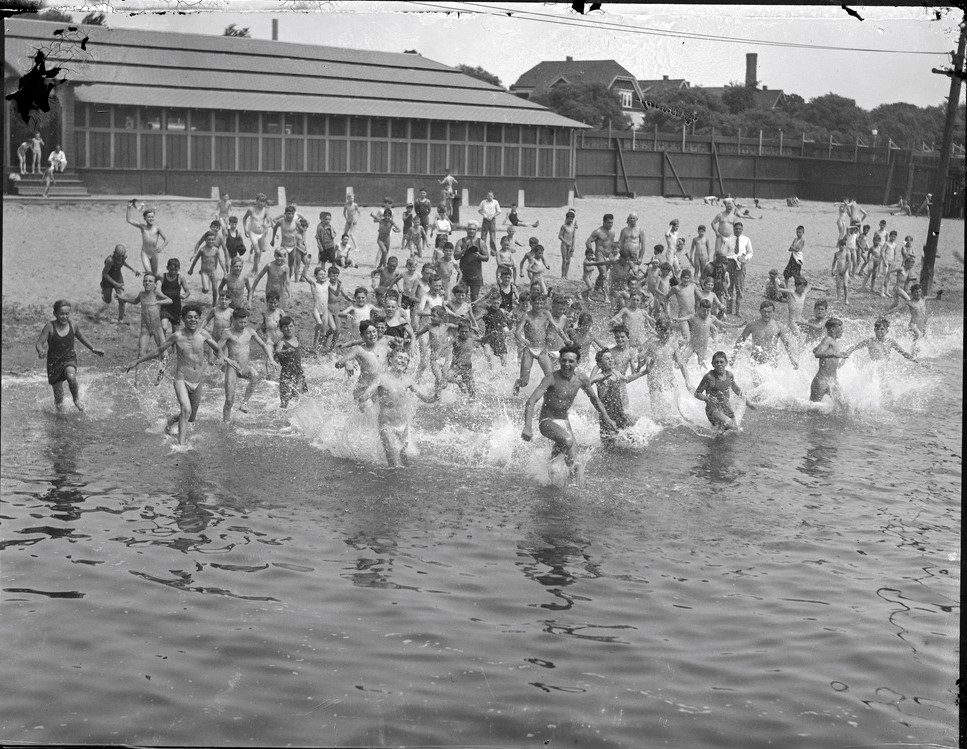
The exact time and place of this scene are not called out except for “Boston Beach 1917-1934.” We are apparently looking at the boys’ section of the bathhouse complex, although there are obviously some men present (including one in a shirt and tie!). The fun part is that the boys are not as respectful of dress codes. If you look at individuals, you’ll spot everything from tank suits to nudes. Some of the bares are waving their suits over their heads. A good time was had by all.
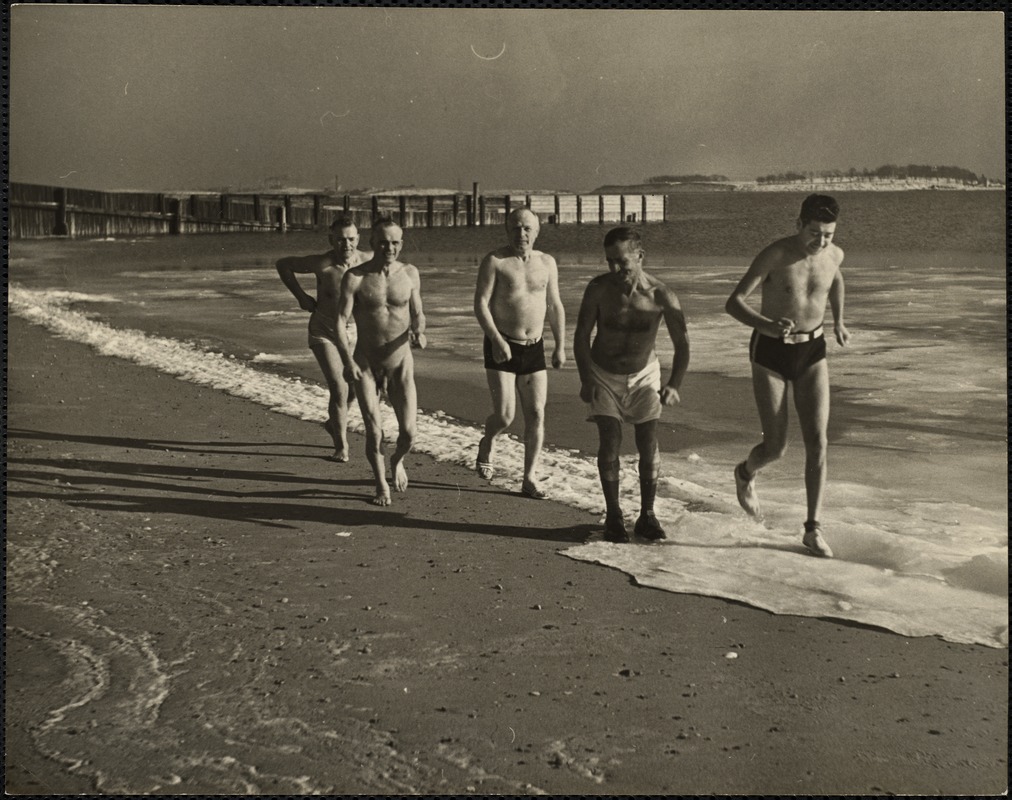
Apparently, not everyone hewed to the dress regulations. Sometimes you have to step out from the crowd. Although this is allegedly from the same time and place as the other bath house pictures, these guys are attired in various swim costumes, none of which are the bikini style we’ve been seeing.
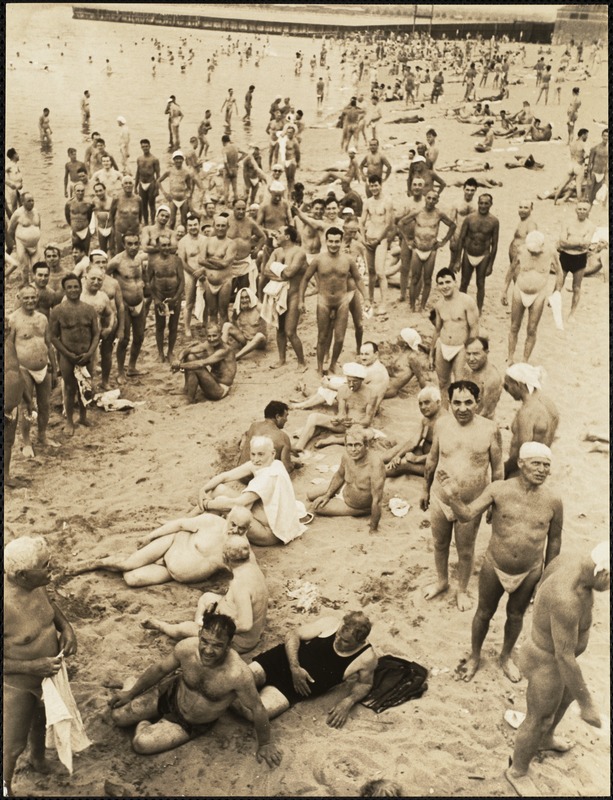
Before we say a fond farewell to the “home of the bean and the cod” we need to look at one more L Street picture.
Dead center in this image is something that doesn’t belong. The nude guy has obviously been added to the original photo from a more contemporary source. Since this photo comes from a library archive, you have wonder when and how it got added.
Topic 3 The UM Flounders
During the 1930s there was a curious lunch time ritual on the UM campus that was held on Mondays, Wednesdays and Fridays. Some faculty members and occasional younger men would strip down to their birthday suits, do a few warm-up exercises and then participate in a pick-up game of naked water polo. In this game, however, the rules had been reduced to one: “Don’t get killed.”
The ensuing mayhem was documented in two articles that appeared in the alumni newsletter in 1931 and 1935 presented here.
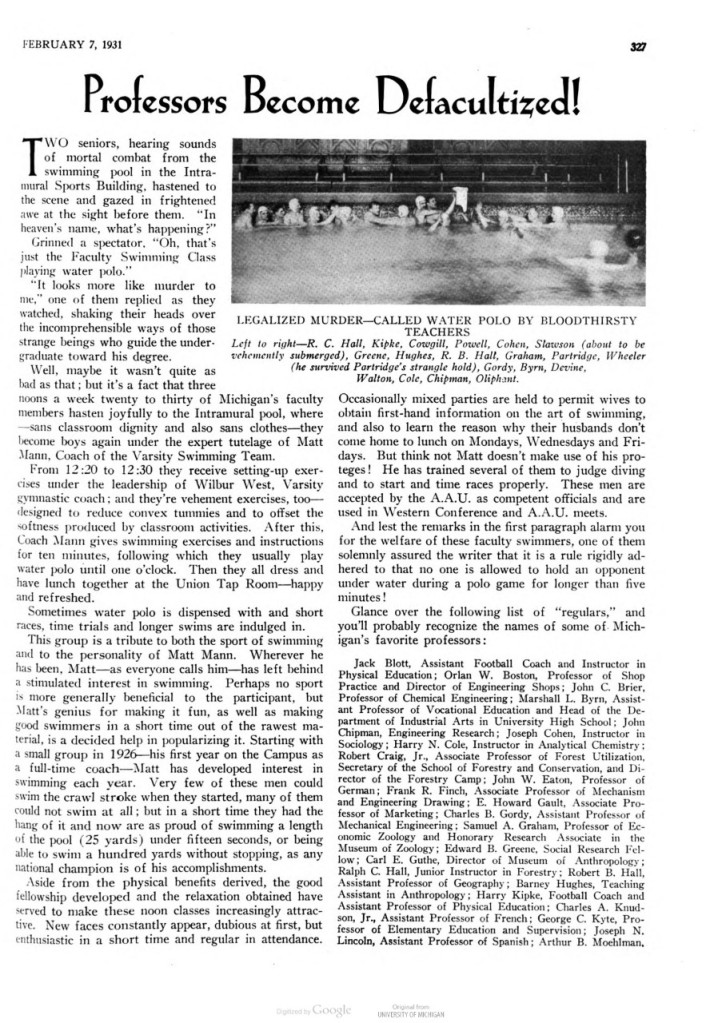
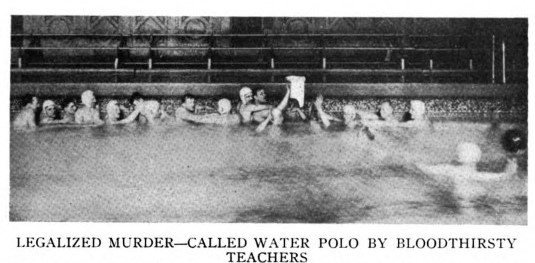
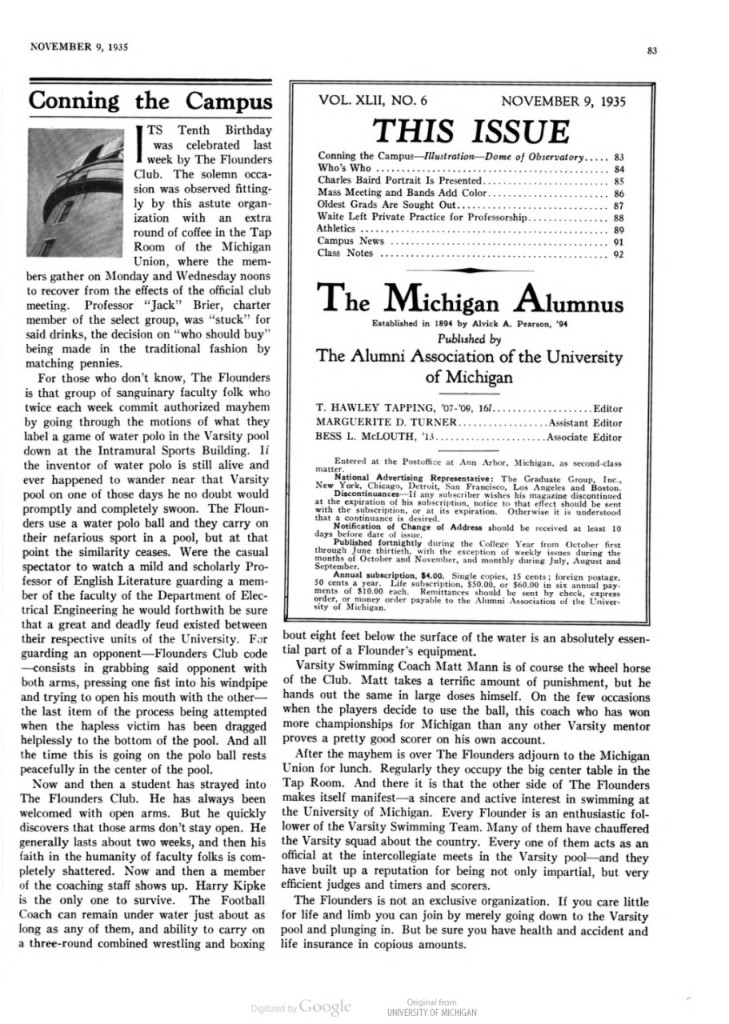
The participants were known as The Flounders – probably a reference to their flailing during the contest. The activity was begun in 1925 by none other than the intrepid Coach Mann. The ritual was apparently still going on when LIFE visited in 1938 and captured the action in this series of unpublished photos.
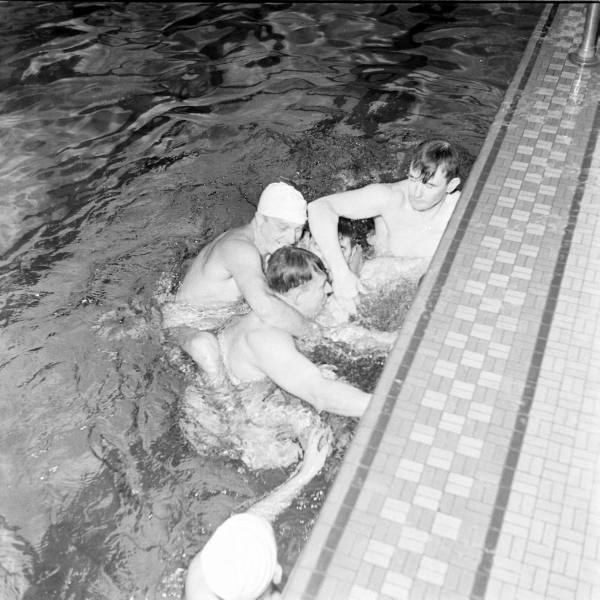
Note that this chokehold is being applied by a naked guy straddling his victim’s back bringing his genitalia into skin-on-skin contact. These guys were apparently very good friends.
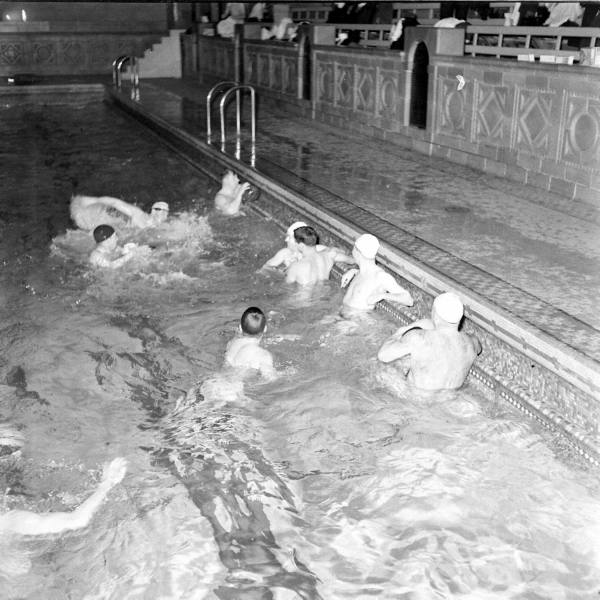
A typical contest was apparently caps vs. no caps.
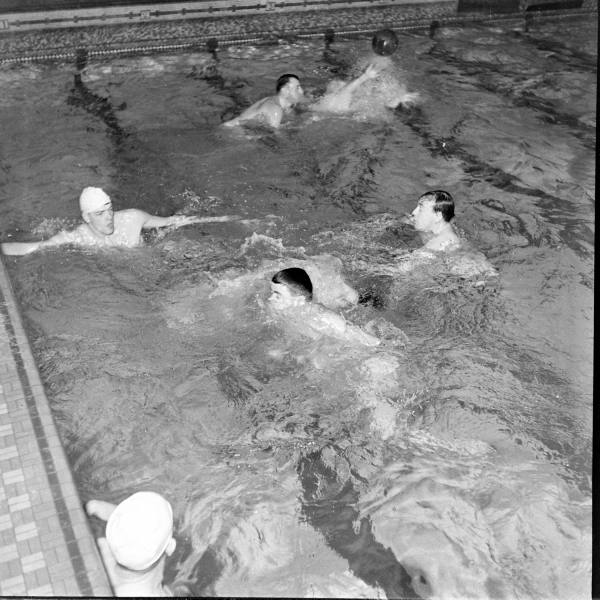
The ball is visible in this shot, but I have never seen a goal net in any of the pictures.
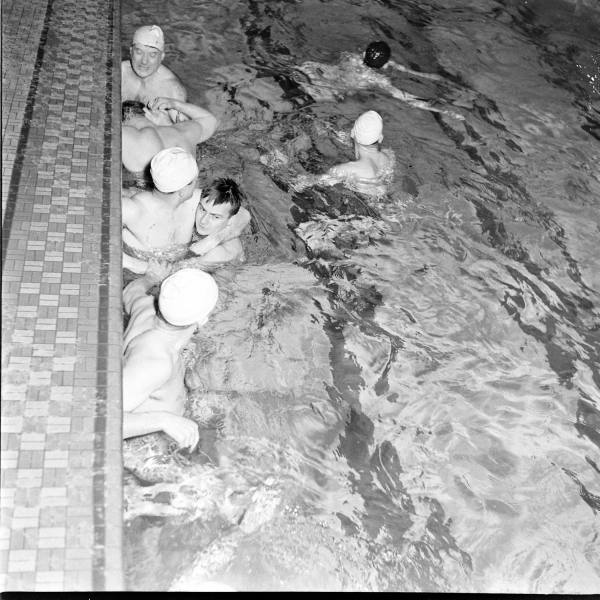
Note the simultaneous head lock and dunk – qualifies as a double header.
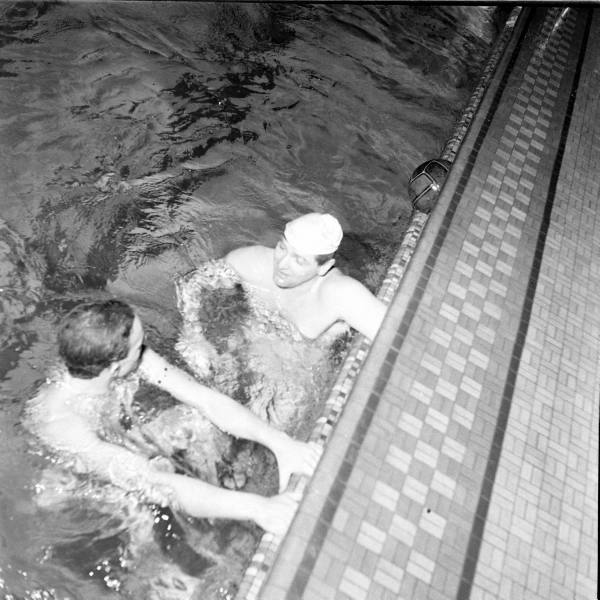
Have you seen the ball?
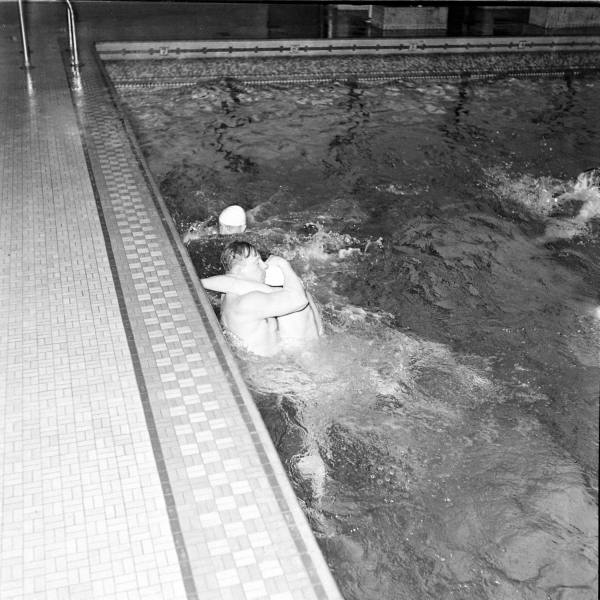
I don’t think this is an affectionate embrace.
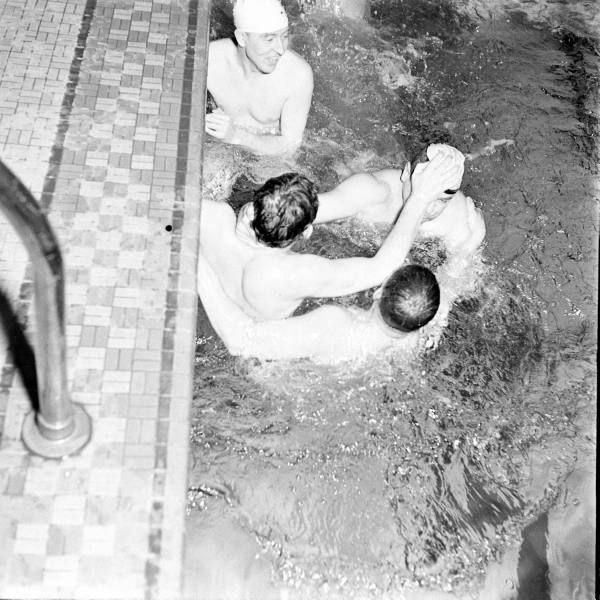
Apparently, hands-to-the-face is not discouraged.
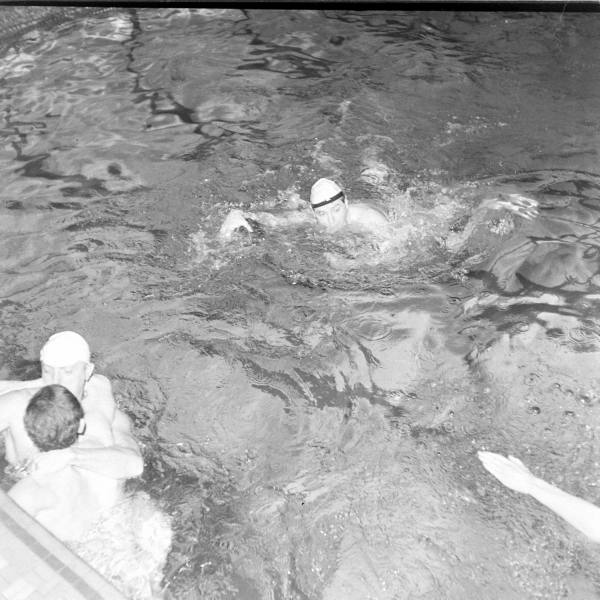
I’m sure the two guys locked in an embrace is part of the game strategy.
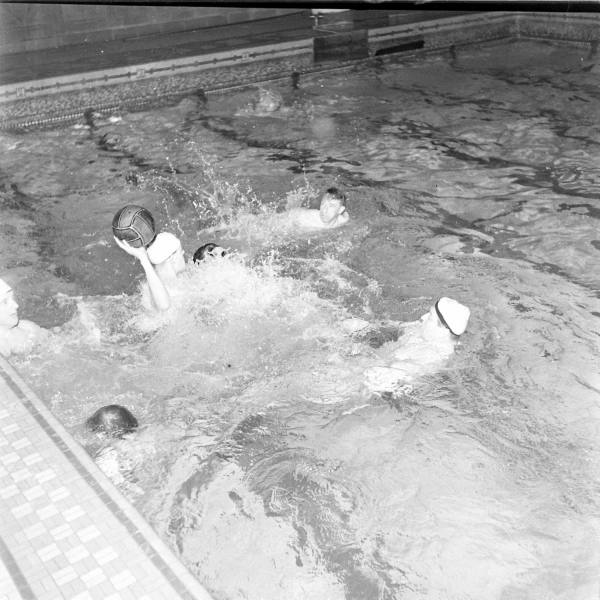
He appears to be taking a shot with one hand while drowning his opponent with the other – a real competitor.
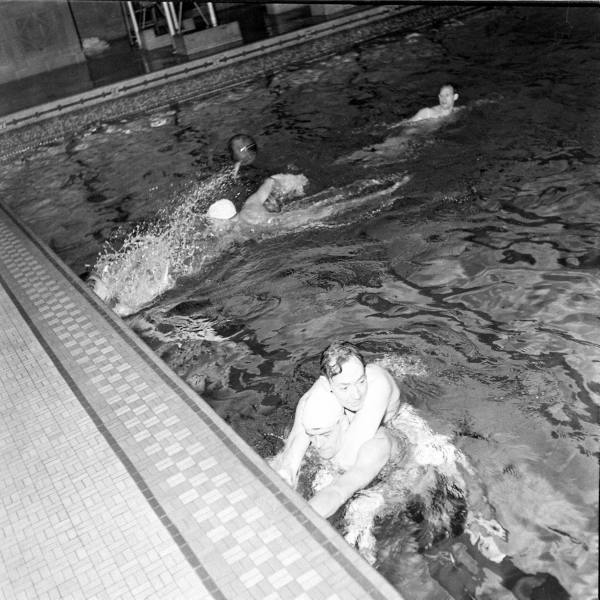
Ah, yes, the naked chokehold again. Does anybody know where the ball is? Or care?
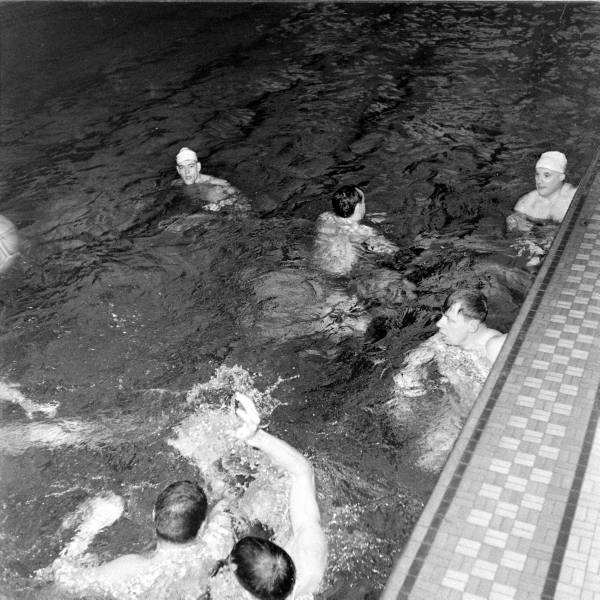
Remarkably, The Flounders’ free form water polo mayhem was still being practiced in 2006 as a Friday night ritual. An account by a female lifeguard relating her experiences overseeing Flounders encounters appeared in the Michigan Daily – the University newspaper – on September 5, 2007. When she pinch-hit for the usual male lifeguard, she caused some consternation because the male participants had to wear swim suits – at variance with their usual practice. This means this activity had been in more or less continuous practice for more than 80 years – a venerable institution.
 Historical Nude Male Swimming Images