Very Informal
Revised 4/3/26 Added one photo to North America
Since the topic of this website is historical organized (institutional) nude male swimming, casual skinny-dipping, whether indoors in a pool or outdoors in a river, is off-topic. However, those who have paged through this site know that I have periodically succumbed to the temptation to include those types of images. In my defense, some of those photos are just very engaging.
Here are some that I’ve found “engaging.”
North America
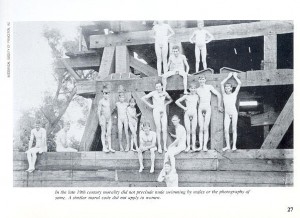
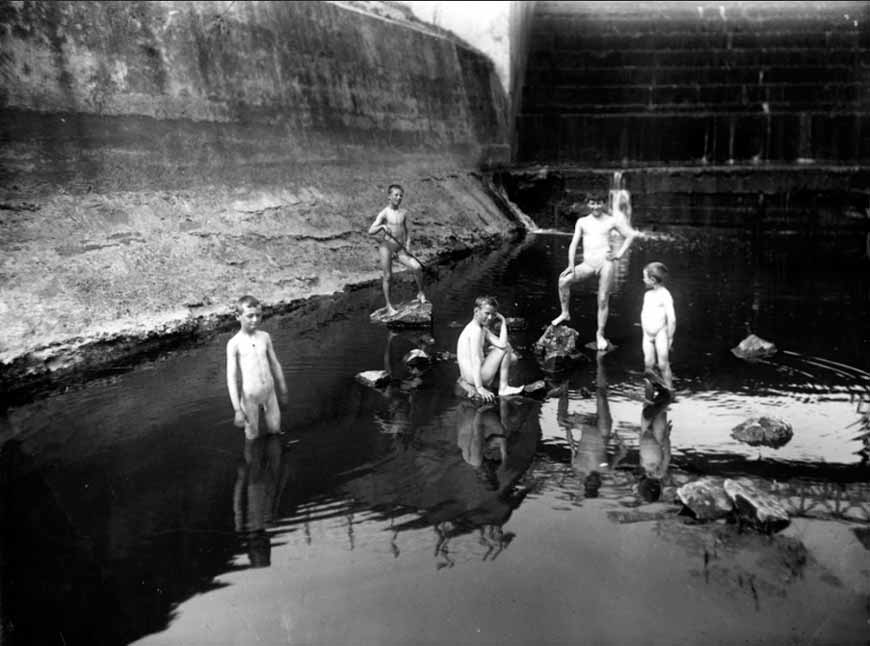
This very low res image was lifted from a 1975 book relating the history of the Delaware and Raritan Canal which crossed northern New Jersey. The figures are boys availing themselves of the cooling effect of the canal waters below the abutment that supported a drawbridge over the canal. The caption reads: “In the late 19th century morality did not preclude nude swimming by males or the photograph of same. A similar moral code did not apply to women.” (Source: Historical Society of Princeton, NJ)
Take away is that these males are engaged in nude recreation and it all seems perfectly natural (pun intended).
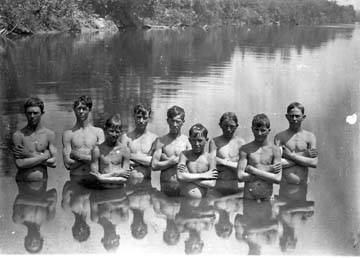
This image comes from the University of Texas San Antonio Libraries Special Collection. It depicts what looks like a group of teenage boys pausing in their swim for a picture. The year is 1905. The location is the San Saba River. The San Saba is reported to lie in an “undeveloped” natural area. Looks like not much has changed in over 100 years. Finding it on the map confirms that it is a long way from anywhere.
The highlight of this image is the boy second from the right whose penis is breaking the surface of the water, frustrating the photographer’s careful staging.
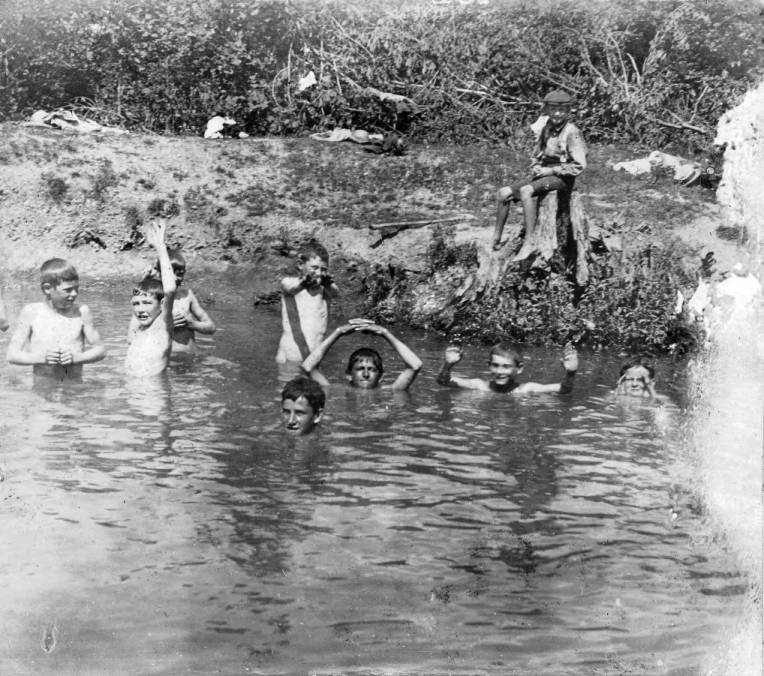
This image dates from the early 1900s. The available description says that it depicts the boys of the Danzero family with some of their friends cooling off in a stream somewhere in southwestern Missouri. Thanks to the boy near the center of the photo who stands up nice and tall so we can ascertain that he is wearing nothing. The dressed boy on the stump has an ax handy, so he should not be messed with.
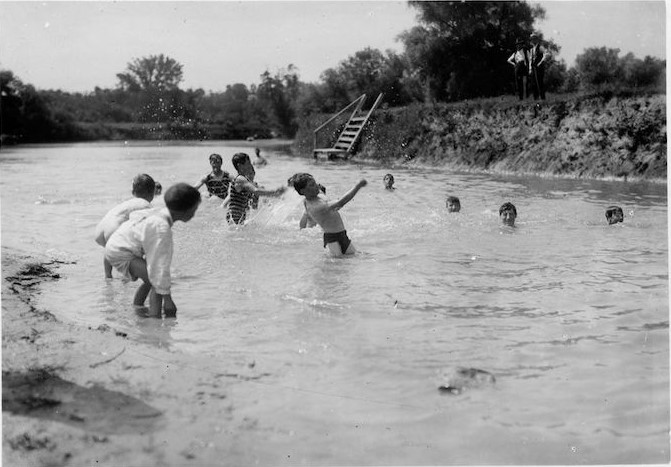
The City of Toronto Archives yielded this image from July, 1922. The location is given as the Humber River near Old Mill. It is an interesting assembly of swimming costumes from the era: tank suits, what appears to be an early version of the brief and, of course, skin. The lad with his bare derriere pointing toward the camera may not be alone in his choice of raiment. His fellows who are neck-deep may be hiding from the camera in water that is apparently only wading depth.
The shadowed figure in the foreground may be the most unique inclusion. It is apparently a girl. I suggest that her hairdo is of the chin-length variety that has been variously called that pageboy or blunt cut. It was favored for small girls over decades. In the 1920’s it was a popular look for adult women. The fact that she is daintily addressing the water to avoid wetting her too-long clothes (is that a tucked-up skirt?) while remaining on the periphery of the action bolsters my case.
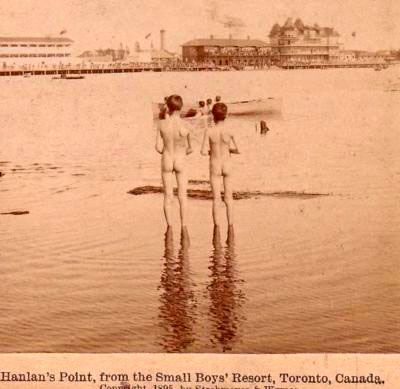
This image is from a very different part of Toronto. The name Hanlan’s Point refers to the western most of the three islands south of the city on Lake Ontario. It is and has been the location of multiple beaches. Some of them are purposed for clothing optional use. This image from 1895 probably shows a scene not of skinny-dipping (an outlaw activity) but rather sanctioned nude recreation.
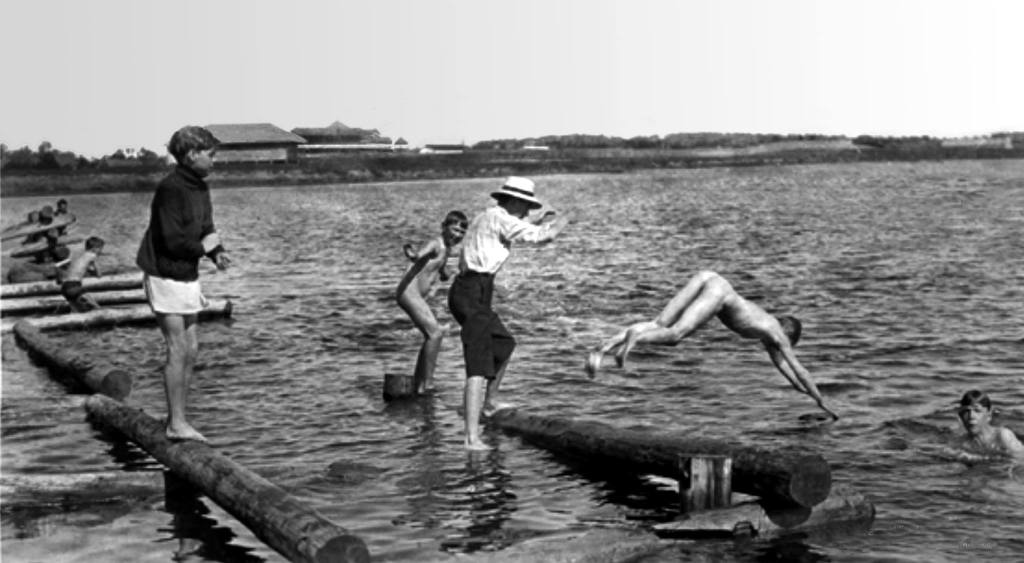
Here we have a scene from the Maritime provinces of Canada, specifically Prince Edward Island province. This episode took place in 1912 in Charlottestown on the Hillsborough River. The aquatic activity seems to involve logs and is pretty well attended from what can be seen in the background. I’m not sure what the game is but swim suits are optional. The fact that one boy is in a jacket and appears to be hunched against the cold makes we wonder how warm it was that day.
Skinny dipping was not always pursued in rural and other unspoiled locations. Industrialized locations were fair game as well for boys trying to beat the heat and have a little fun. The rivers that flowed through cities were arteries of commerce with all the attendant hazards that could entail. Sometimes that meant swimming among industrial wreckage. These next few images capture those sorts of scenes.
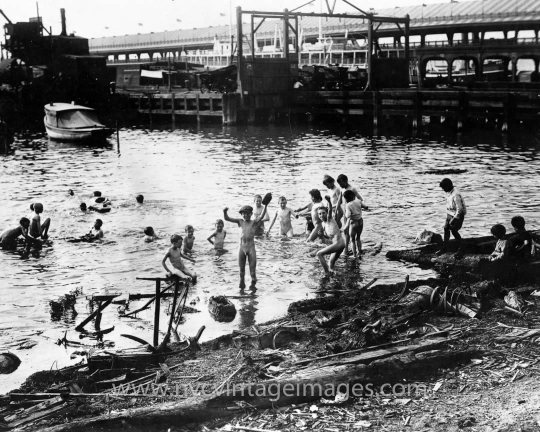
A notation on another print of this picture attributed it to the East River in New York City but is undated. It captures a large group of naked boys enjoying the waters of what appears to be a dirty and dangerous industrial location. Two of the boys are reacting to the presence of the camera. The one in the center of the image presenting a full frontal is wearing a hat and holding an object aloft. Something he found on the bottom?
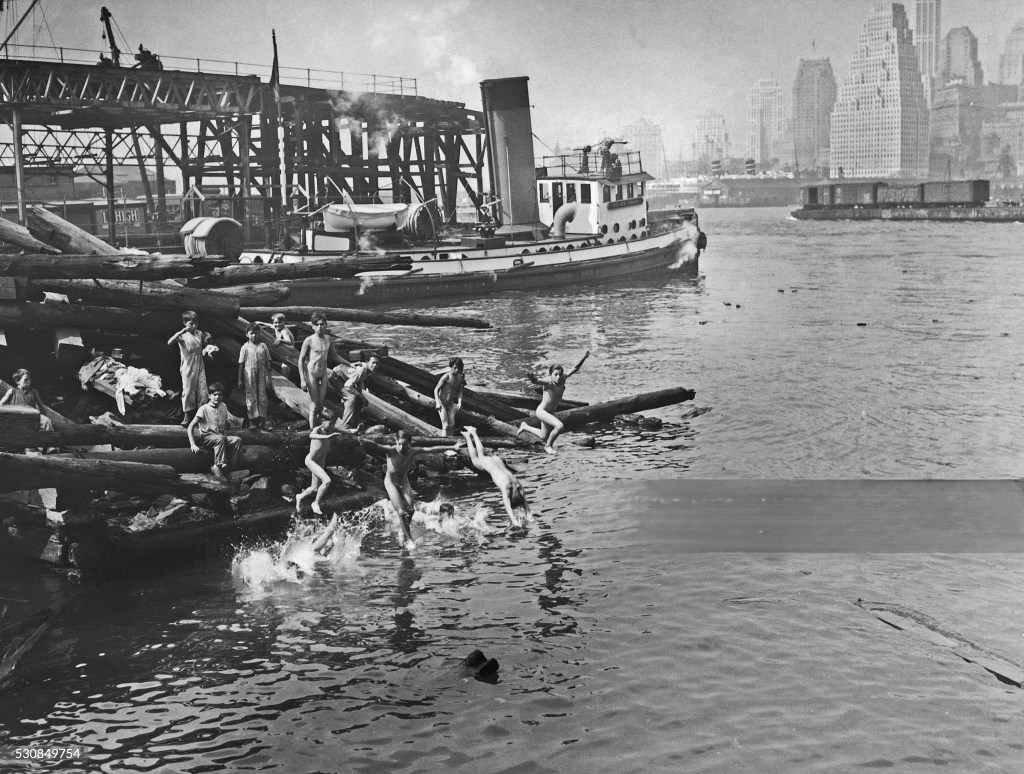
This scene took place at the foot of Pierrepont Street. Nowadays, this area is part of a waterfront park system that includes a beach. Things were a little rougher at the time of this photo, but the local boys had the right idea – water recreation. The naked lads are diving off a ruined pier in a cascade reminiscent of penguins diving off an icefloe – probably a staged shot. However, nothing could mitigate the hazards to life, limb and health present in such a location.
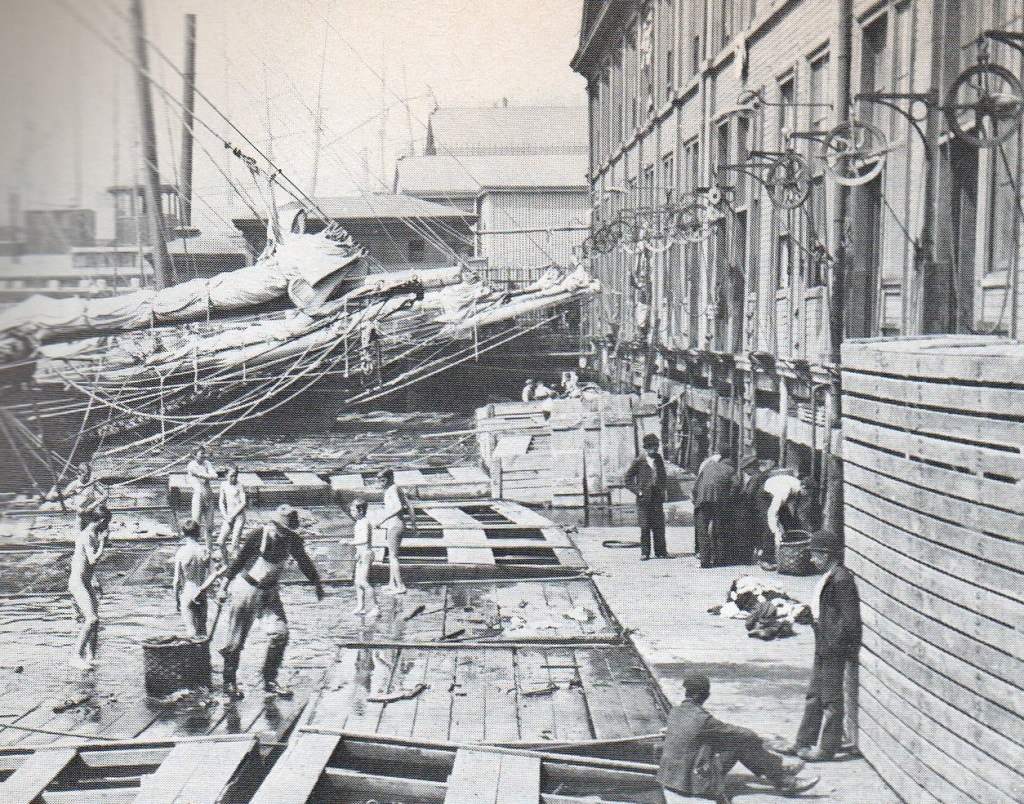
Although the main activity of this facility was fish mongering, the local boys were enterprising enough to see its recreational possibilities. They just piled their clothes on the sidewalk and waded in.
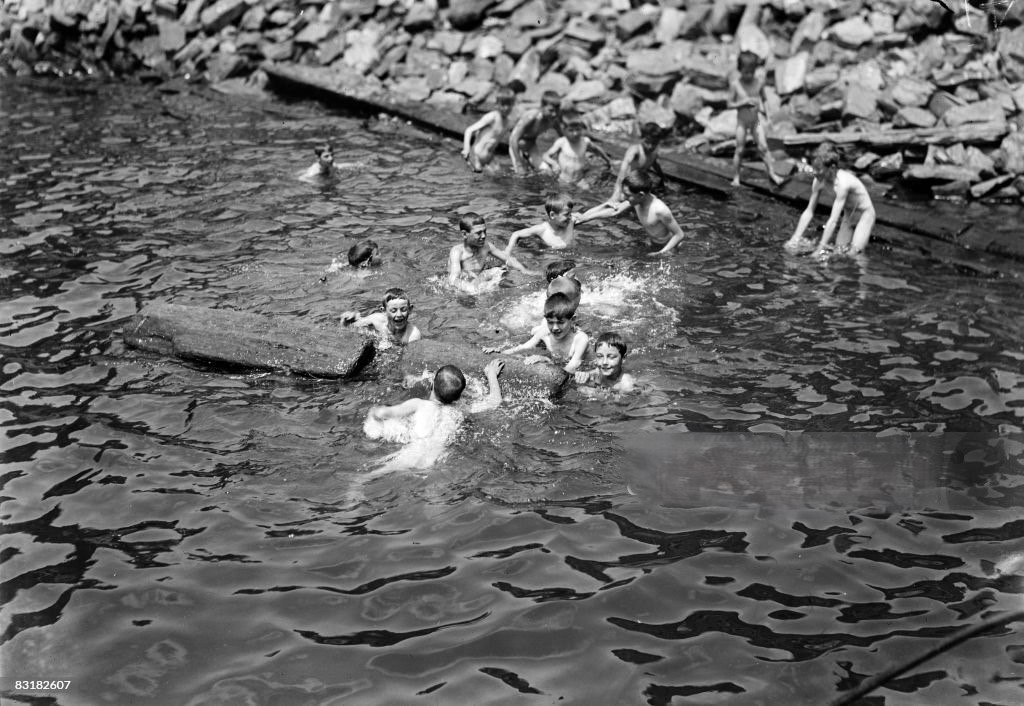
Except for the name of the river, this image is unattributed. Early 20th century, anyone?
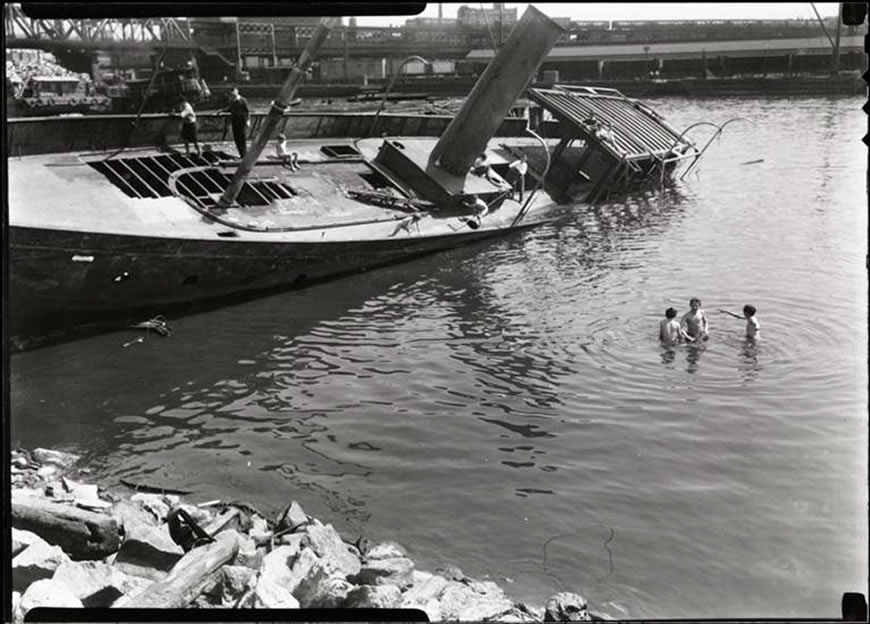
Unlike the previous picture, this one has a date: June 11, 1932. It’s a familiar image of a derelict ship with all of its attendant hazards being used as a skinny-dipping base.
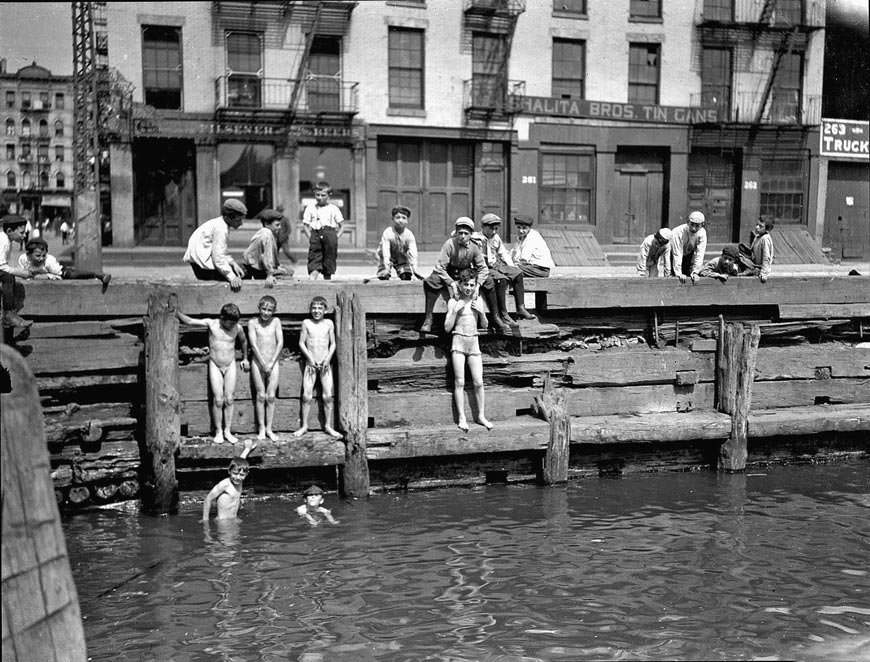
This image proports to be from around 1900. At that time, the Lower East Side of Manhattan was a teeming, overcrowded immigrant slum. Most of the immigrants were from eastern Europe and were primarily Jews. Here a few boys are braving the East River while their doubtful companions debate the wisdom of joining them.
Further to the endless variety that can be found among the boroughs of New York City, here is a scene from Port Morris, a section of the West (South) Bronx along the East River. This is specifically labeled Oak Point, but the location of that geographical feature is somewhat ambiguous.
The date of this image is 1897 when this was an active industrial area served by a deepwater port and rail lines. There are hints of that in the background features (the piling on the right, the tower in the upper left and the narrow gage rails in the center left). Whatever the purpose of this gathering, the individual boys have chosen an array of costumes, including nothing at all.
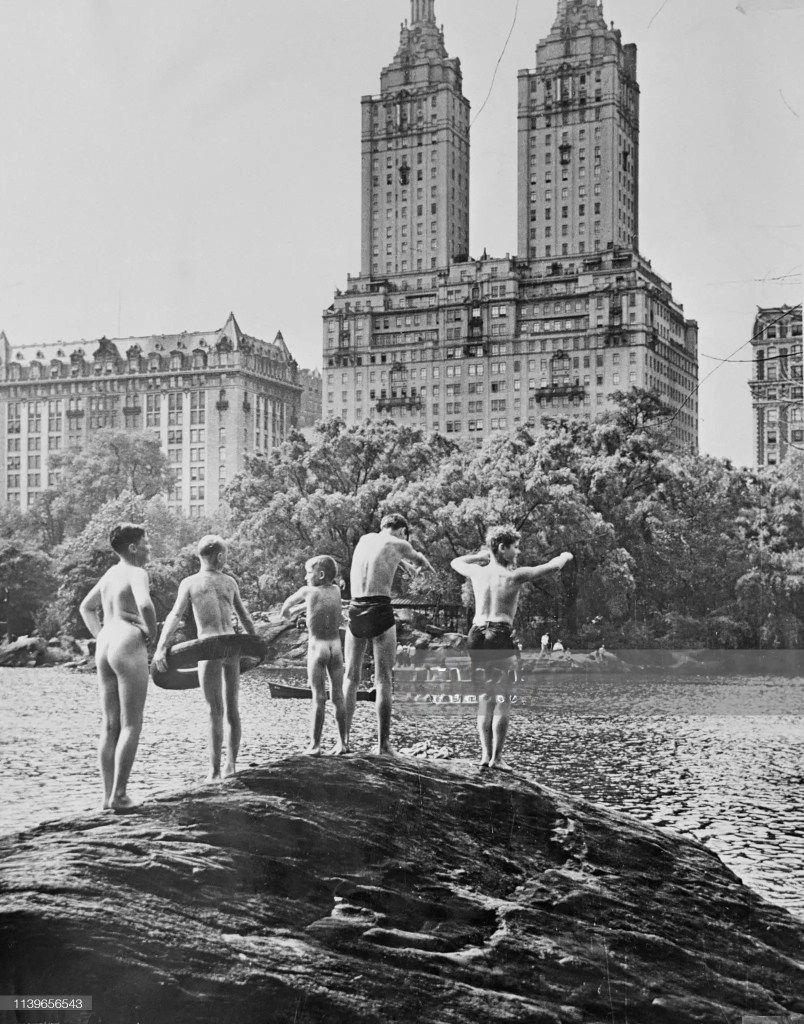
Having viewed multiple images of skinny-dipping scenes in the waterways around the five boroughs of New York City, it’s time to move uptown to Central Park in Manhattan. This scene overlooks The Lake, a 20-acre pond that is one of several bodies of water doting the Park. The year is 1955. It appears that this pond is in use for a range of aquatic recreation including boating. If you consult the Central Park Conservancy website these days, you will see that the public is strictly enjoined from coming into contact with the Park waters. Apparently, there are significant levels of industrial toxins present. It seems 1955 was during a period of blissful ignorance regarding this hazard.
Returning to the figures in the image, it appears that nude boys were welcome to swim in the Park in those days. One even came equipped with a flotation device. Given the mix of bathing regalia, it is likely that the boys were recruited on the spot to pose for the picture.
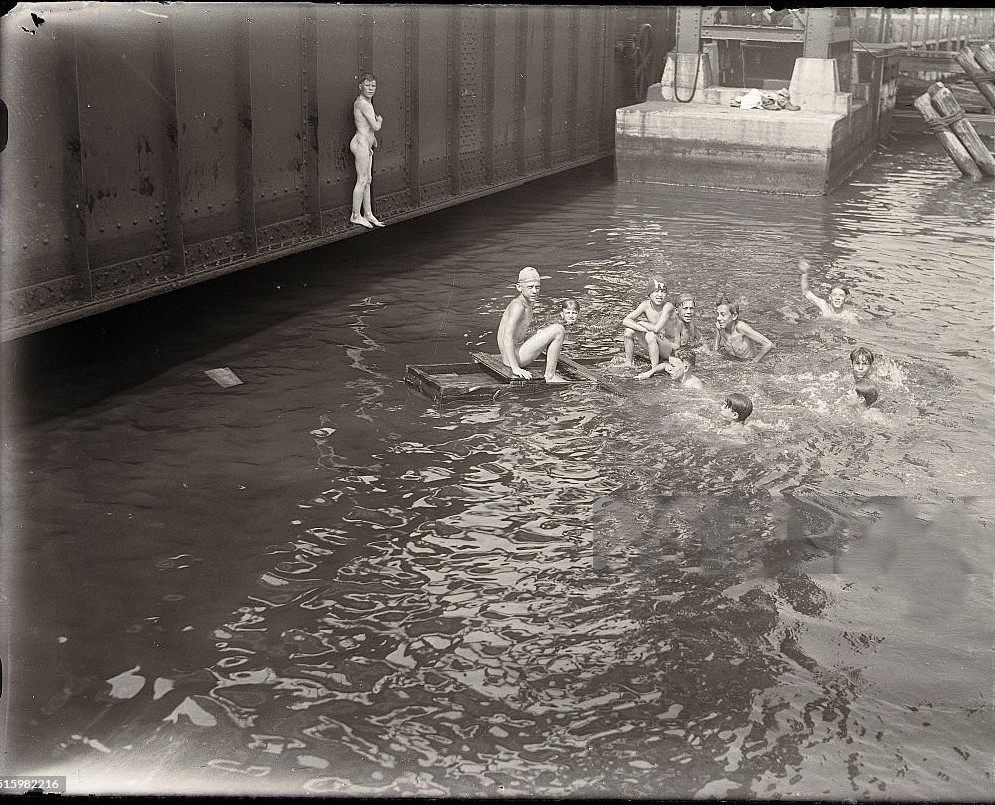
Let’s continue our tour of New York City’s five boroughs with this image from Queens. On July 23, 1930, someone snapped this image of an informal aquatic event on the East River at the foot of 6th Street in a neighborhood known as Long Island City. Thanks to the boy standing on the partition wall ledge for confirming the nude nature of this recreation. His companions seem to be clustered about a semi-submerged object that appears to be the base of operations.
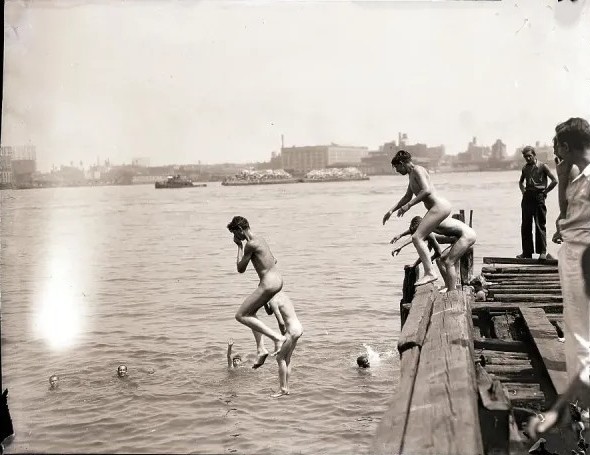
The date of this image is 1933. The scene of this action is not known. It could be any of the four NYC boroughs that border this river. The nude participants in this recreation seem a little older, but just as uninhibited as the youngsters. The barges under tow in the background are a nice touch emphasizing the gritty industrial setting for this skinny-dip episode.
Before we leave the topic of urban skinny-dipping in and around New York City, we need to consider two interesting images of mixed mode swimming.
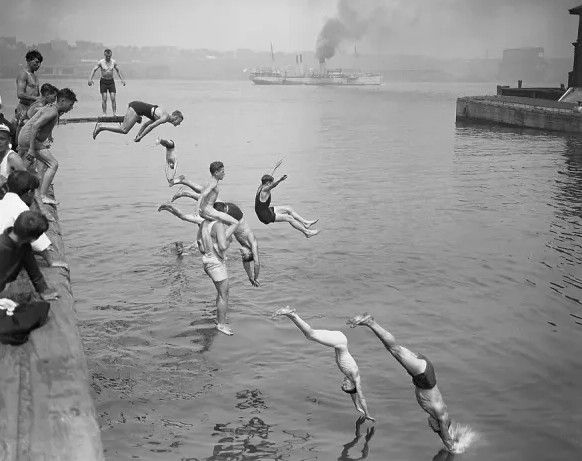
This image is dated July 21, 1930. It is obviously the product of a professional photographer who captured this action on some occasion that brought a number of boys and some men to the waterfront for a swim. The adult in the background seems to standing on a diving board while he monitors the activities. That might suggest that this location might be a regular (supervised?) swimming site. Since the participants are clad in a variety of suits and at least two are au naturel, he is not enforcing any dress code.
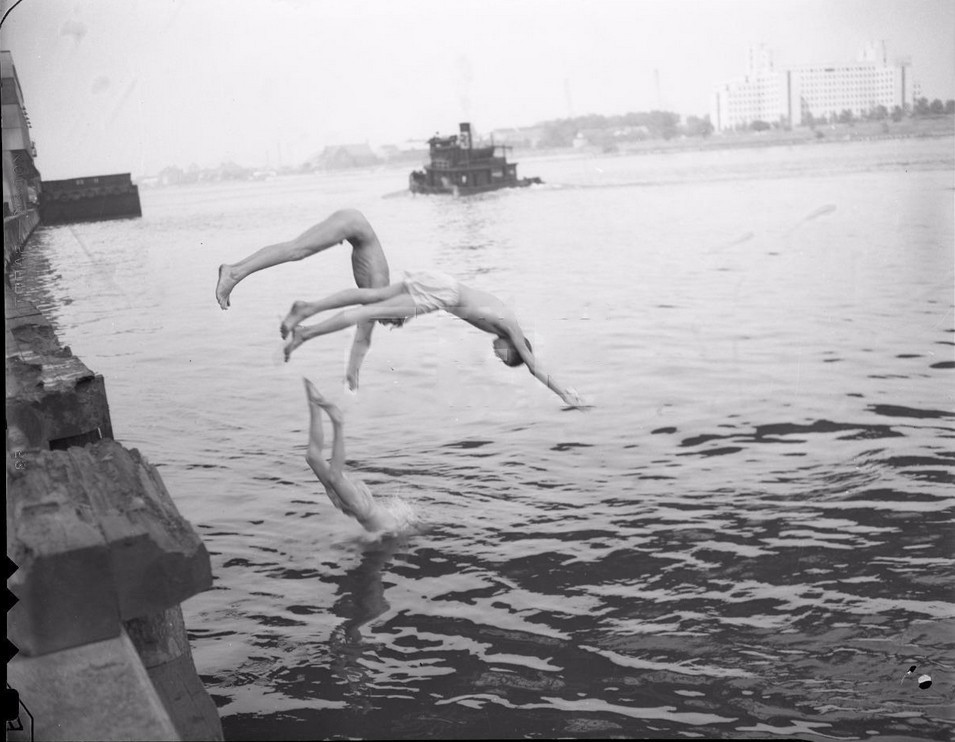
Still in NYC but the year has advanced to 1947. I may be prejudiced, but I think the nude boy has the best diving form. Everyone knows that clothes impede athletic performance.
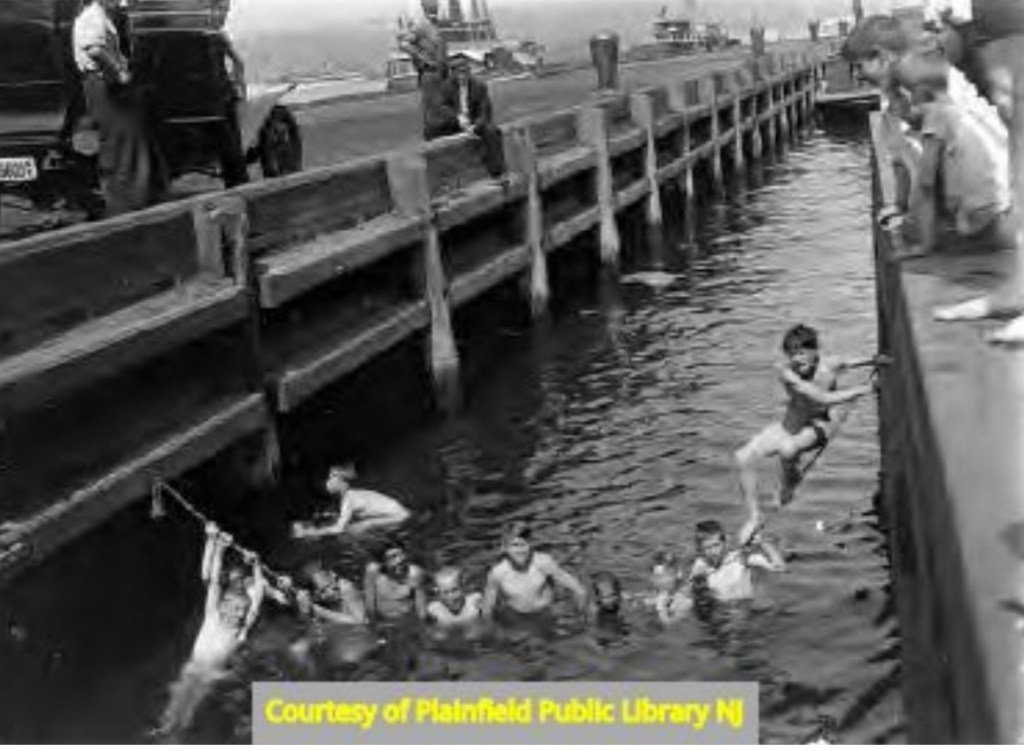
Northern New Jersey was no stranger to urban skinny-dipping, apparently. As the placard across the bottom indicates, this image is from the Plainfield Public Library archives. However, this waterfront scene could not have taken place in Plainfield, which is well inland. Newark or Perth Amboy, New Jersey are more likely locations due to their port facilities.
Having provided us with such a rich image, the library failed to provide any particulars. We are left to employ our powers of observation and deduction. With such a large contingent of boys, both in the water and spectating, it is possible that this was an outing rather than an impromptu plunge by a few boys with time on their hands. The fact that it is being observed by adults, especially the one by the parked vehicle may reinforce that conclusion. That takes care of the where and what, but when? Based on the configuration of the motor vehicle on the dock, the time period must be in or around the 1920s.
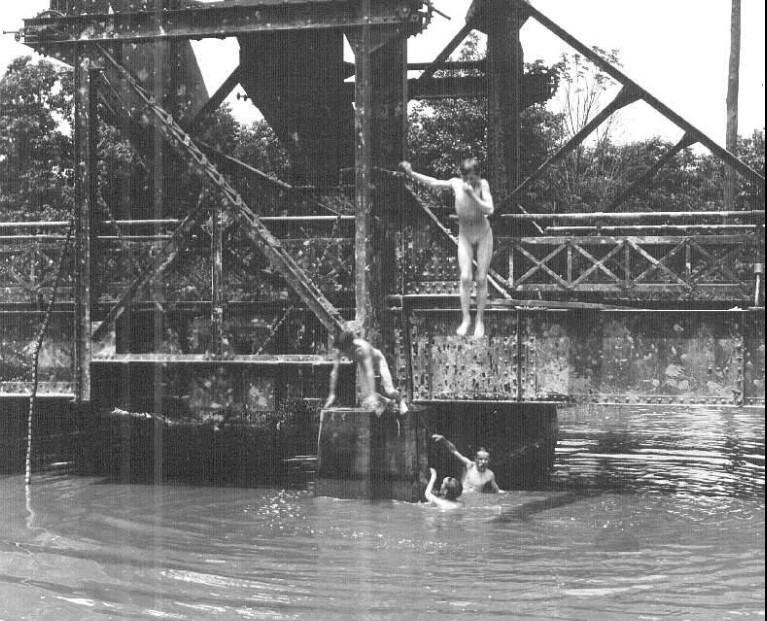
The Toledo Lucas County Library in Ohio reports that this image was made around 1920. The canal had been closed and abandoned in 1913, so there was no interference from barge traffic when these boys decided to utilize it. The advantage of canals for swimming was that the channel was usually a uniform, shallow depth with no currents – the closest thing to a swimming pool rural boys at this time could hope for. The bonus of this location was that the rusty lock works provided a serviceable diving platform.
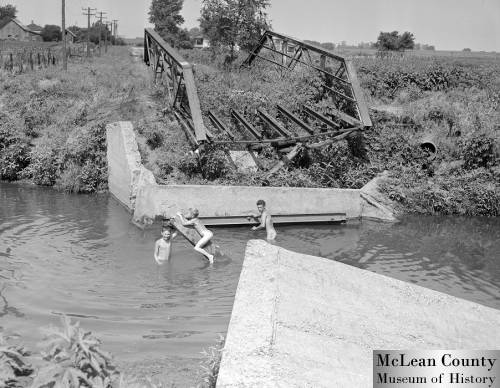
Hopefully, these boys were familiar enough with this remote location that they were sure the submerged hazards were not lethal. The obstruction that the center boys is climbing on looks dicey enough.
The newspaper archives of the Bloomington, IL Pantagraph contained this image which the McLean County Museum of History preserves.
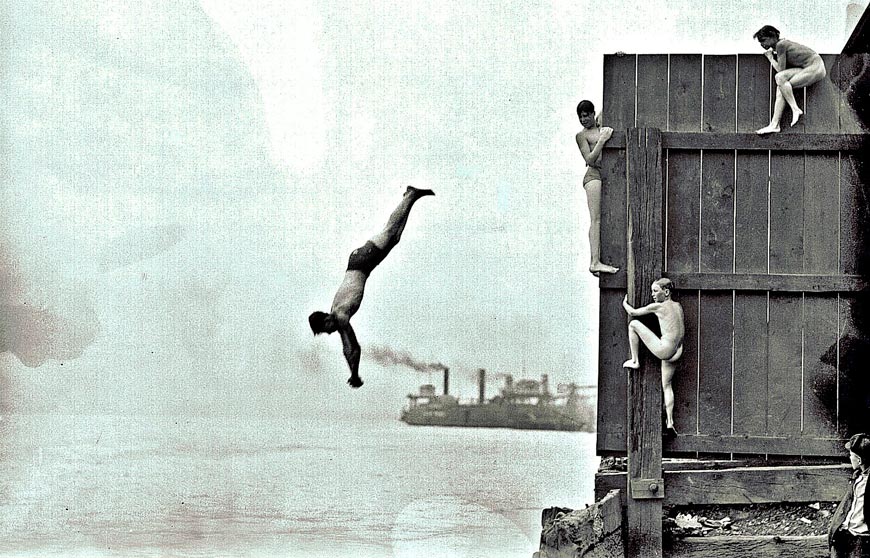
This undated image comes from the Wayne State University (Detroit, Michigan) archives. The difference in choice of swimming costume is inconsequential to these boys. The sketchiness of their diving platform is also of no apparent concern. In this heavily industrialized setting, one can’t be too choosy.
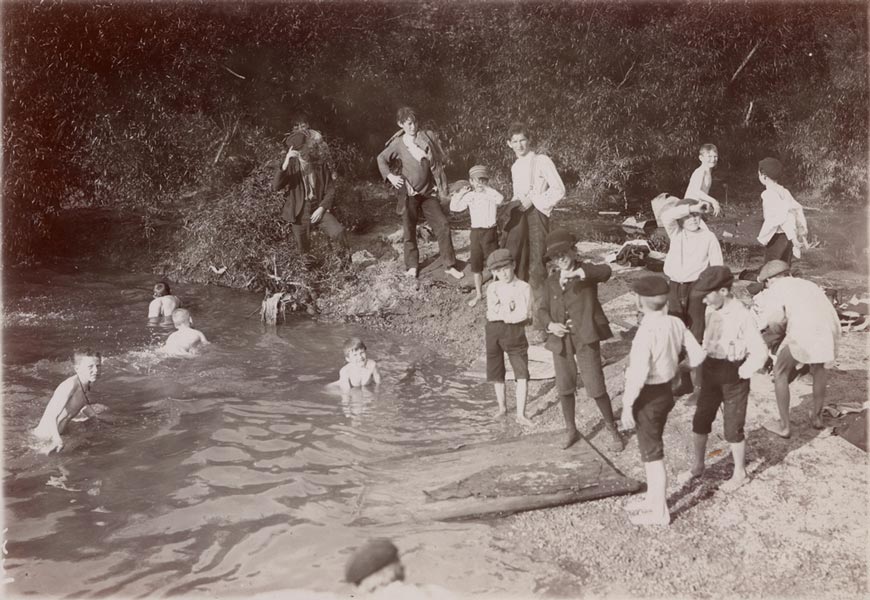
As this group of boys strips down for a cooling dip, they are imparting some interesting information about their life and times. In this case, the point of interest is not the naked boy swimmers (one of whom presents his raised butt to the camera) but the clothes of the dressed boys. Those in the foreground are wearing the knee pants that were the typical attire for younger boys in this period. But there are three taller (older?) boys in long pants. The inference is that the latter have attained an age (post-puberty?) that confers on them the right to wear adult trousers. It is also interesting that they are the ones aware of the camera and seem to be hesitating to drop their pants.
A few other sartorial points: The boys all seem pretty well dressed. Could it be that they just got out of church services and are wasting no time getting out of their (no doubt woolen) suits? Then there are the hats. Back then, if you were outdoors, male or female of any age, you were under a hat. Most boys in this photo are sporting the baker’s boy style with its soft, floppy crown and short bill peeking out from the front fold. At least two, however, seem to be wearing a fiddler’s hat. It has a high, shaped crown and long bill. I think that type may have been more popular in Europe at the time. Too much information? Sorry.
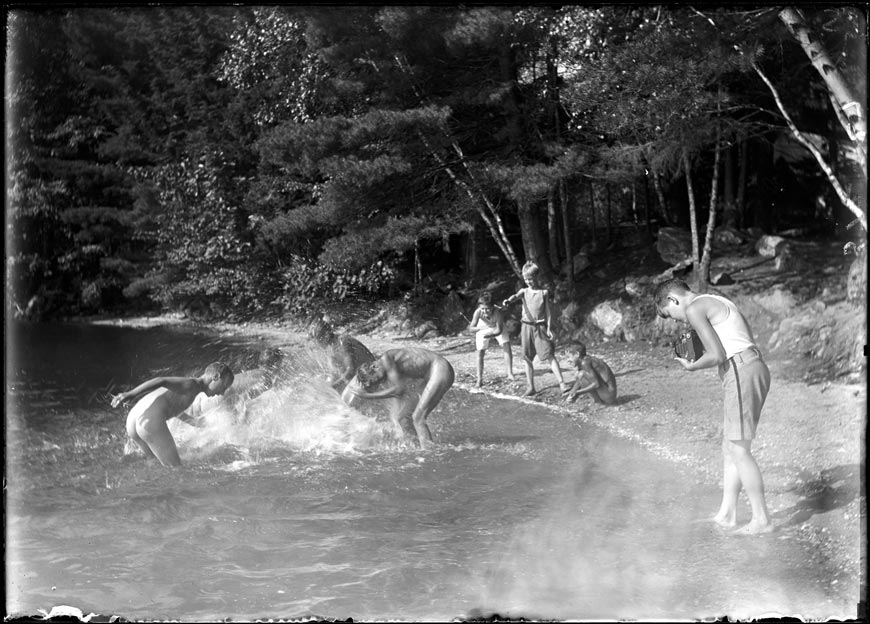
The caption is the only information on this image. The one fact that can be deduced is that this is a picture of a picture. The young photographer is captured ostensibly taking a photo of a staged water fight among naked boys while spectators follow the action enthusiastically. The camera wielded by the boy in this picture is the bellows type which was the preferred camera style from its invention in the 1850s until the 1950s. I’m guessing the date of this image is somewhere in the 1940s or 50s.
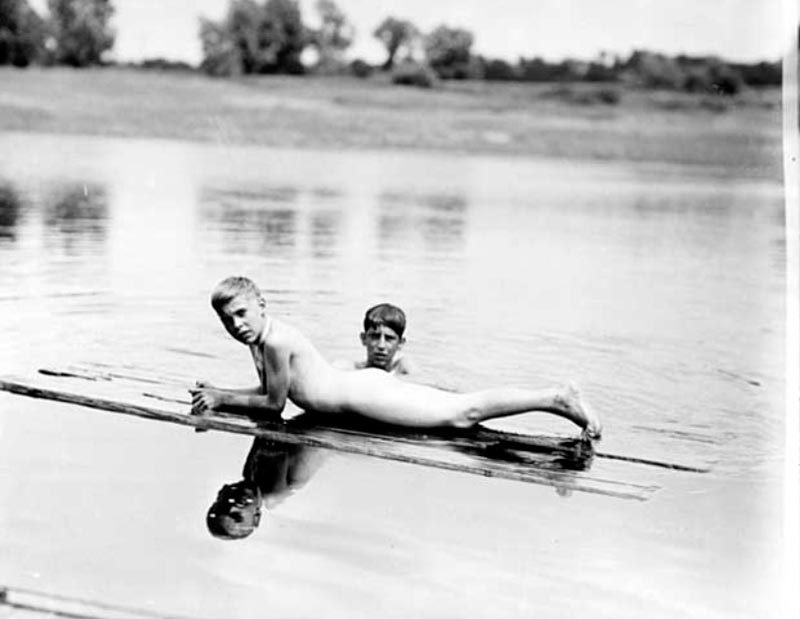
This time we have not only the name of a state but also a year as the attributes for this image. I suppose you can say that this a picture of tranquil nudity. Or vice versa.
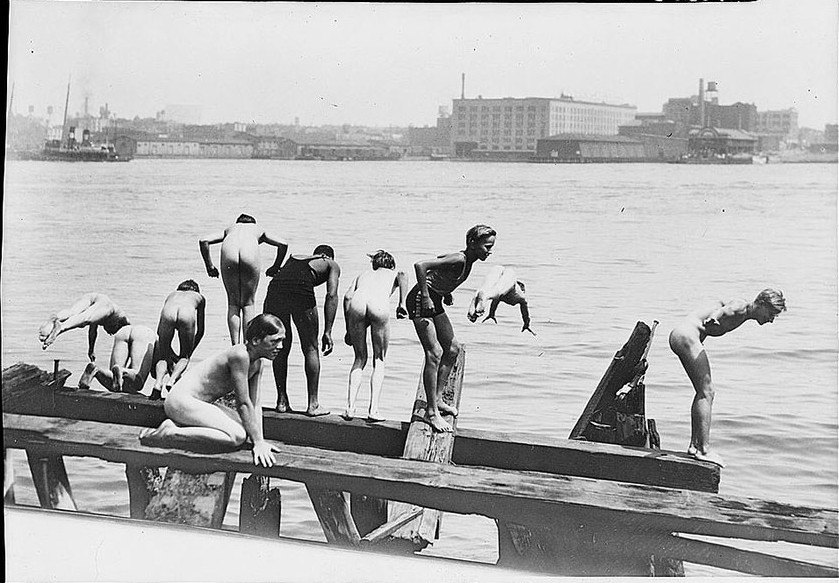
This image comes from the Library of Congress and is attributed to the 1930s. The location is not provided. One observation is that these boys seem somewhat older than in most skinny-dipping photos. I’m guessing they’re teenagers and that this is a staged shot.
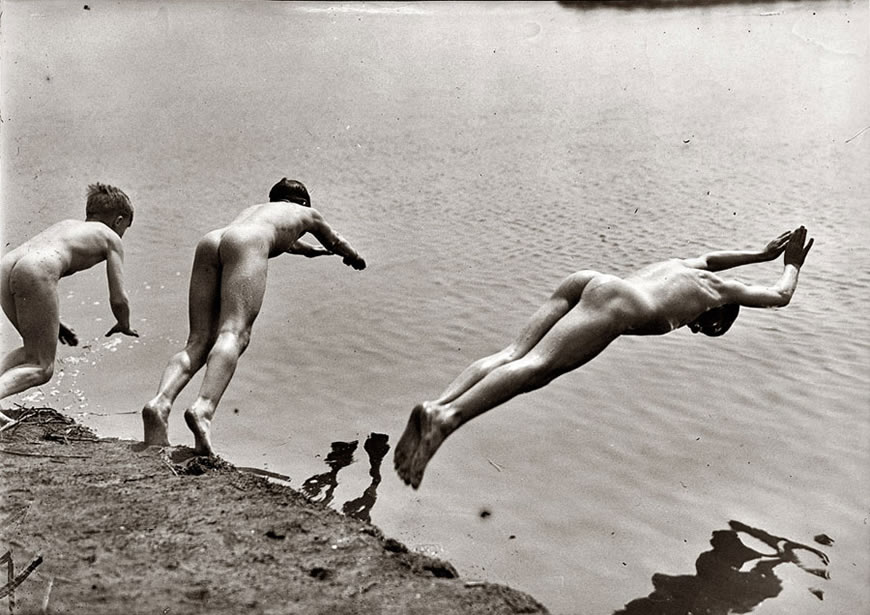
This staged image also comes from the Library of Congress with a date of 1935. It carries the additional attribution of the photo archive of the Acme News Service. That organization existed from 1923 to 1952 when it was absorbed by another service. The archive of photos passed through various hands. Curiously it is now owned by a Chinese company. Getty Images holds to distribution license outside of China, but the Library of Congress also holds a license.
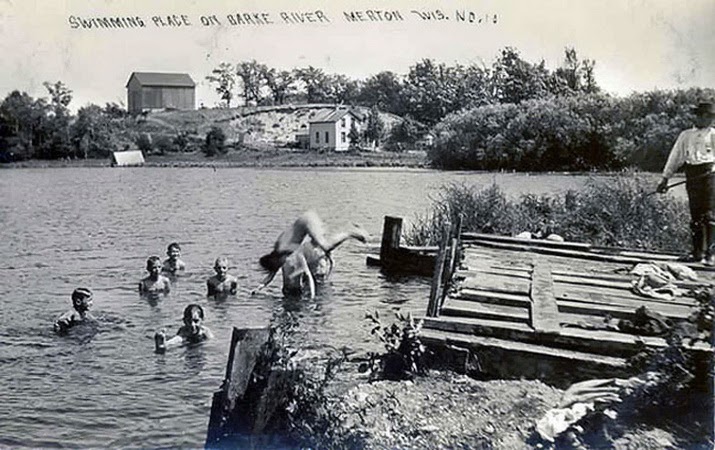
One take away from this obviously old but undated photo is that photographic technology at the time wasn’t up to freezing the action clearly. Nevertheless, the effort bore fruit for us by confirming that these lucky lads were engaged in nude recreation.
The inscription misspells “Bark River” which these days is a scenic boating destination. Merton, Wisconsin is the site of a dam, so this may be a manmade lake. The role of the adult in the frame is unclear. He’s holding some sort of pole, so maybe he’s the lifeguard.
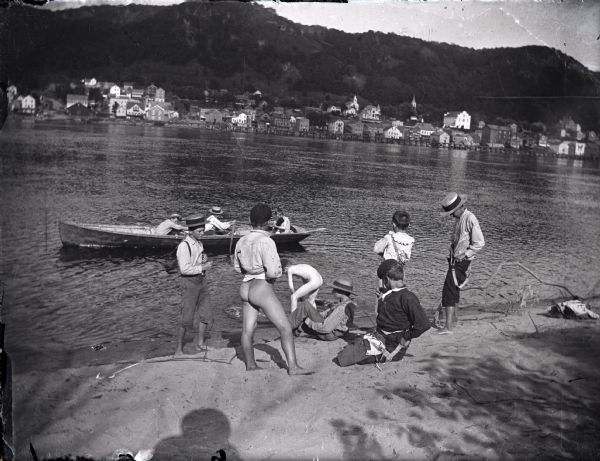
In Alma, Wisconsin (county seat of Buffalo County with a current population of 761), the site of this image, the Mississippi River is not so mighty. Nevertheless, on this fine day around 1900, a few of the local boys decided to take a dip – a skinny dip, of course. This photo catches them in the act of disrobing. Special shout out to the young man of African descent who brings some welcome diversity to this otherwise lily-white scene.
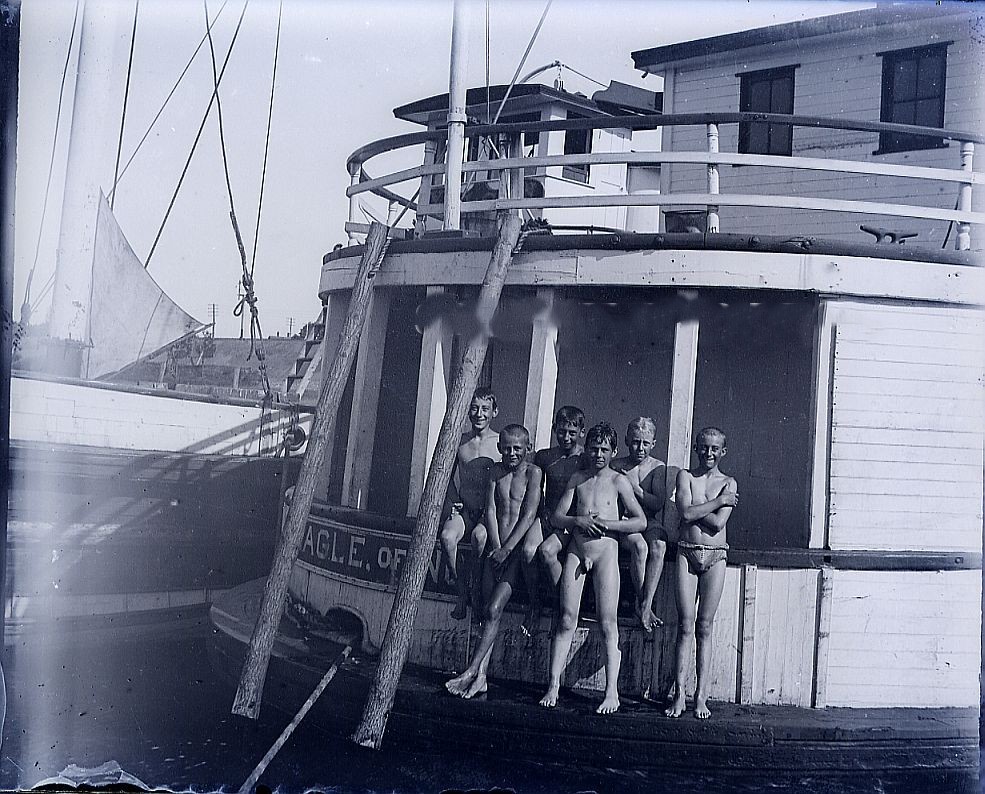
This very interesting photo is completely without attribution. A dating guess is that it is from the 1920’s. Another guess is that the boat these boys are posing on is a ferry. There is no doubt concerning the condition of the boy front and center.
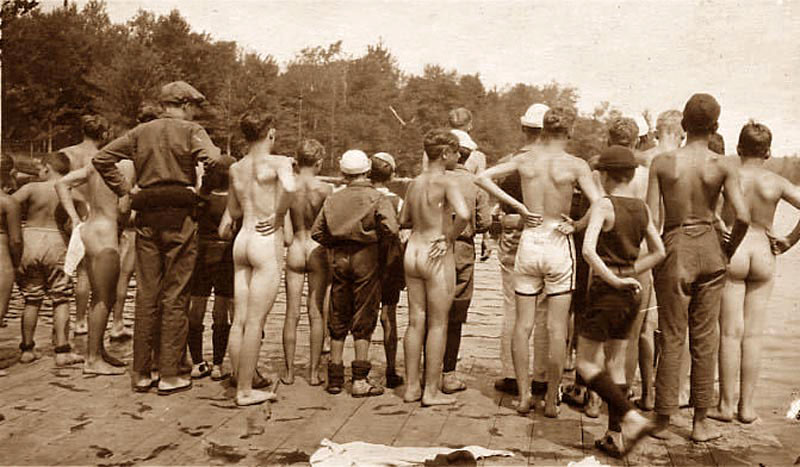
As long as we’re on the topic of images with mysterious provenance, here’s one to ponder. The only attribution is “USA 1930-1940s.” But even more intriguing than its origin is the high drama captured in this scene. Some event caused boys that were engaged in nude aquatics to climb out of the water and join their dressed fellows on the dock to watch something unfolding on the lake. Maybe an accident caused those in charge to clear everyone out of the water. I note one unusually tall person seems to be up front of the group (only his head, bare left upper arm, right shoulder and hand are visible – he might be nude as well). Is he the adult in charge?
While we will never know the nature of this incident or the location, there is the matter of the time. Looking for clues among the figures, there are a few boys wearing high top sneakers. That isn’t helpful since that type of foot ware was sold in the US beginning in 1916. The hats are another matter. Although one boy is wearing the soft-crowned baker boy hat, there are at least three others wearing white “whoopie” hats. One source I found said they were introduced to the general population in a 1937 Humphrey Bogart movie. They were popular among the youth in the 1940s and 50s. In their original form, they were homemade affairs fashioned from worn fedoras (wide brimmed men’s hats with creased crowns – think Indiana Jones) whose crowns were punched to a dome and brims were cut back to a serrated edge and turned up. Often, some bling was added for distinctiveness. However, fedoras rarely came in white. I suggest that the ones in this picture were commercially manufactured, suggesting this image is more likely from the 1940s after the whoopies became generally popular.
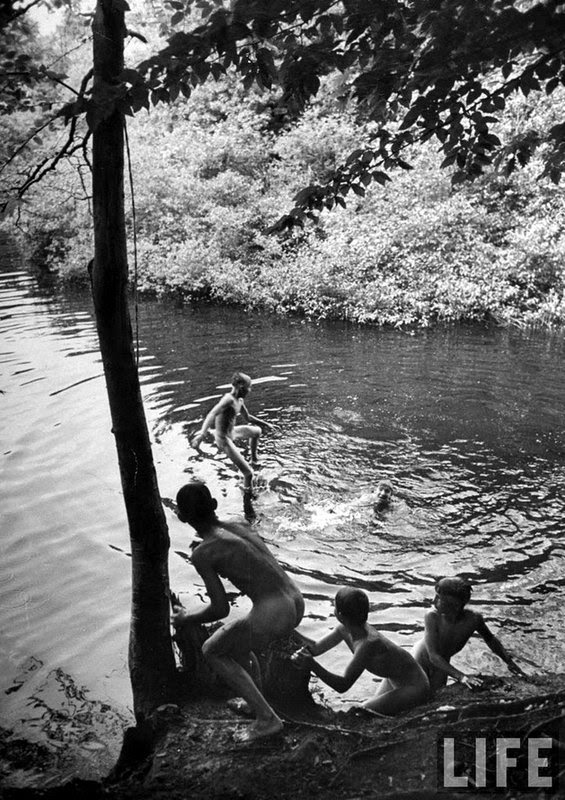
As I have noted in previous posts, an image sporting this watermark is usually the identifier of an unpublished photo from the LIFE magazine archives. Indeed, the clarity and excellent composition tends to validate that source. The problem is that this was free-floating on the internet with no attribution and it doesn’t comport with any of the know major articles of interest to us. It could be that a LIFE photographer on assignment turned aside to collect this image on the off chance that it could be used somewhere.
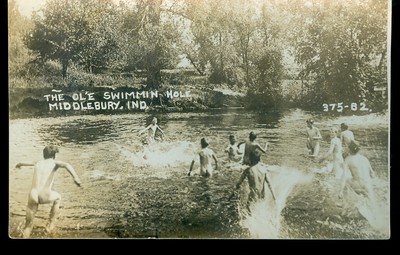
There’s no denying the youthful energy captured in this frame as this group of nude boys dashes into the “hole.” Although undated, the location “Middlebury, IND” is pretty specific. It is the name of a town on the northern border of Indiana. The body of water pictured is probably the Little Elkhart River.
This photo was identified as an outtake from a boys’ magazine. The rounded corners and the on-picture annotations argue against that description. Usually, photos that appear in a magazine are clean of markings and sharp-edged. Besides the caption, the numbers on the right side are in the format of catalogue labeling. This looks like an archive photo from some collection.
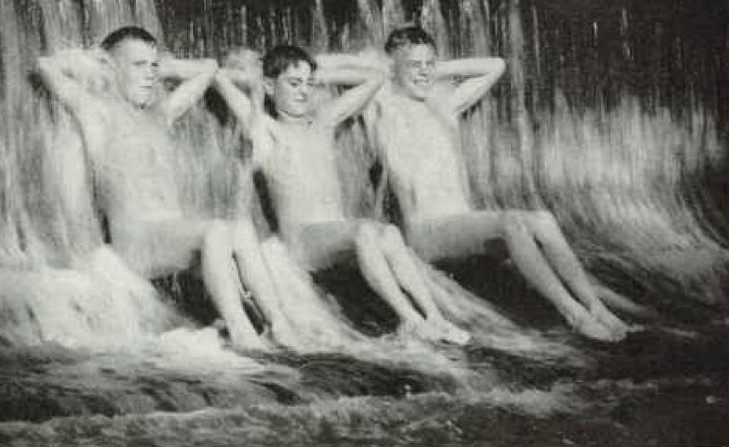
This image has some unusual features. The boys are sitting under overspill of a small dam on Cross Creek in Ohio – not something you see every day. The other noteworthy bit of data is that this photo appeared in the September 1946 edition of National Geographic. Apparently, images of skinny-dipping boys were considered entirely appropriate for this prestigious publication.
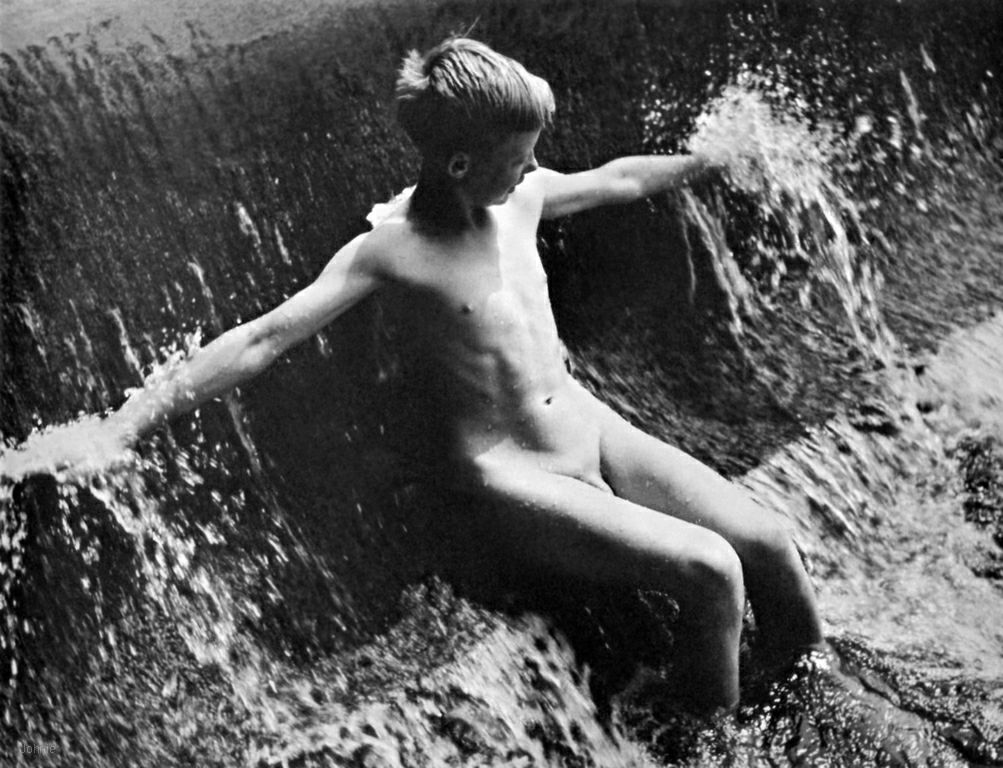
Whereas the boys in the previous image were being pelted by a flow that was kicking up some serious white water, this lad seems to have located a more tranquil setting for his summer afternoon cool-off. His pose is also a bit more forthcoming regarding his male attributes. Unfortunately, this very fine image is unattributed.
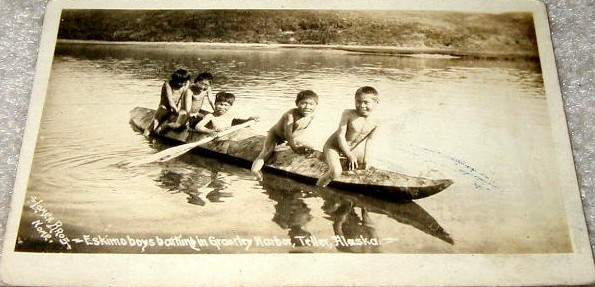
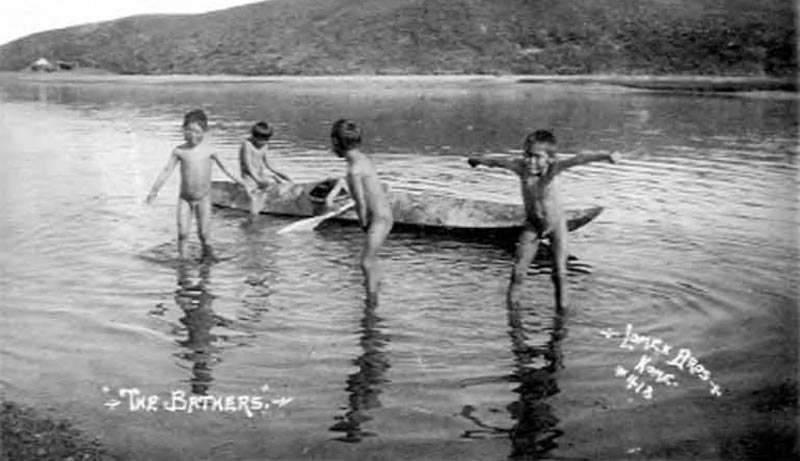
Moving to another part of North America, we have the town of Teller, which is located near the western tip of the Seward Peninsula. The peninsula in turn is the western most land projection of the State. On a clear day, you can stand on the tip of the peninsula and look across the Bering Strait into Russia.
One day sometime during the period of 1908-15 a professional photographer from Nome took these shots of native boys playing in a kayak. Since it happened during the brief summer, the boys were nude of course.
UK
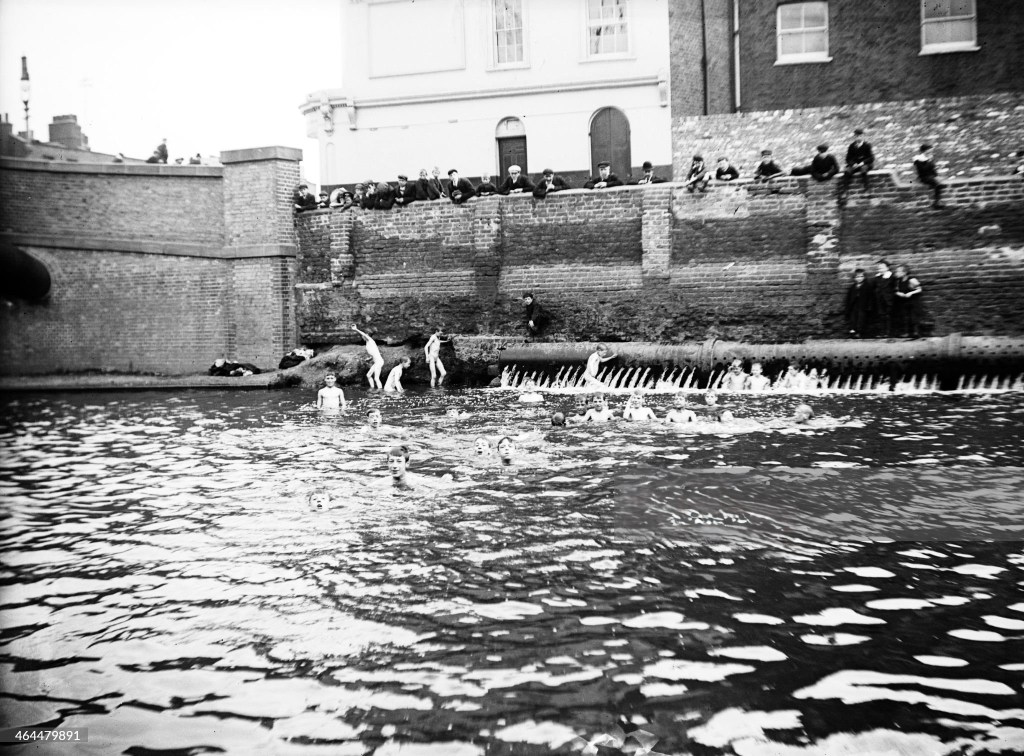
The scene is the Grand Union Canal in London in 1905 where boys are dealing with the summer heat as boys did back then. They are under the approving eye of many an envious passerby. The arresting element of this image is the long horizontal pipe running along the water’s edge. It is perforated to allow streams of water to drain into the canal. I’d like to think that is clean tap water, but somehow I doubt it. It is the sort of configuration that is used to disperse waste water into a flowing stream. Back then, no one would have minded – least of all the unsuspecting boys.
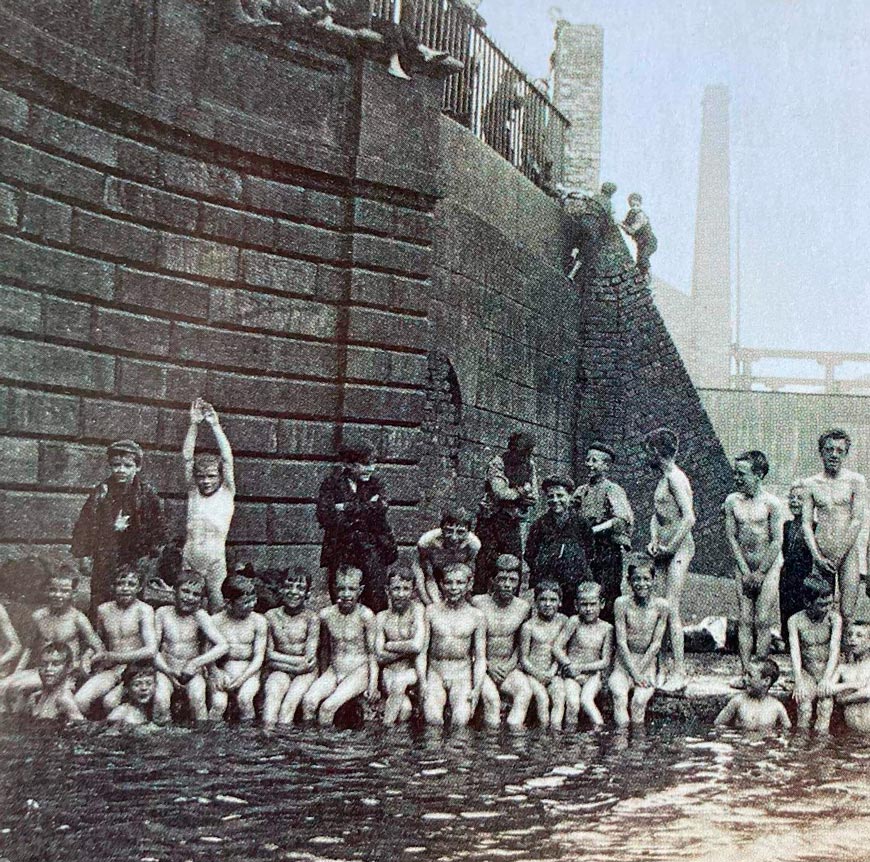
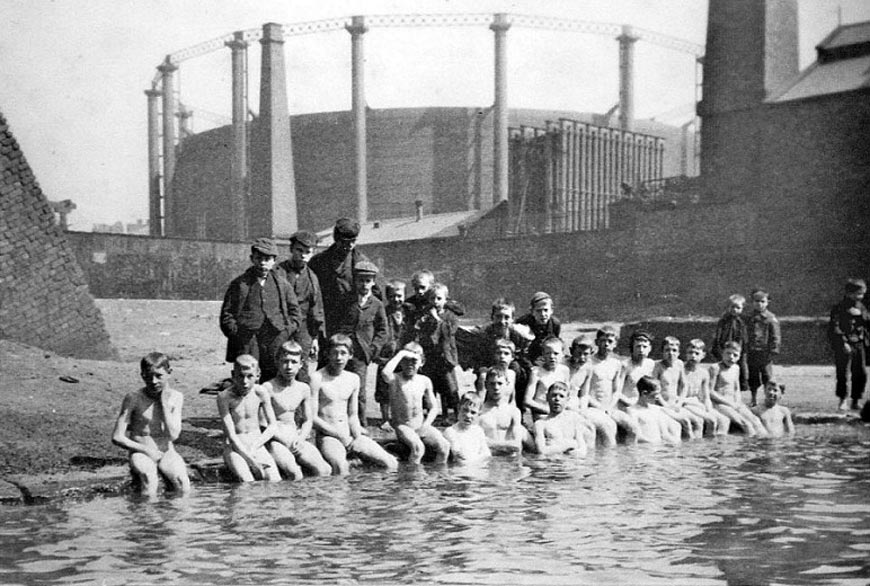
These two images from 1890 are set on the banks of the Leeds & Liverpool canal which connected those two 19th century industrial cities. The bridge referred to was located toward the Liverpool end of that manmade waterway. Apparently the canal drew a regular clientele of juvenile swimmers. It’s interesting to note that there is considerably more exhibitionism in the first photo.
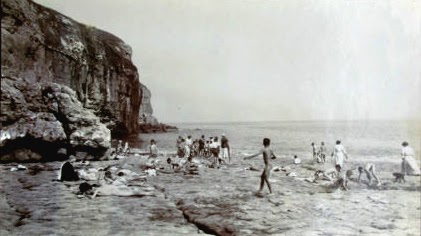
This scene is from the seacoast around Dorset, England. It is the site of an old quarry that was situated on a natural harbor. In the early 20th century, after the quarrying had ceased, some prep schools in the area blasted a hollow into the rocky ledge to form a swimming pool. That was necessary because swimming in the sea there was impossibly dangerous. This undated photo may be from that era, although there appears to be mixed-gender patronage on this day. Nevertheless, the young males seem to be availing themselves of the opportunity for nude recreation, mixed company notwithstanding.
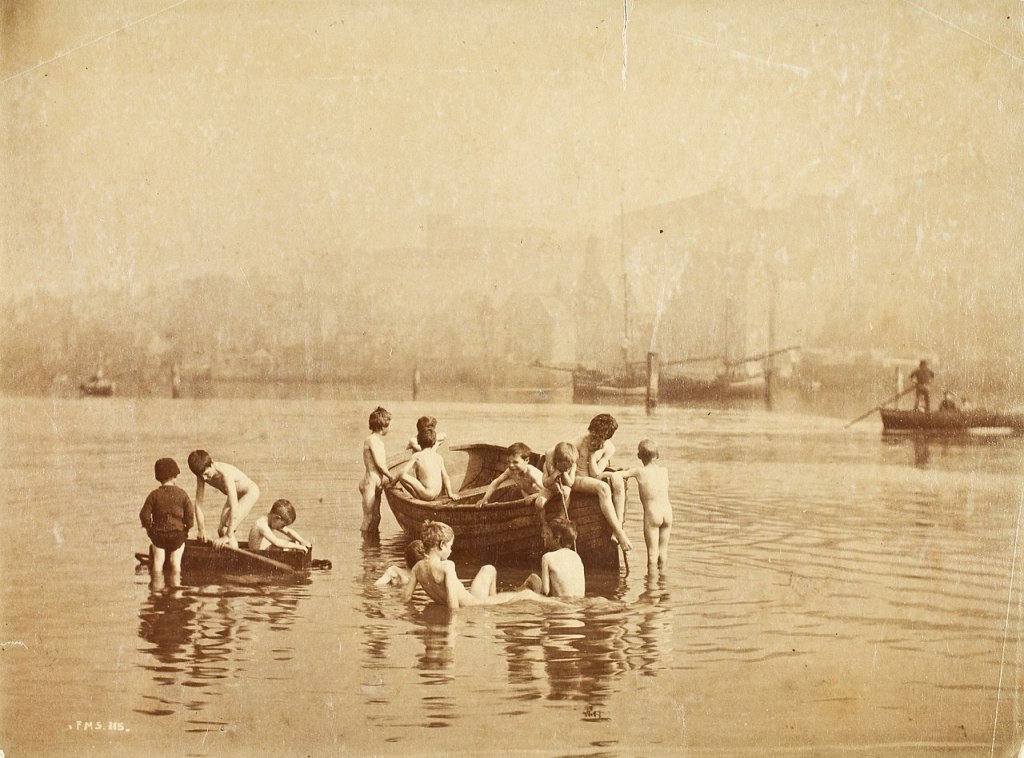
This is the title of what is apparently a fine art photo from England dated 1886. It comes from the collection of the LA County Museum of Art.
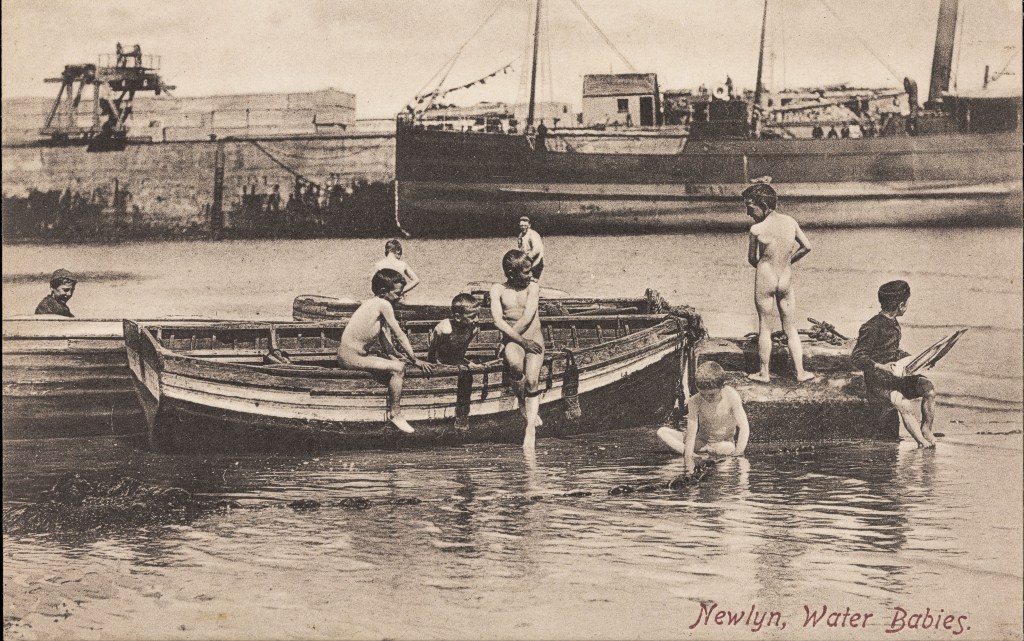
Still in the UK, we go from River Rats to Water Babies. This image is also a fine art photo. This is the sort of visual that would have mass distribution as a postcard or lithograph.
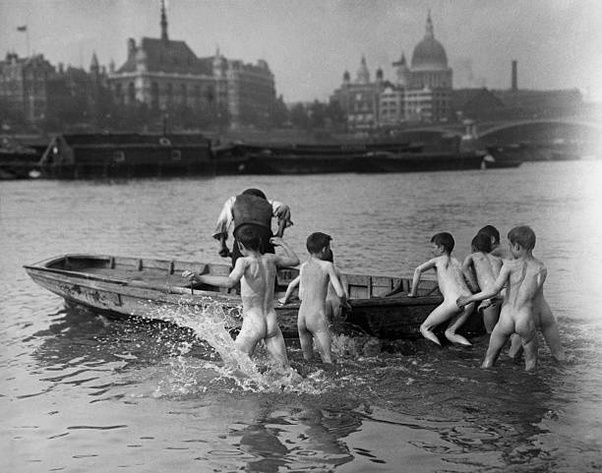
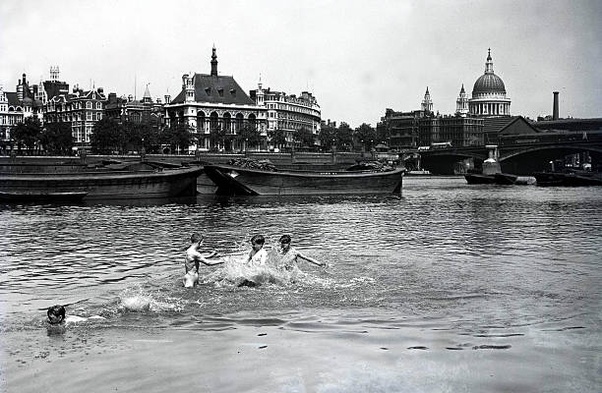
These two images document the regular use of this fabled river that flows through the heart of London in the same spot a “couple of hundred yards from the Blackfriars Bridge” over multiple decades. Apparently, it was a very public location in which the boys would be visible to passersby.
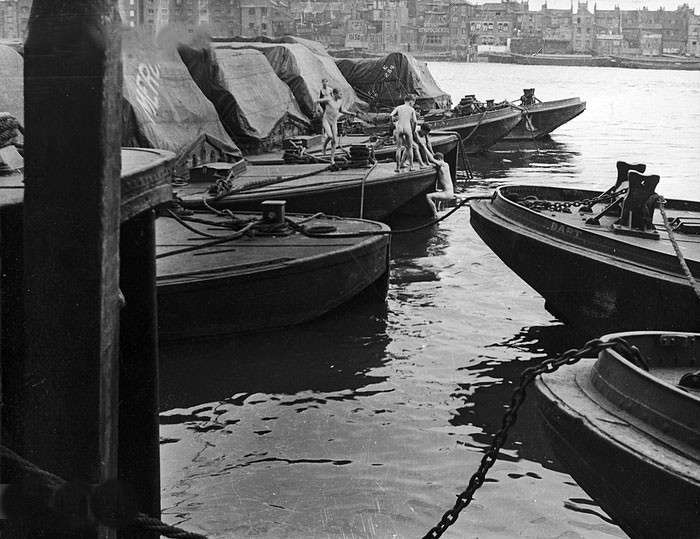
Here is a grittier view of skinny-dipping in the River Thames. The scene is in the waterfront neighborhood of Wapping in the 1930s. The boys swimming among the anchored freight barges may have gotten to a sticky situation. One lad is being assisted from the water by the vigorous exertions of two of his companions while another looks on tensely. A fourth boy is coming on the run, possibly to lend a hand as well. How serious a situation this may have been is not known, but it underscores the hazards of swimming in these industrial settings.
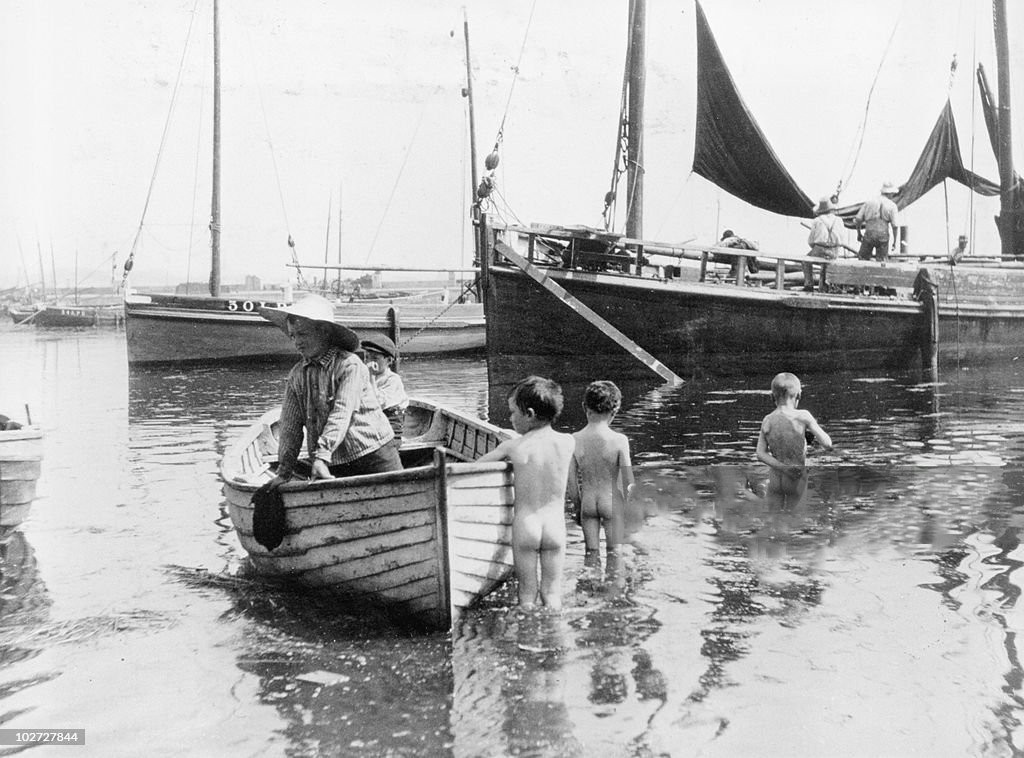
The caption is the title of this fine art photo. The date is given as “1900s.”
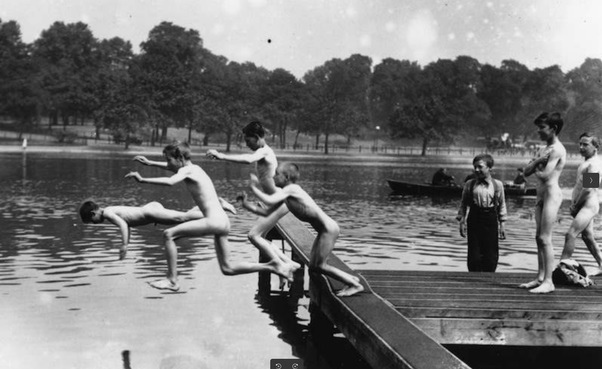
This scene from the late 1920s records the regular use of this lake/pond in this famous London park for nude swimming during this era. The park underwent some renovations a few years after this photo was taken. After that, nude swimming was more restricted.
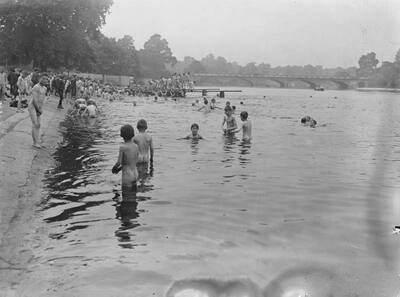
This image records the nude swimming activity in this same Hyde Park location probably around the turn of the 20th century. You will note the throng of nude swimmers. This was because nude swimming was not permitted all day. Apparently, users had to get their skinny dipping in between 4 and 8 AM. Another London park – Victoria – was put to similar use on the same restricted basis. There are photos showing that it was similarly mobbed by the male bathing public. Seemingly, Victorians would tolerate public nudity as long as it was off-hours.
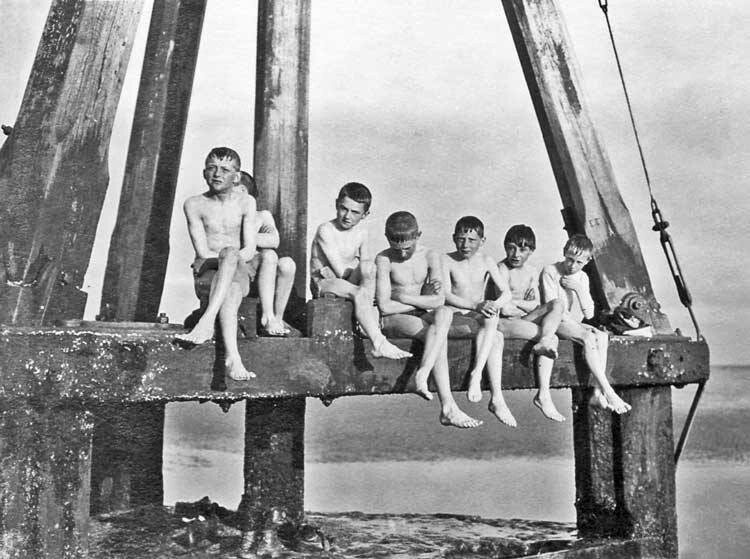
Moving to another UK location, the River Mersey runs through central England from Manchester to Liverpool – two old manufacturing towns that figured in Britain’s industrial heyday. This photo is likely from that era – the early 1900s.
The striking thing about this image is that these demurely posed naked lads are apparently perched on a timber and iron structure some distance above the river, based on the view of the water and the shore below them. Moreover, they apparently disrobed once they got up there, since their shoes are piled on the level below them. After all that, they don’t seem to be very engaged with the camera or the setting.
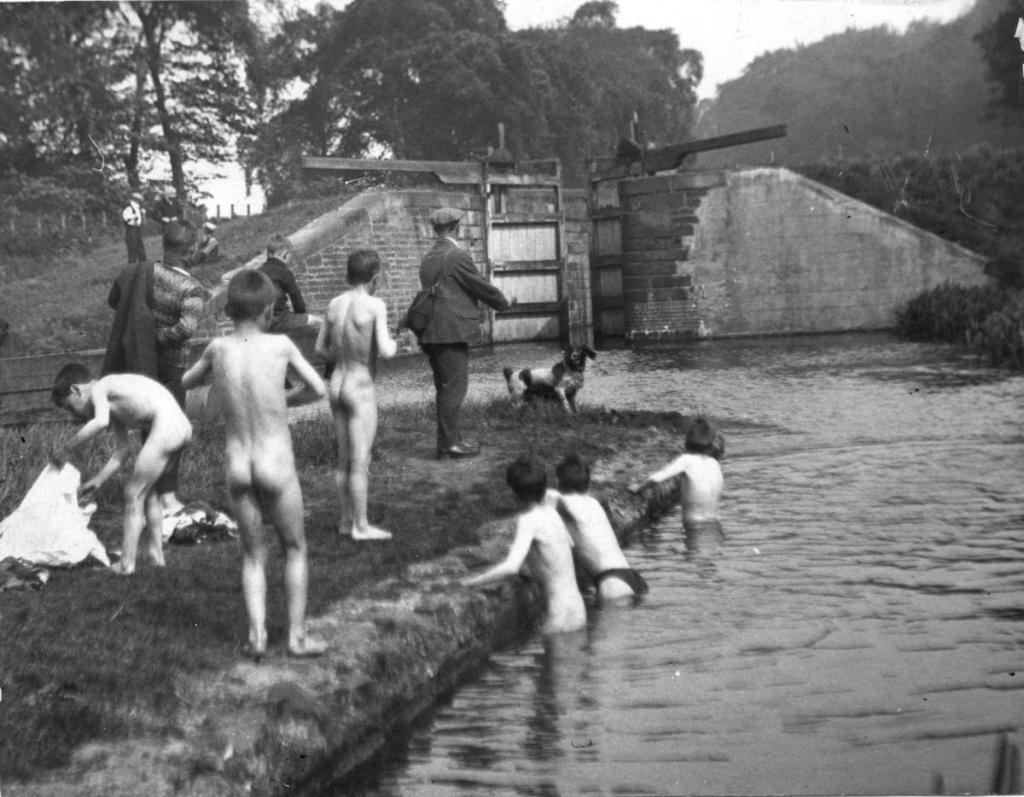
This dramatic scene occurred around 1930 in Falkirk, Scotland. It appears that an adult-supervised nude swimming outing is being disrupted by some unexpected development. Some boys seem on the point of dressing while others are hesitating before climbing out of the water. All heads are turned toward the canal lock in apparent expectation. Even the dog seems to be picking up on the tension.
My best guess is that they have received some notification that the lock is about to be cycled in response to the approach of a canal boat. That might be expected to release a torrent of water downstream where the boys are swimming. Best get out of the way.
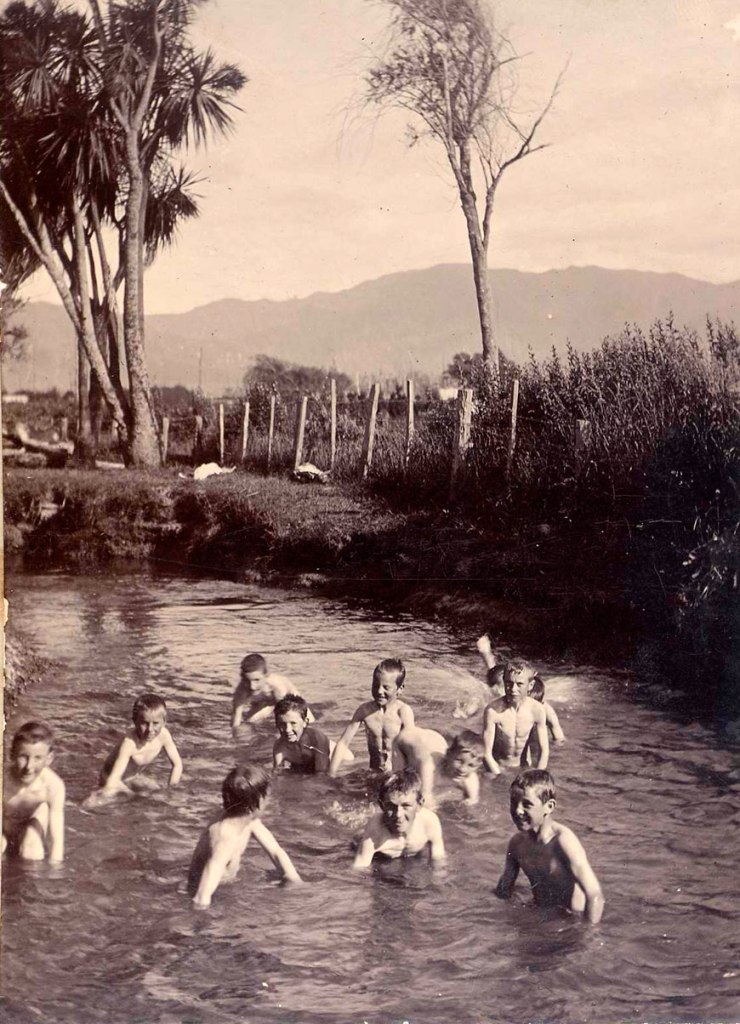
These boys are frolicking in a rural settling in western Ireland in 1901. This image is included in the UK section because at that time Ireland was indeed part of the English realm. It took a few decades of political unrest to get that problem sorted out, but nude swimming was never one of the points of contention.
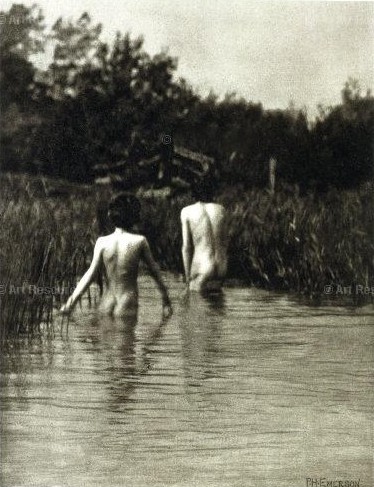
Before we move on from this “sceptered island,” we have to acknowledge this oldie from the Victoria and Albert Museum. This 1887 fine art image depicts two older nude boys wading among the reeds – apparently in motion with no sign of “smearing.” Photographic technology was making progress.
Mediterranean
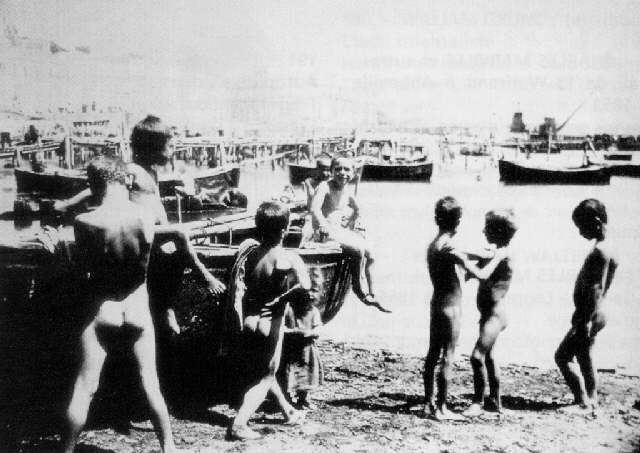
The description on this says “boys in Naples 1870” (in French). Looks like there is a fully dressed little girl in the midst of the group. Is one of the boys supposed to babysitting his sister?
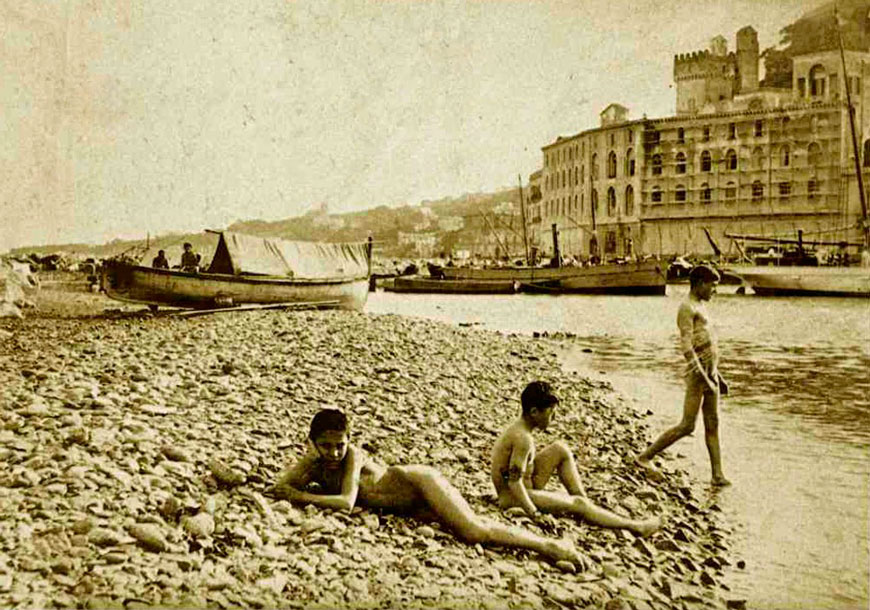
We’re back in Naples a couple of decades later in the waterfront district of Mergellina where some boys are lazing away a summer afternoon after a swim – nude, of course. The crenellated tower in the background might be Castel dell’Ovo, a scenic point in the neighborhood. As you can see, the quality of the photography has improved since the 1870s.

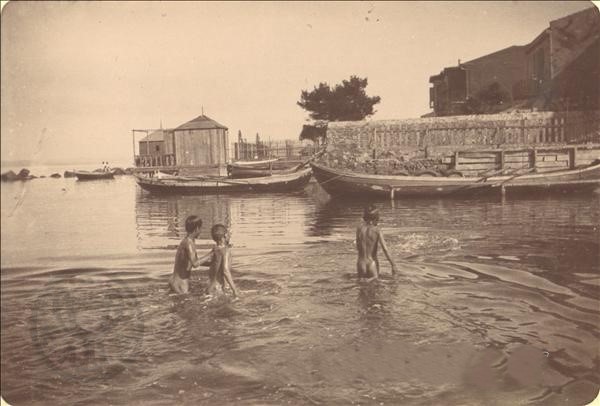
These two images are supposed to be set in Turkey but the documentation was in Greek. Except for the title shown, the only other information was that the date was “in the decade of 1900.” These very clear images were likely the work of professional photographer.
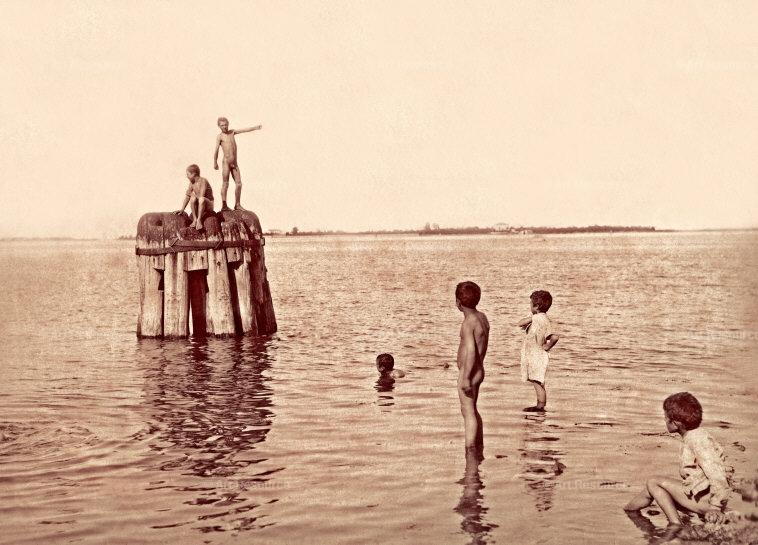
Once again, we have a very fine image with practically no attribution data. Of course, the center of attention is the heroic pose of the boy standing on the pylon unconcernedly displaying that which makes him a boy. Comparing it with other images, the date must be no later than the first decade of the 20th century.
Australia
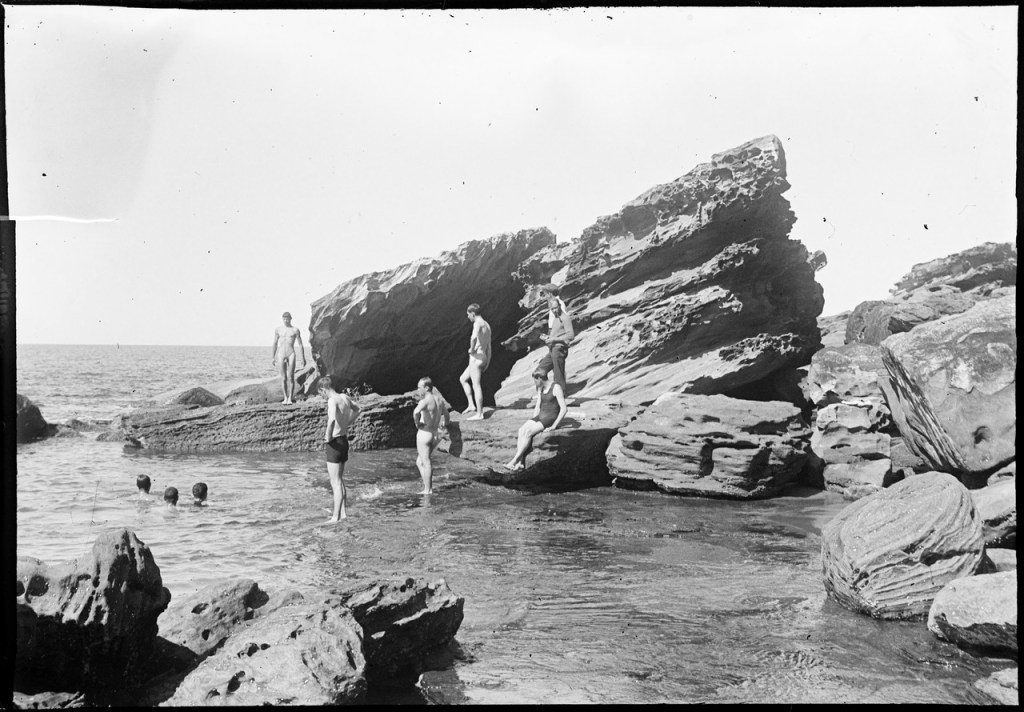
This image comes to us from the Library of New South Wales (Australia). It is from the McPherson Family collection and captures a scene from the early 20th century. The figures are young adult males (although the three heads in the water may belong to boys) enjoying aquatic recreation in a coastal area. The variety of bathing attire is the story here. There is a fully dressed man, a guy in a tank suit, one in trunks and three nude. The one nude figure favors us with a full frontal.
It must be pointed out that there is some sort of patch on the upper left-hand corner which may be a repair or may be hiding something (like imbedded text?). Also it should be noted that this image contains metadata. It is not the sort of data that indicates alteration. It may be associated with the scanning software that translated this hard copy image to digital format.
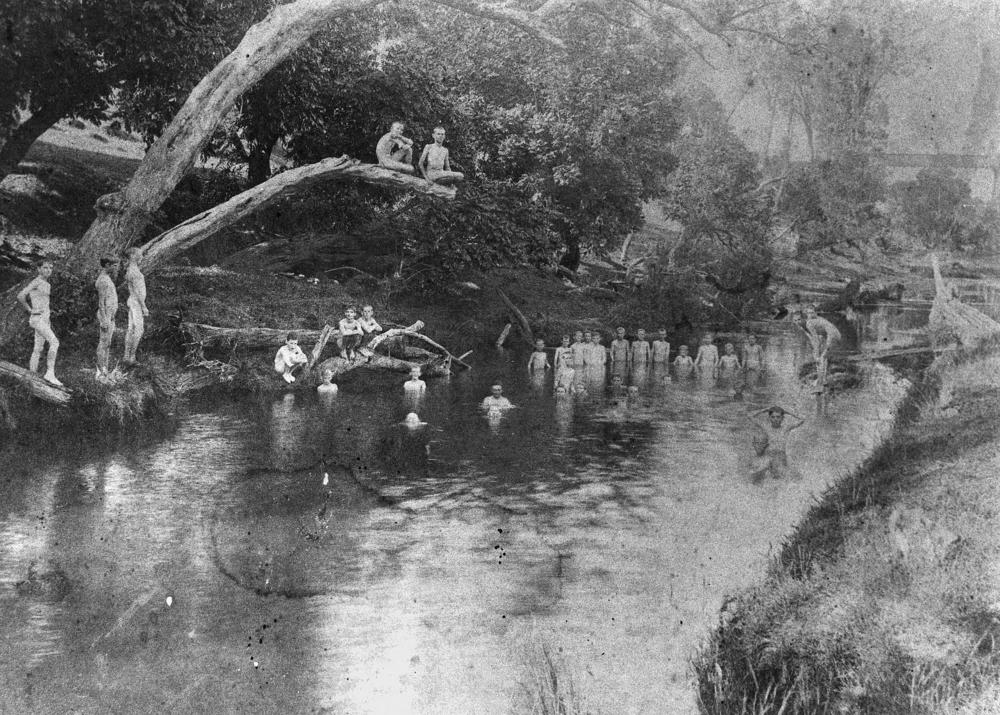
Sometime in the period 1890-1900, a large group of boys gathered for some aquatic recreation in Gatton, Queensland, Australia. Although the meager documentation doesn’t say so, this must have been an organized event. But no one had to organize any bathing suits, thankfully.
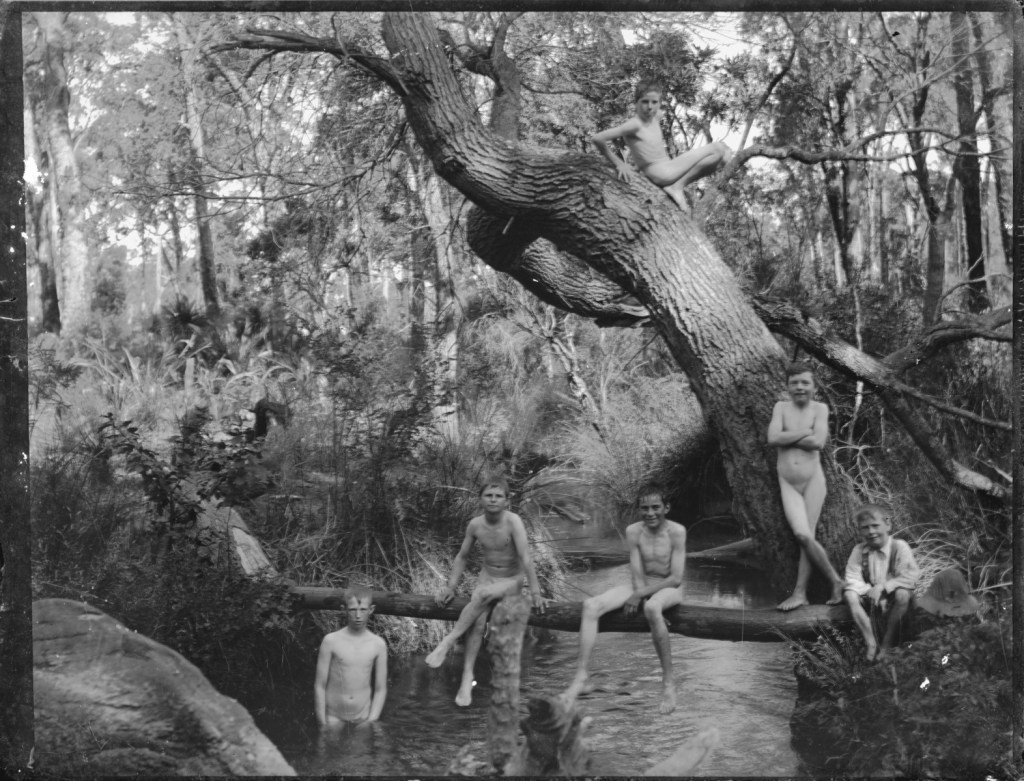
In this image from 1905, each of the boys has adopted a different method to comply with the photographer’s request to “hide the goods.”
The boy in the tree does the classic side turn to show only a buttock. The guy on the lower left does the old cup-the-balls routine. The guy to his right simply crosses his legs. The next one does the old reliable hunch with the crossed arms. But the prize goes to the boy who assumes the “I’m a girl” between-the-thighs tuck. No points to the dressed boy.
The location of this scene was Riverton, South Australia. The photo is archived by the State Library of South Australia.
On a lovely day in 1913, five boys were cavorting in the River Torrens which flows through South Australia near Adelaide. At the photographer’s behest, they unabashedly posed in all their glory. Nice look, guys.
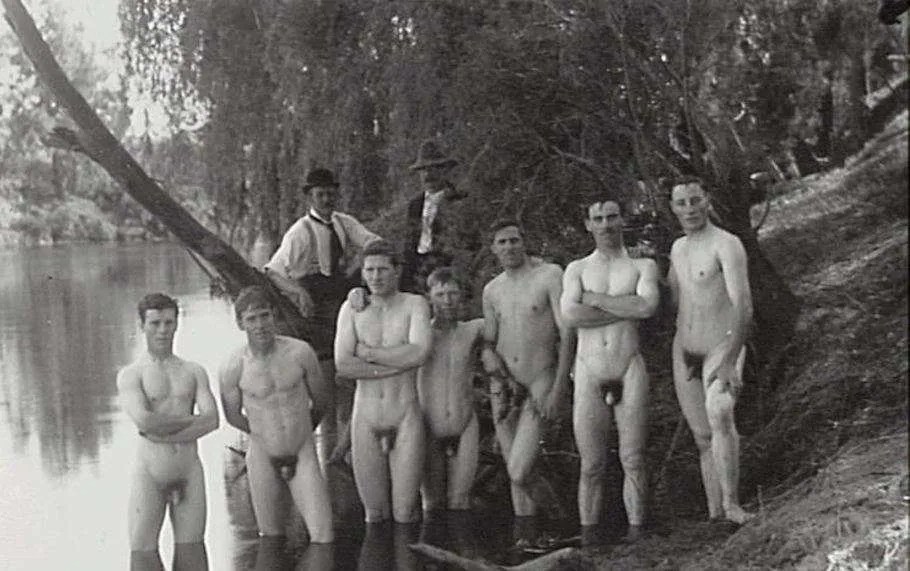
No penis peek-a-boo here (although the guy with the sprig is teasing). These proudly naked and very fit guys are standing in the Hawkesbury River which flows past Sydney in New South Wales. The time is between 1890 and 1900.
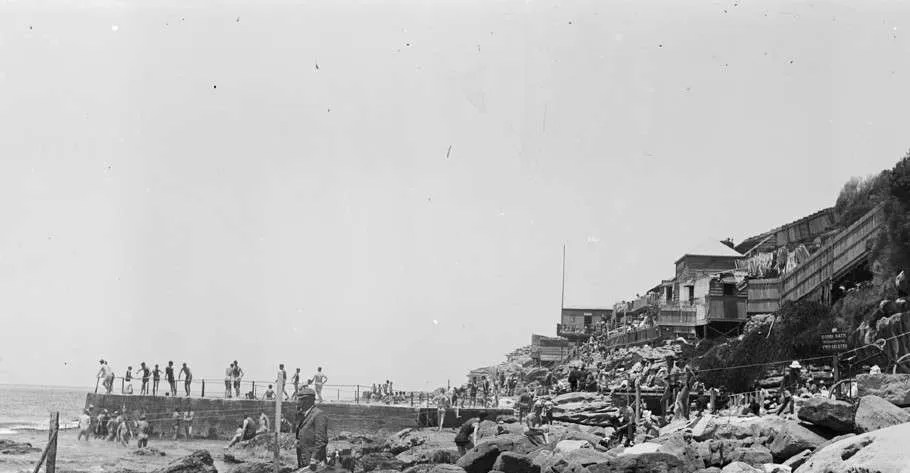
These baths comprise two ocean swimming pools in which the ocean waves are allowed to crash over the seawall and into the lead pool. They are located on the south end of Bondi Beach in New South Wales. The baths were built in 1887 and were replaced by a more modern version in 1931. This image is thought to date from around 1900 when the facility was clothing optional. If you look closely, you will see that many patrons opted out of swim wear. This image is held by the Victoria State Library.
American West
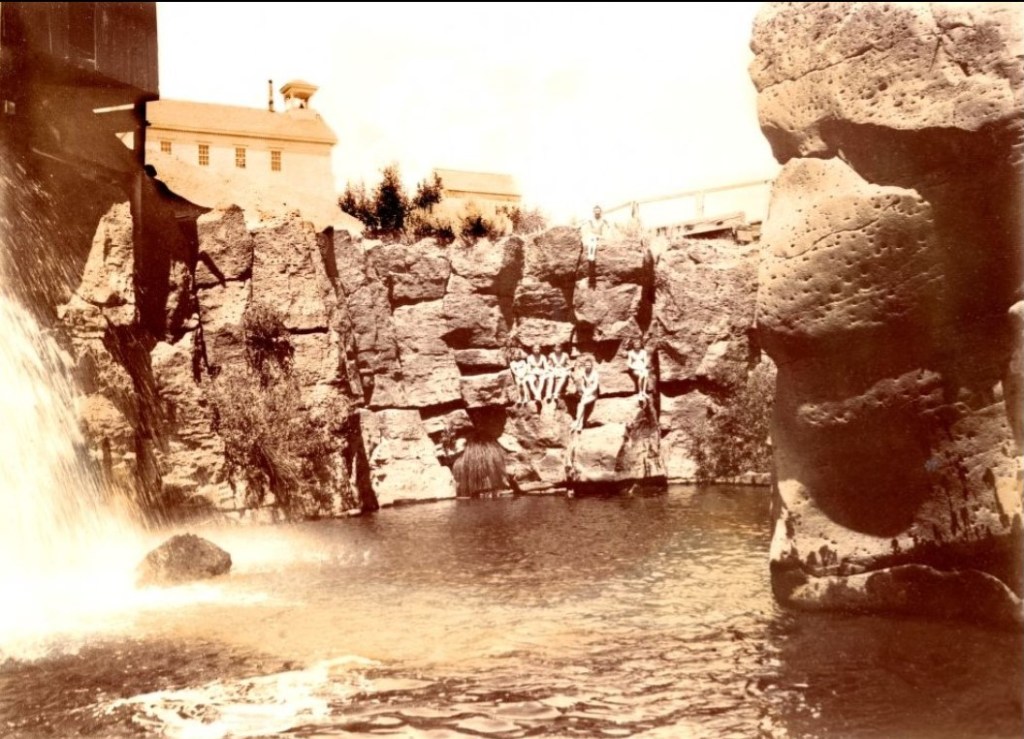
This picture of naked boys interrupted during their swim by an enterprising cameraman, came with almost too much information. The scene takes place in the above-named town that is the county seat of Lassen County located in the rural northeast of California. The town is located on the – wait for it – Susan River. The description is at pains to mention the planing mill and the old schoolhouse visible at the top of the frame. This image is held by the Special Collections Department of the Meriam Library of the California State University, Chico. Any questions?
Hope the boys got back to their swim without too much delay
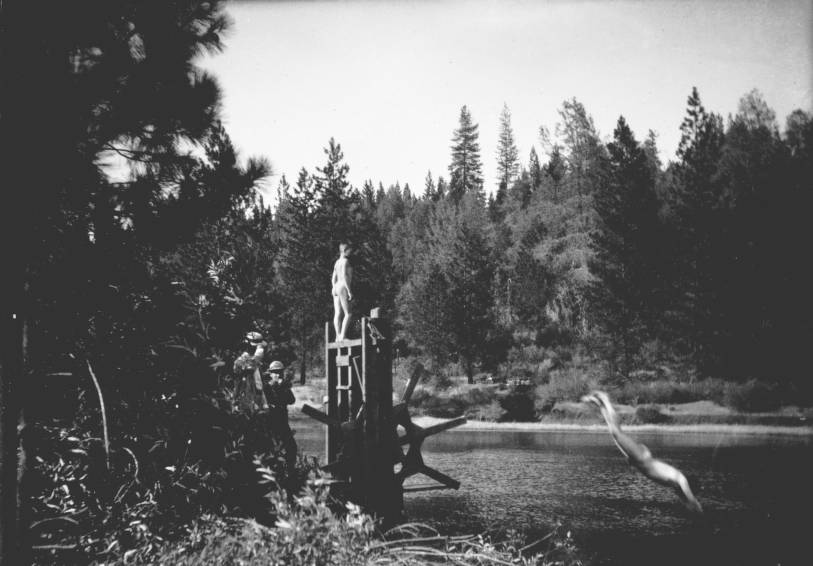
This exquisite image shows two nude males utilizing the sluice gate structure as a diving platform. The scene is from Trinity County in northwest California and the image resides in the California State University at Chico archives.
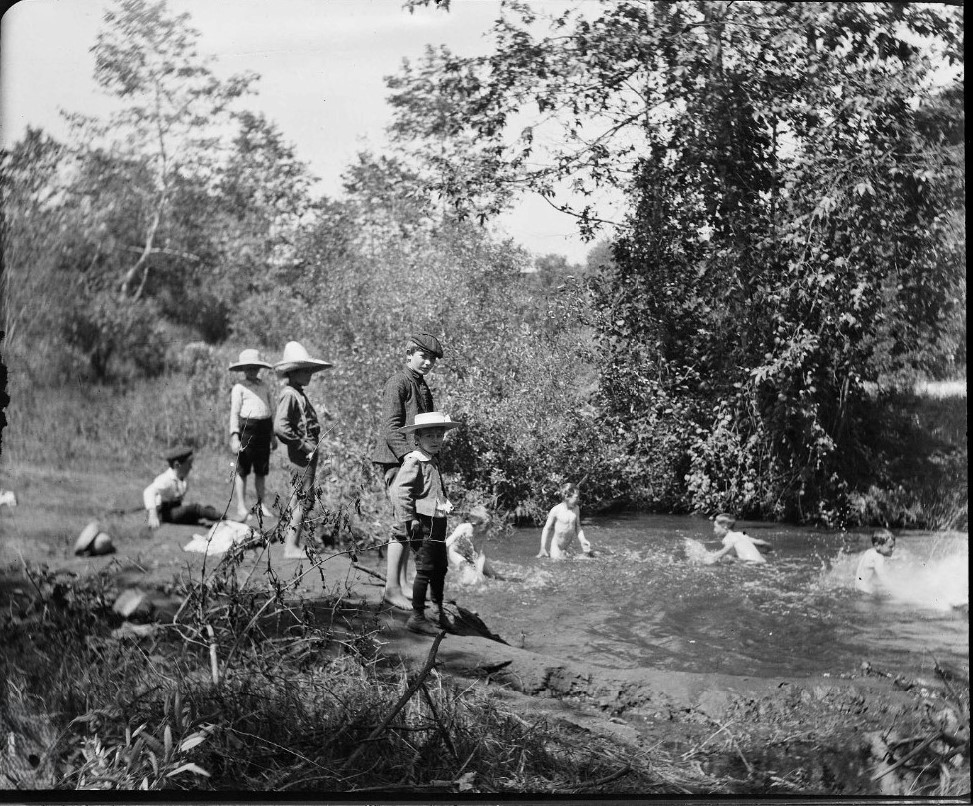
For me, the main point of interest in this photo is not the naked boys frolicking in the water, but rather the eclectic array of hats worn by the bystanders. Everyone has one and no two are alike.
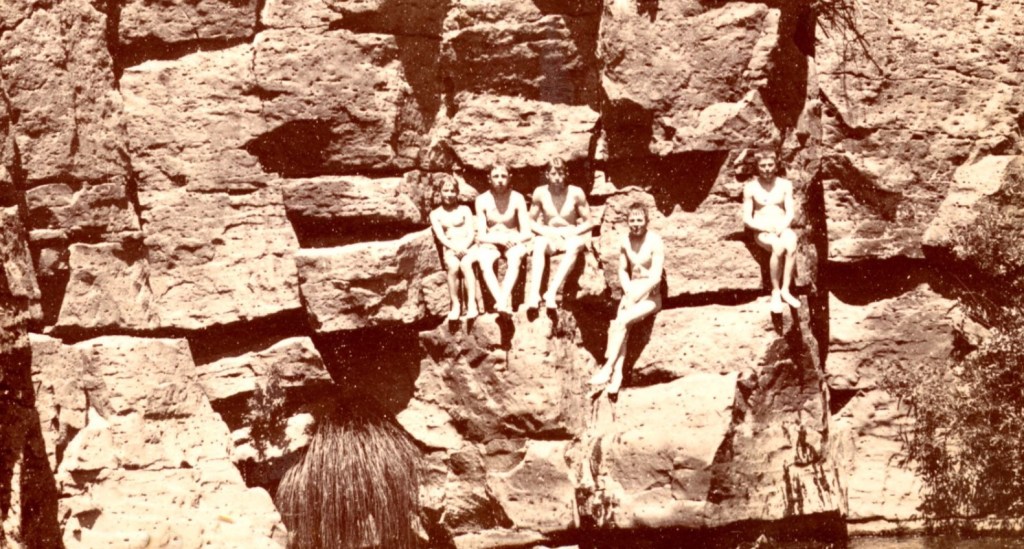
As to provenance, there isn’t much. The only clue is the source of the image: the Huntington Museum and Library, located in San Marino, California. It is a serious research facility with art and documents from all over the world, but it makes a point of declaring itself a uniquely comprehensive source of material relating to California as well as some other western states. We can therefore make the leap that this scene is from that region. Based on the attire of the figures and the general “feel” of this image compared with others we have documented, this likely from around the turn of the 20th century.
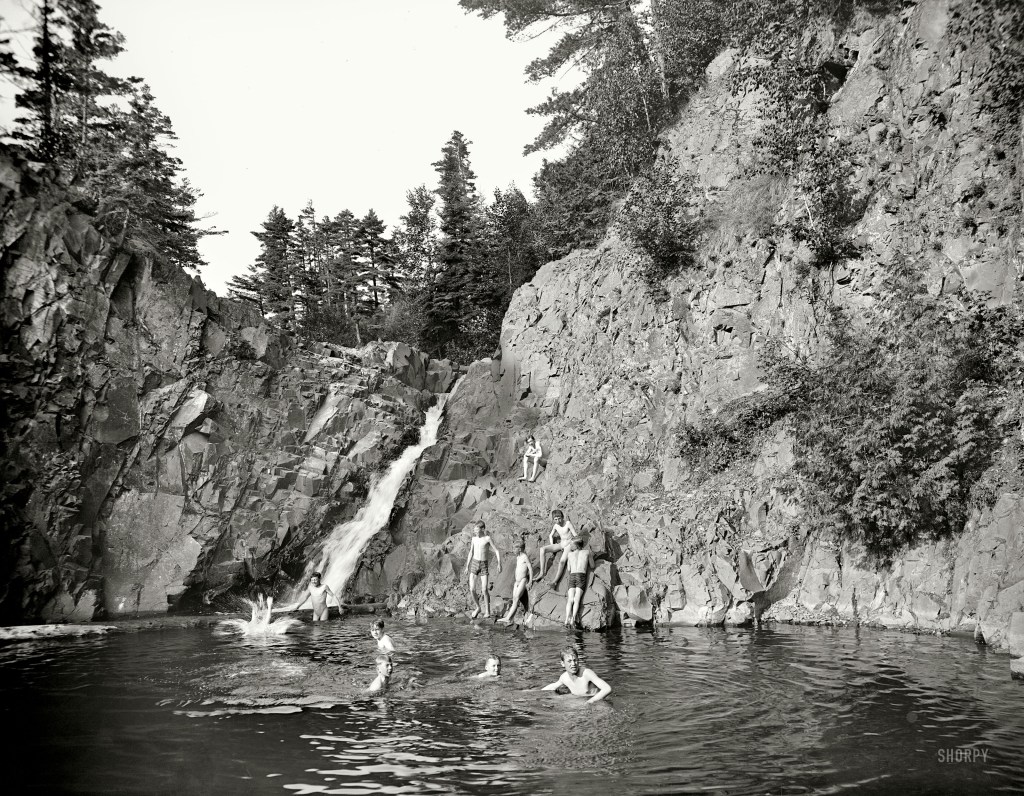
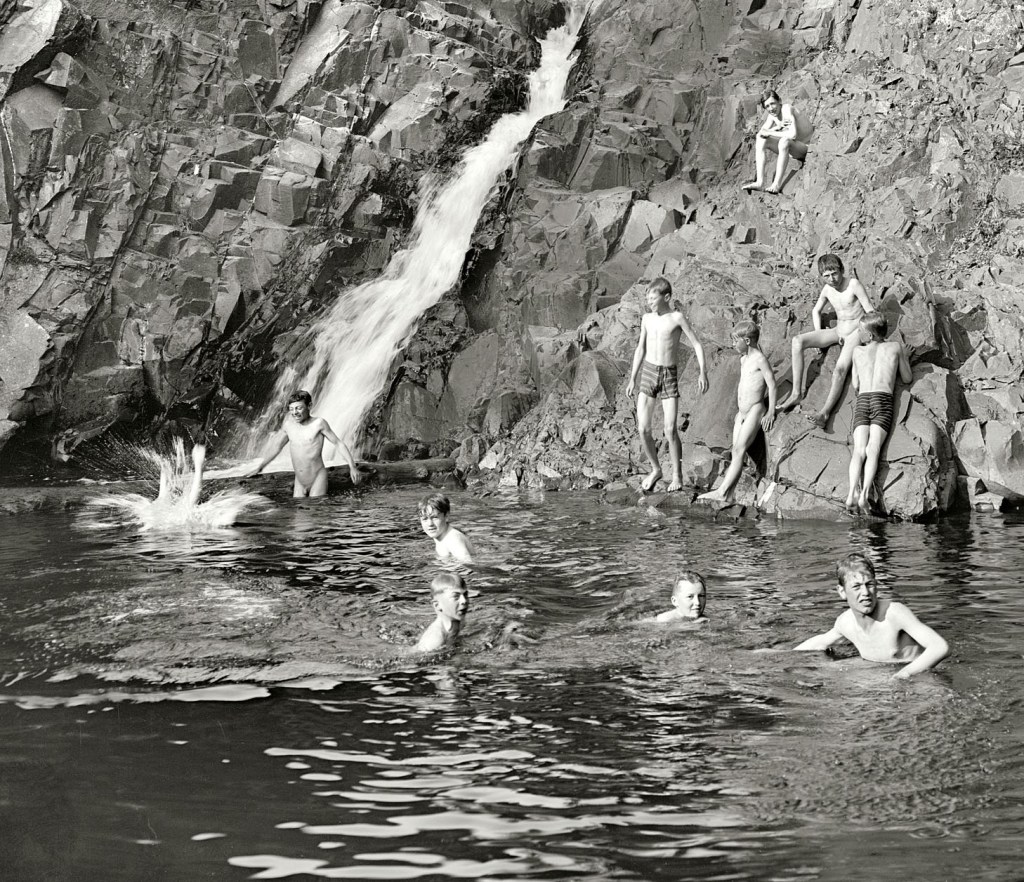
If there is a rival to the scenery in the Hawkings Reservoir photo, it’s this one. The location is near Duluth, Minnesota. The three boys unabashedly offering frontals are probably representative of all of their fellows in the water and above. Based on research, a correspondent advised me that the two “no show” boys are attired in contemporary under drawers. Those are not swim suits. Apparently, they were willing to go only so far for the camera.
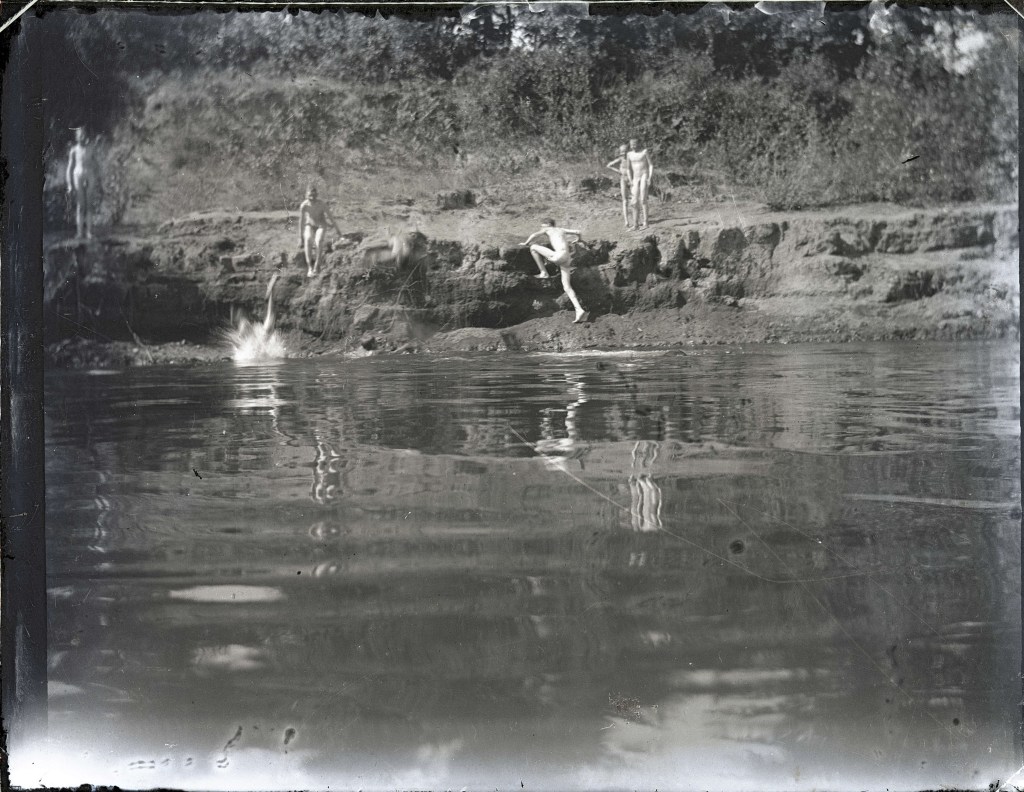
The Oregon State University libraries from which this image was obtained simply states that this is a picture of skinny dippers showing unknown men in an unknown river. The photo apparently resides in a collection that has a date range from 1890 to 1925. The only quibble I have with that information is that, try as I might, I cannot find any “men” among the adolescent boys in this frame.
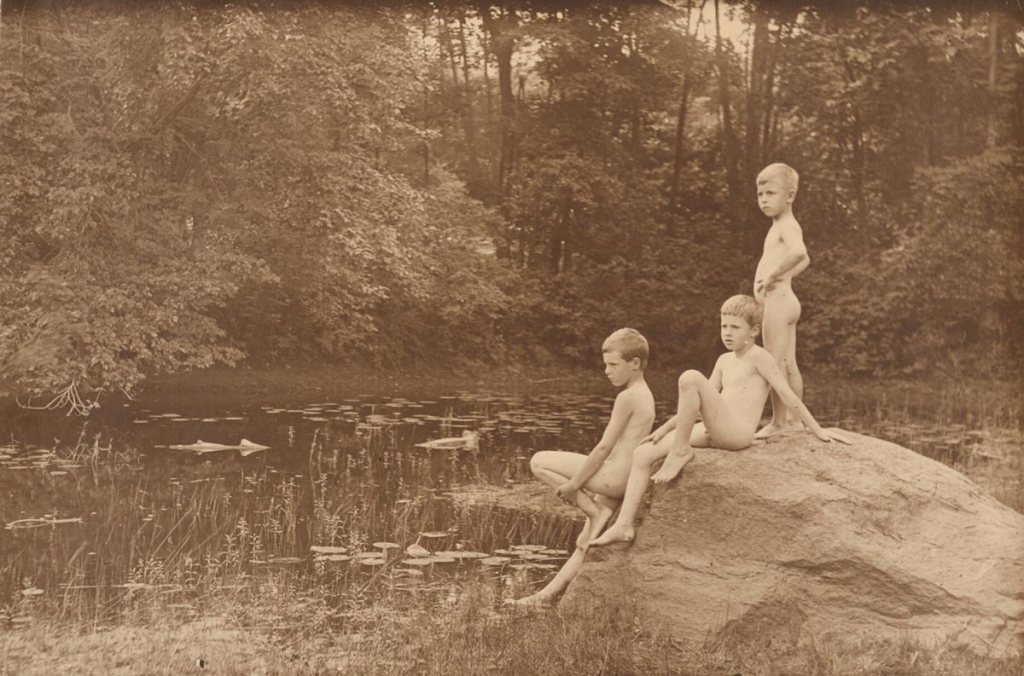
This fine art photo is held by the Getty Museum of Los Angeles. The date is 1895. It’s hard to decide which to admire more: the composition, the setting or the quality of the image. The similarity in the appearance of the boys right down to their haircuts makes me wonder whether or not they were siblings.
Elsewhere
Skinny-dipping was by no means confined to the locations treated above. Here are some “none of the aboves.”
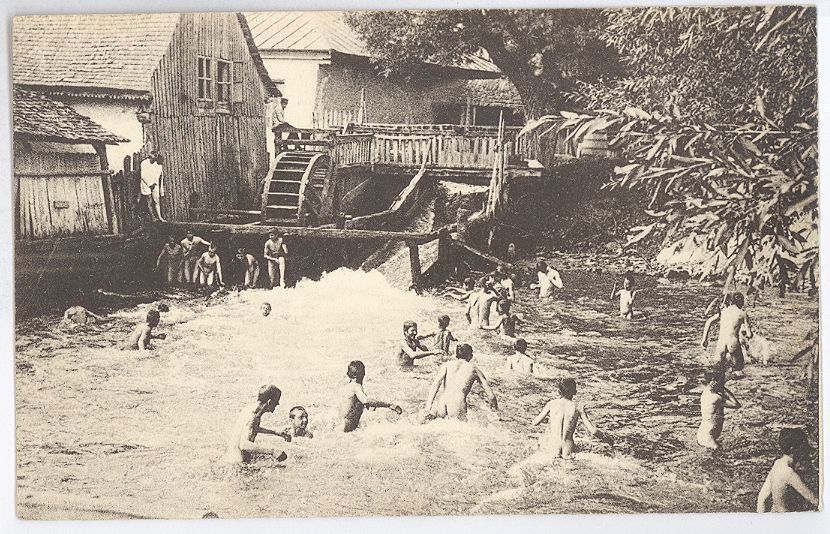
Addressing the image itself, it looks as though the flow of the mill race has been obligingly diverted from the path of the water wheel down a sluiceway where it froths the water to the delight of the boys.
The quality of the image is such that it must be the product of a professional photographer. It seems likely that the prints were intended to be used for a postcard or some other commercial purpose.
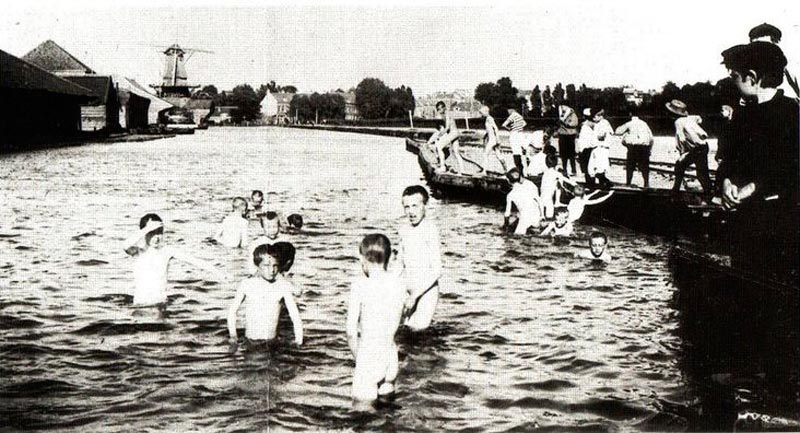
We’ve seen similar scenes in the Danish portion of Nordic Natators – waterways passing through populated areas whose banks are confined by bulkheads and whose water was full of nude boys. This body of water was known as the Schie. It no longer exists as such. It now flows through a manmade underground conduit. A thoroughfare known as the Stadhoudersweg was built over its course. At least the boys made good use of it while it existed. (Gotta love the windmill in the background – very authentic.)
Anywhere
Those skinny-dipping images with no attribution but are too good to ignore find a home here.
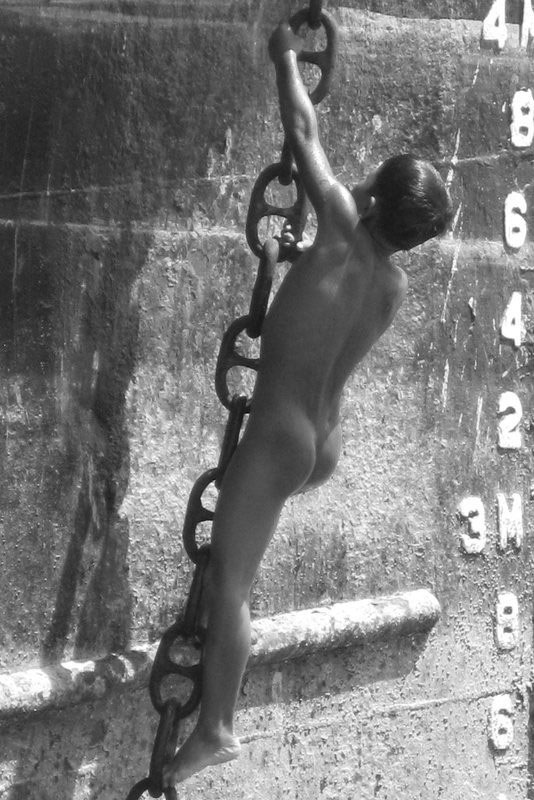
This young, nude daredevil undertook his climb at an unknown time and place. That doesn’t detract from how great a pic this is. The submergence graduations on the hull are in meters, which suggests a non-US origin, but, by definition, ocean-going vessels can be anywhere in the world. No help there.
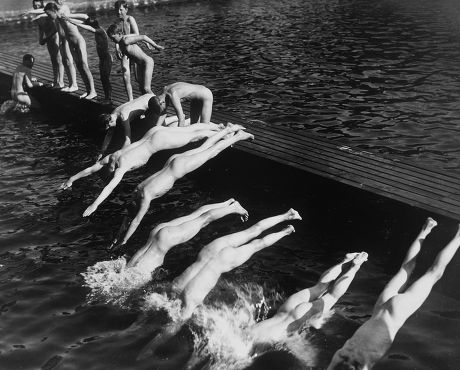
This looks like a sequential (wave) dive that came up a bit ragged on the timing. Still, the execution on the part of each of the nude divers looks pretty good. Since this image is closely focused on the action, it’s not possible to ascertain the nature of the venue. It is certainly a natural body of water with a narrow pier that extends far out into the stream/lake. I’ve seen this sort of pier in another photo, but I’m not clear on functionality of it and it offers no information as to time or place.
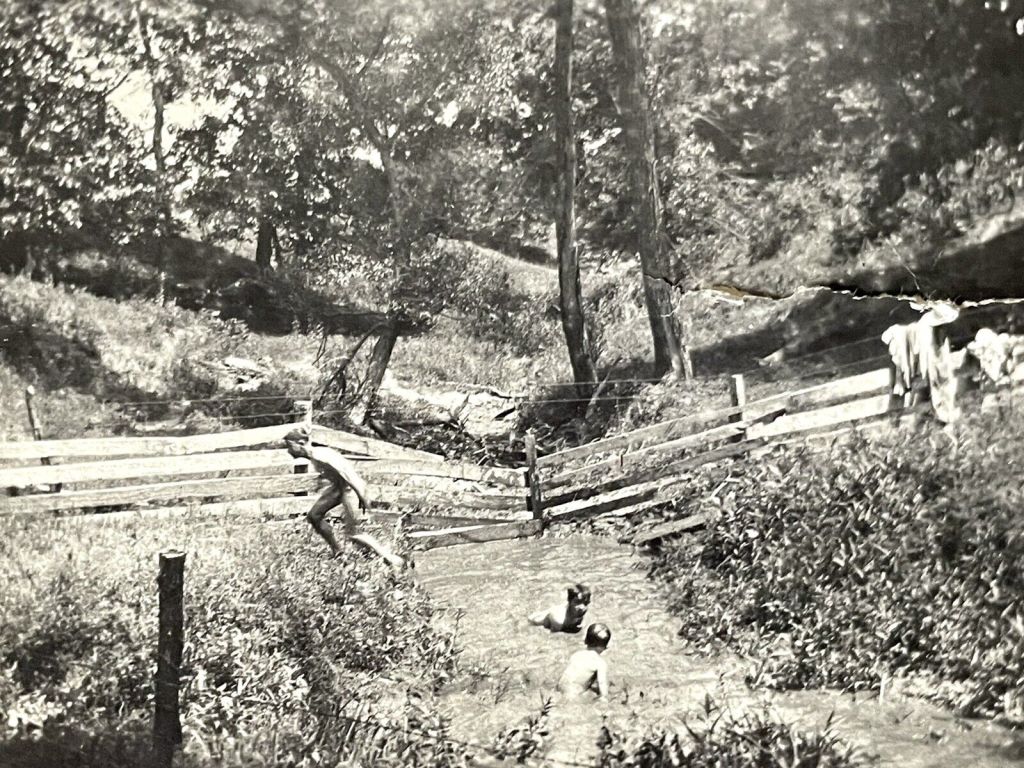
This rural scene came with no information except a suggestion that it might be from the 1920s. It is a captured moment when one of the swimmers abandons the stream on a note of some urgency. In spite of the activity, I really think the background/setting is what makes this an attractive image.
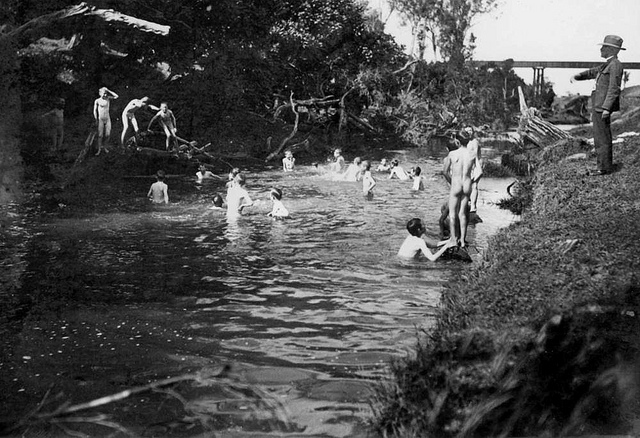
The dressed adult male in this frame is the point of interest, notwithstanding the presence of this large group of naked boys. To assemble a large number of boys like this suggests an organized event of which our suited friend is in charge. What direction he might have been issuing at the moment of this photo will remain unknown (as will the date and location). However, close inspection shows a slash of white at his neck above a darker collar. Was this guy a clergyman overseeing a church outing for boys?
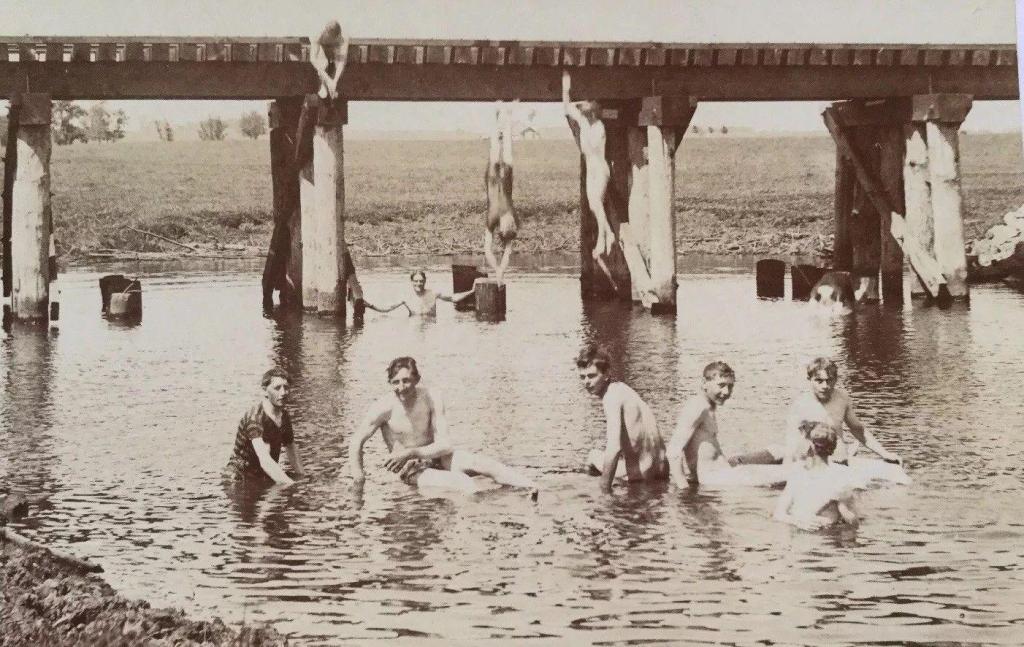
On a sunny day in 1910 this group of older boys paused in their aquatic pursuits under a railroad bridge in an unknown location to have their picture taken. Judging from their attitudes, they seemed only too happy to perform for the camera. Their lack of textiles did not seem to inhibit them. The photographer was similarly nonplused, since he eventually rendered this image on a postcard.
There is a lot to see in this scene. The diving boys seem to be unconcerned with plunging head first from height into water that is only chest deep. Unfortunately, the photographic technology used failed to freeze the divers in the act, resulting a series of smears. More interesting are the nude youths in the foreground who are apparently perched on some submerged structure. Judging from the fact that the standing figures in both the foreground and the background are immersed to the chest, the object has the shape of a wall. Normally one would expect it to be a low dam, but there does not seem to be any depth difference between the two sides. Another mystery from the distant past.
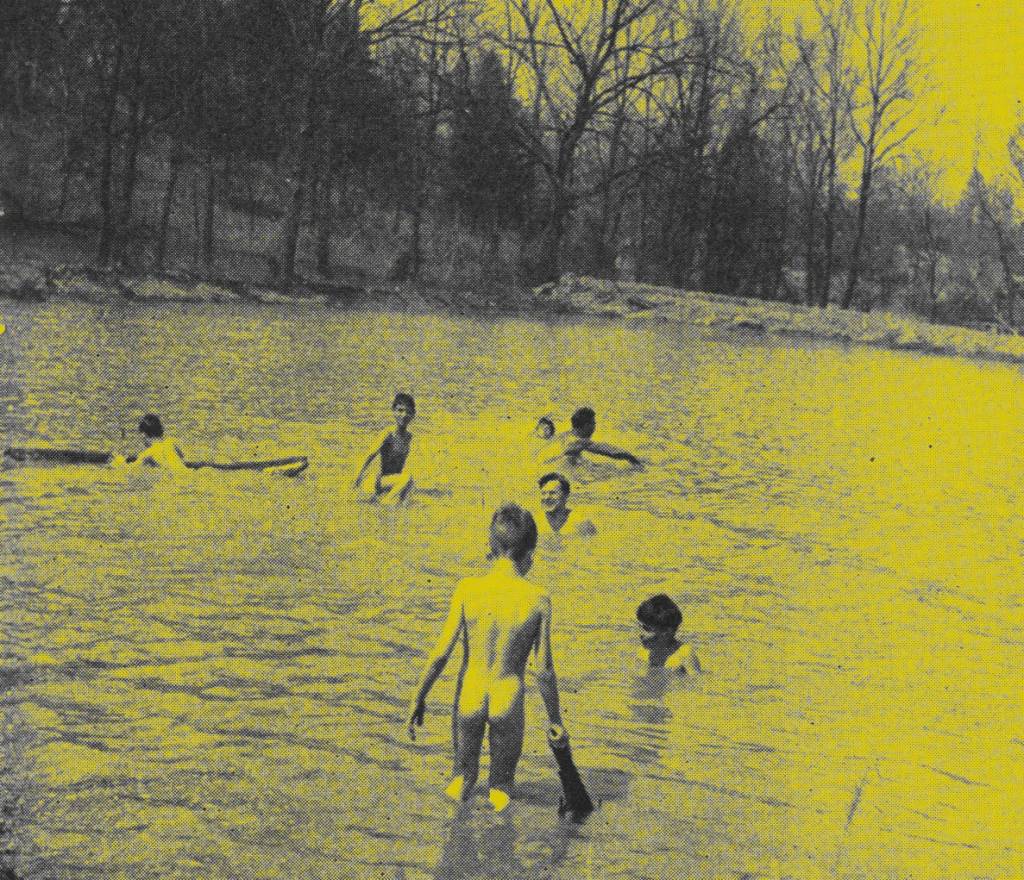
This mysterious image has some noteworthy attributes aside from the fact that nude boys are recreating with adult males who may also be sans suits. As to content, the straight line of “shore” in the background is probably an earthen/rock dam constructed to form a small lake or pond. That suggests that this is a spot designated for recreational aquatics rather than a natural swimmin’ hole. Could these guys have an audience (other than the photographer)? As to quality, the low resolution is due in part to the fact that this image was scanned from a print that appeared in a publication. It has the characteristic screen or dot matrix texture typical of those photos. Did this image appear in a local newspaper? Then there is the question of what the boy in the foreground is holding …
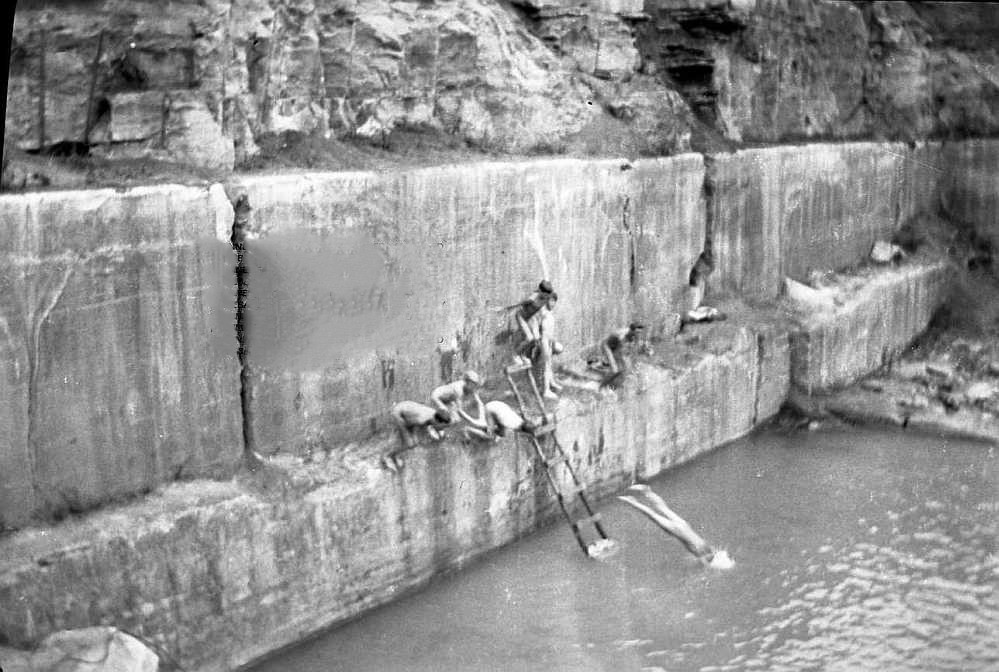
Flooded abandoned quarries were typical sites for boys to skinny-dip. Of course, the hazards posed by these types of locations were many. Hopefully, these boys had swimming lessons before undertaking this risky recreation. This image has no attribution to indicate the location or time of this scene.
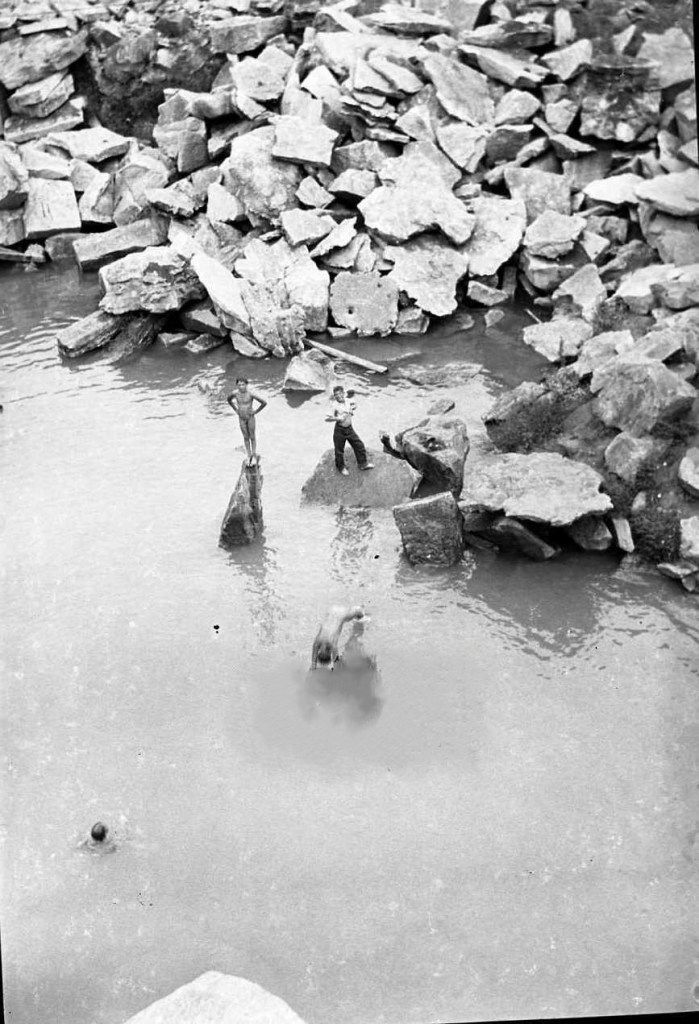
This equally undocumented quarry image seems to be a tutorial on all of the aspects of skinny-dipping: Disrobing, full-frontal posing, diving and swimming. Photography is optional.
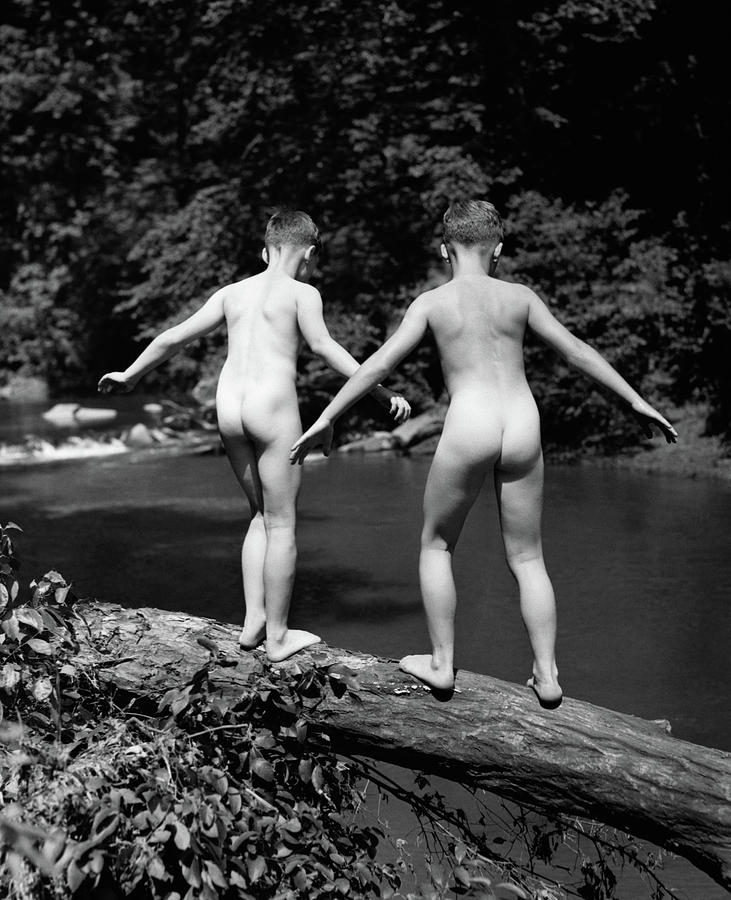
This image pops up on the internet from time to time. It is likely a posed shot for commercial publication. The only data associated with it is a date: 15 July 1938. My guess is that is the date this photo appeared in print.
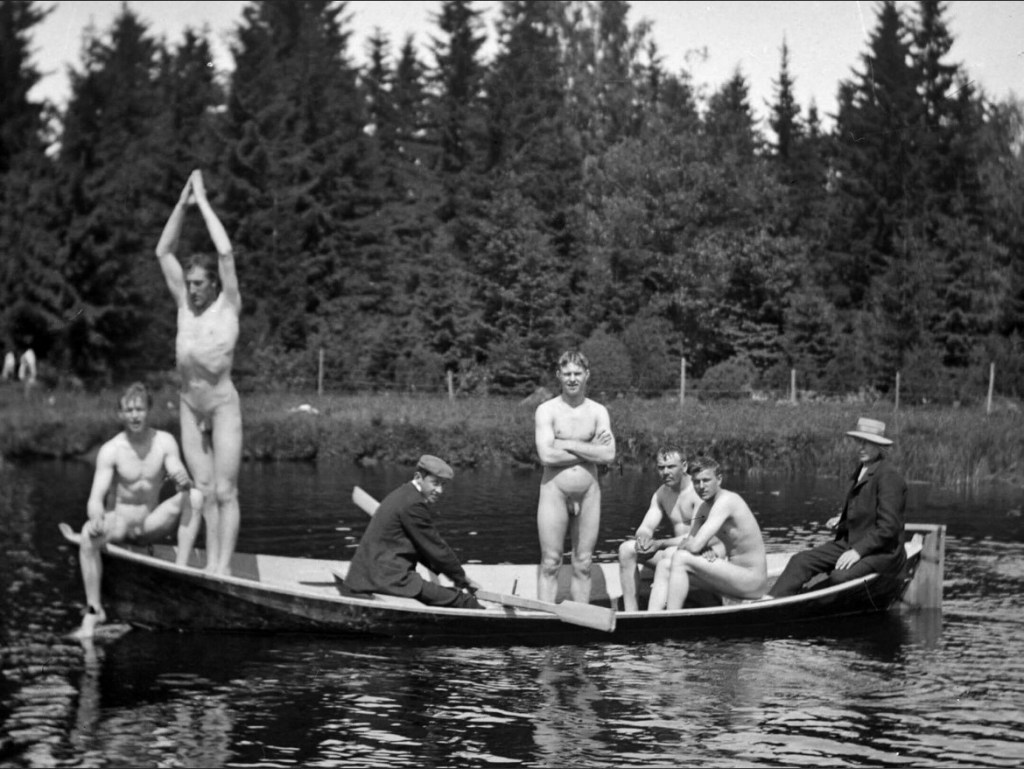
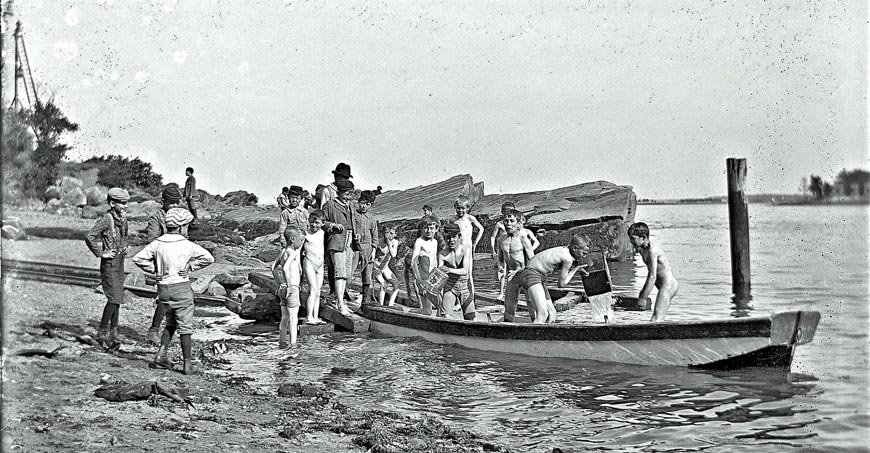
This very interesting image is unattributed. Except for the guy posturing as a diver, everyone is giving their full attention to the camera. This appears to be a staged shot, perhaps an artistic effort, given the high quality of the image.
It also appears to be very old, based on the clothing – especially of the older gentlemen at the tiller – and the down-the-middle part in the center guy’s hair. It is likely not much if any later than 1900. I would not be surprised to learn that it dates to the 1890s.
 Historical Nude Male Swimming Images