More Genuine Historical Images
Revised 4/1/26 Added two images
In The Good posting I made repeated references to additional images that were “just more of the same.” I omitted them from that posting in the interest of expediting the flow of the historical narrative. Here is the iceberg under that tip.

This is a detail of image 1 of The Good posting. It is also reversed.
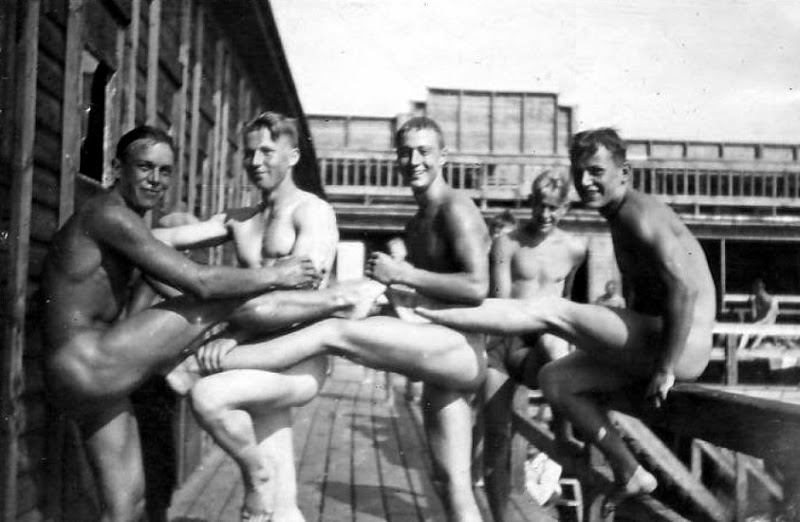
An unattributed floating bathhouse shot from that long ago era. These stalwarts are clowning for the camera, but they are not doing so with reckless abandon. Note the coy pose that conceals the family jewels from view.
New York City Bathhouses
Based on the photographic evidence, NYC adopted the floating bathhouse on a huge scale. Various source claimed the total number of such baths in the city peaked at either 22 or 30.
Since the city is essentially an archipelago of islands interlaced with various rivers, inlets and sounds, there was a lot of waterfront on which to locate this type of facility
This section pays homage to that long gone system of public recreation – and to the male nudity that was woven into its fabric.

As noted in my original post, New York bought into floating bathhouses in a big way for public entertainment/pacification. This picture shows an aspect of those facilities that wasn’t apparent previously: the kiddie pool. This cattle chute along the periphery of the well must have served to safely confine younger children. The patrons in this view seem to be all boys, some in suits and some naked. There are also some older males around the periphery of this chaos that all seem to be in suits. I might suggest that there may have been a dress code that allows boys below a certain age to be nude (or not), but above that age, suits were mandated.
TThe occupants of the window that overlooks the trough are interesting in that there seems to be a girl in what might be a bathing costume and also a fully dressed man. I wonder if the latter was supervising the play. In other words, he was the life guard. One is left to ponder his effectiveness in that role, given his sartorial state.

This is another view of that same facility. The age differentiated dress code seems affirmed by this additional image.
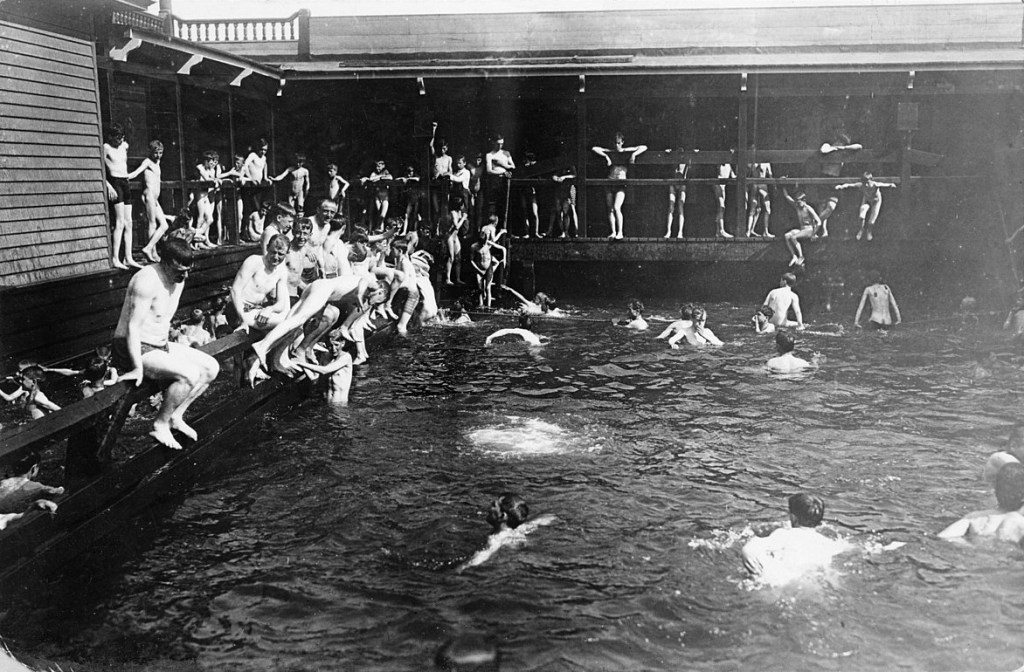
Definitely a well-documented facility. Clearly, the naked kids are having a better time.

There is a suited guy descending the steps into the well of an unnamed bathhouse. The (mostly) naked denizens, who seem to be adults, are all watching him. I wonder if he was subsequently thrown out for violating the (un) dress code.
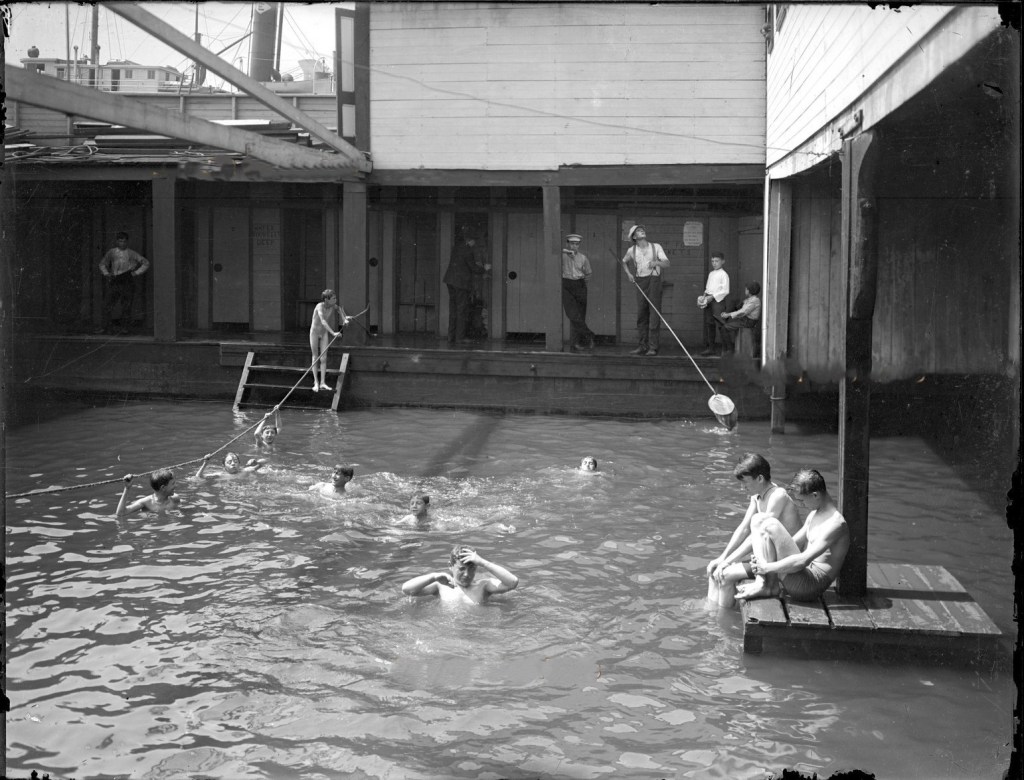
Photographer Bracklow returned to the same NYC floating bathhouse in 1910 on boys’ day. Seen from this angle, the viewer can tell that this swimming facility was very close to commercial shipping activity – a sure source of hazardous contamination. The one attendant seems to be scooping out some unwanted flotsam.
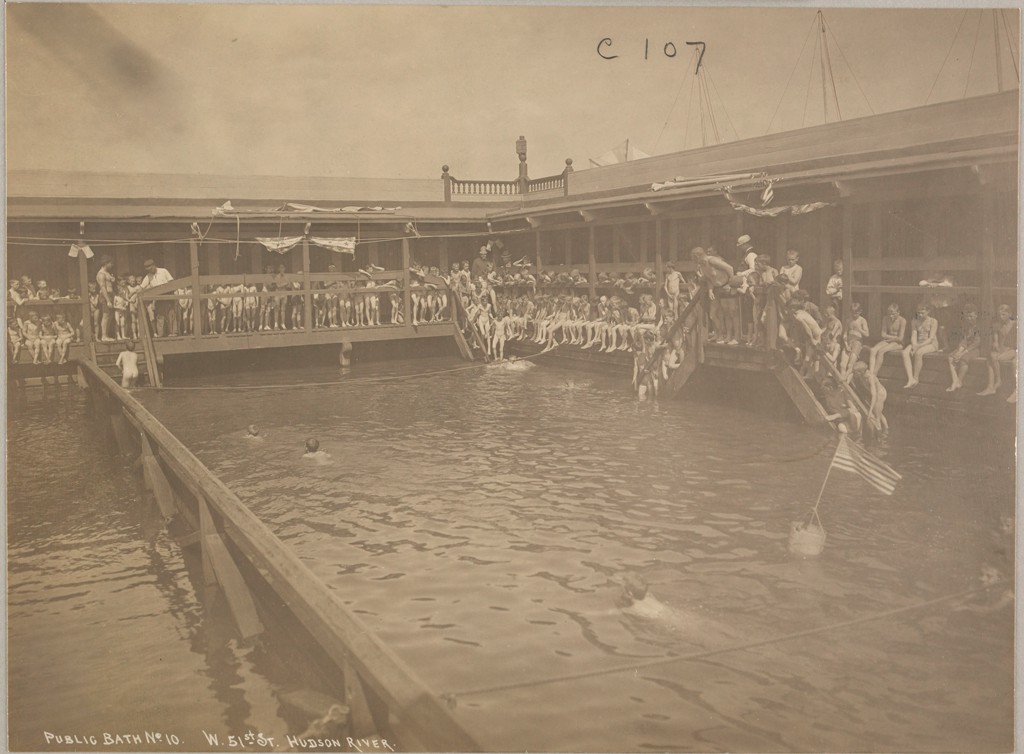
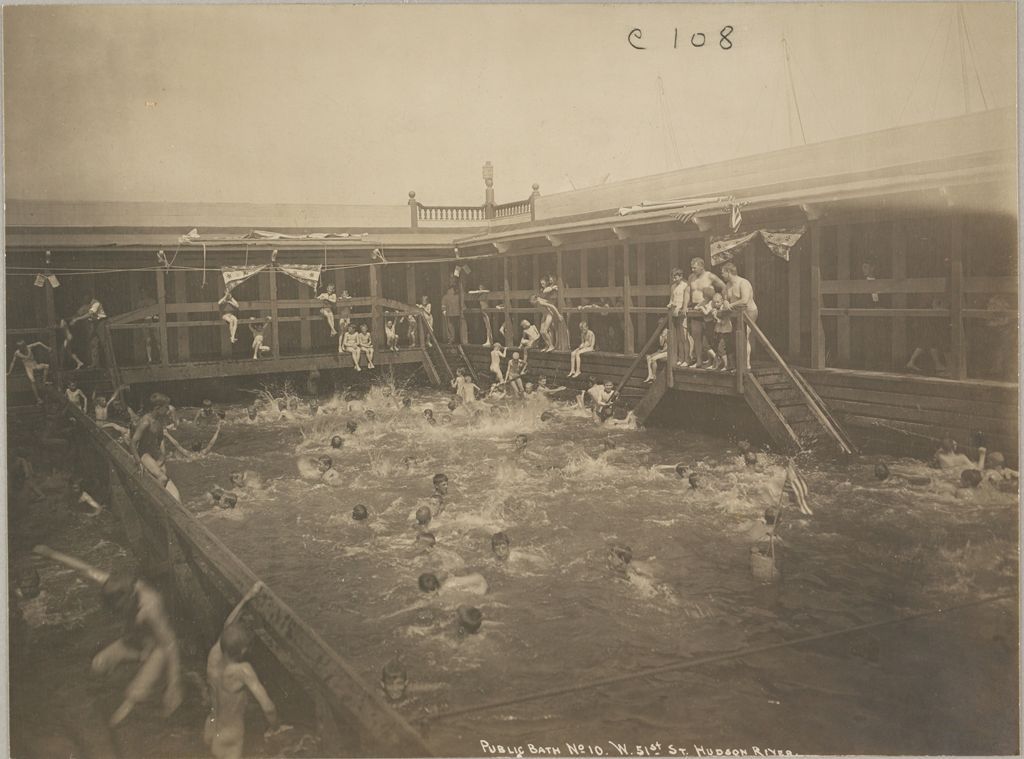
The labels indicate that these two images are of Public Baths No. 10, West 51st Street, Hudson River, NYC. Apparently, the photos were taken on the same day. The first looks like opening time with files of naked kids entering the water under the watchful eye of multiple adults, including one cop. The second shows the recreation in full swing. The date is probably around 1910.
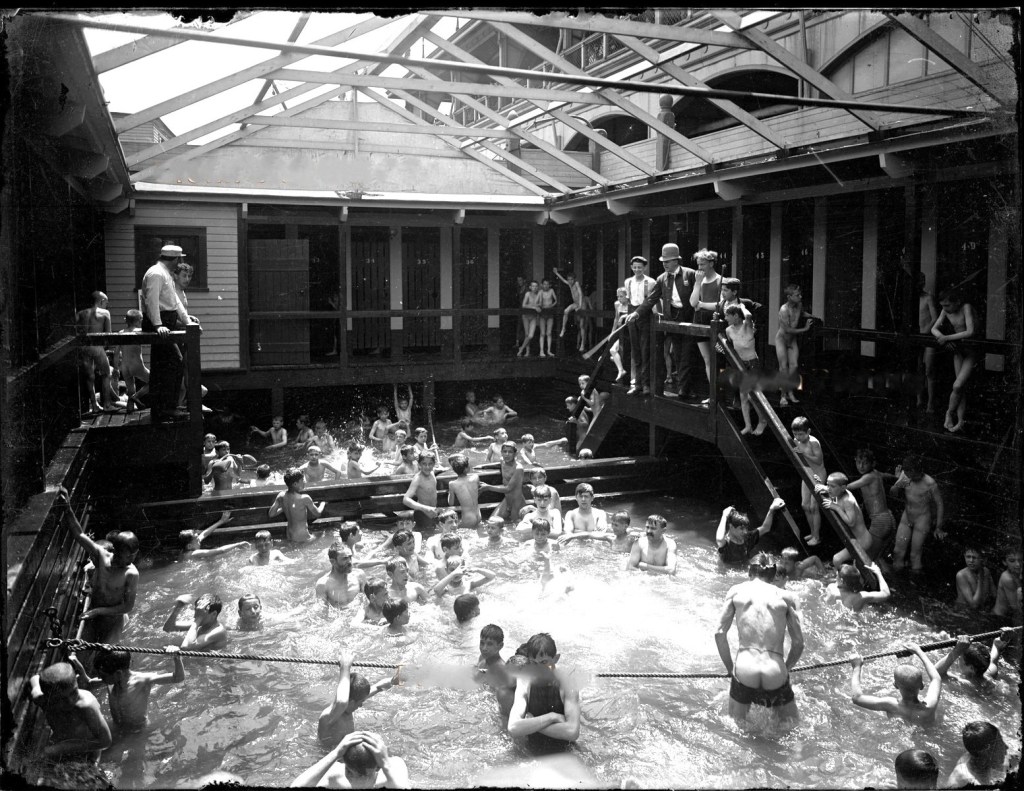
There seems to be plenty of adult supervision in this facility and it looks like they need it. The cop is the featured character here as he wags a disapproving baton at some malefactor. The helmet he’s wearing was discontinued by the NYPD in 1912, so this picture is from before then. Gotta love the fine moon being displayed in the foreground. Nice touch.
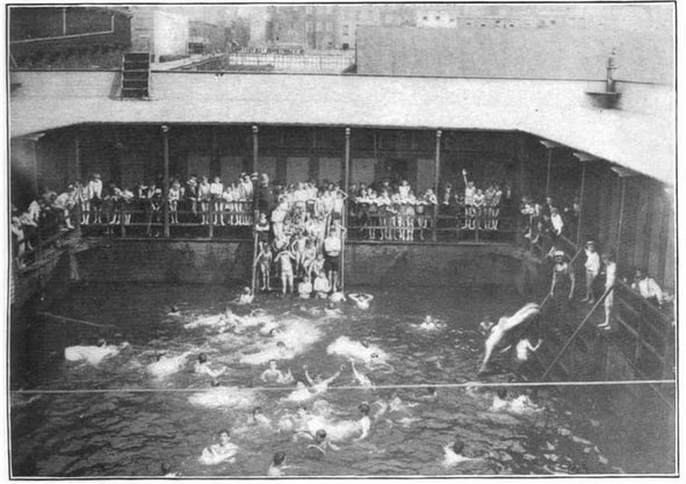
This low res image has something of a back story because I was able to locate a couple of architectural drawings (archived by Harvard University, of all places), one of which was a sectional elevation view of this precise location. It carried an approximate date of 1903. Since this facility could not have been opened for use before 1904 and there is a helmeted cop in this scene, that brackets the date as 1904-12. Unfortunately, its location was not called out.
The story takes an odd twist in that there was an indoor public bath built in the Greenpoint section of (northwestern) Brooklyn in 1903-04. The building still exists. Of course, the suggestion might be that they are one and the same, but the indoor facility is located several blocks inland from the river and had no swimming pool. The conclusion is that these two facilities (both called bathhouses) were built simultaneously for different purposes.
Based on the photo above, Bath No. 2 was obviously put to good use by eager, mostly naked boys.
The description accompanying this floating bathhouse image retrieved from the New York State Archives was “NYC Swimming School 1900.” It seems as though neither swim suits nor order were required for instruction.

This image is from the Museum of the City of New York, which was founded in 1923 and was apparently overshadowed by the more prominent institutions of this type in that city. There is no information offered relating to this photo, so we will have to conclude that the scene is from a city facility and the date is from sometime before 1920. There seems to be quite an age range among the clientele. From what can be seen, the older patrons seem to be eschewing suits like the youngsters – the water seems to be breaking low enough on their hips strongly suggesting they are not wearing suits.
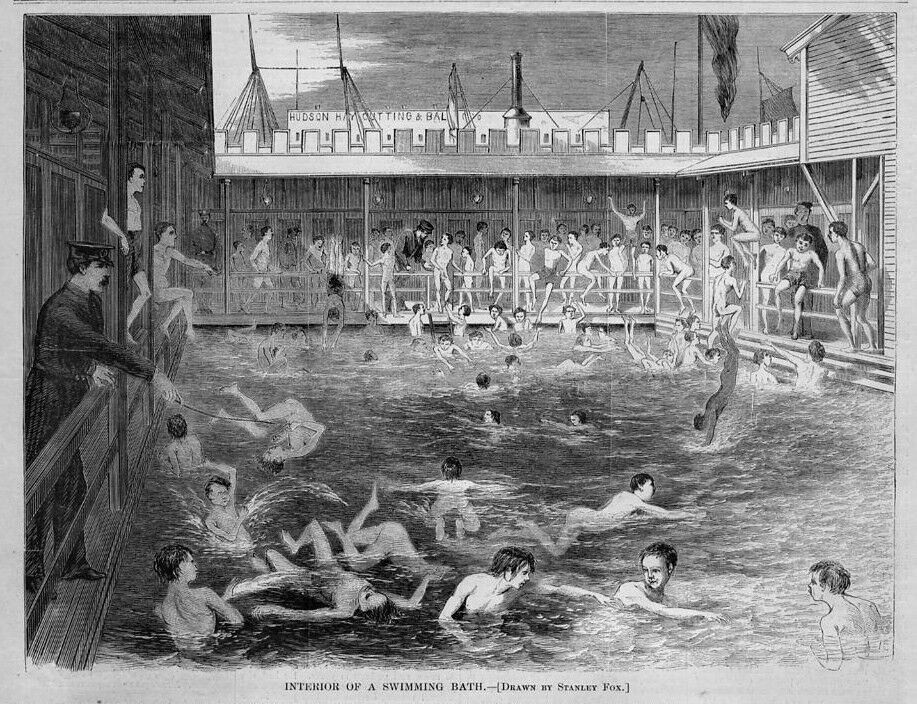
Note should be taken of the fact in most of the group images prior to the 1920’s show the adult moderators (instructors, life guard, etc.) of swimming venues in street clothes. This large view drawing of an NYC floating bathhouse validates that finding, showing several uniformed officials policing the activities in this bathhouse. How they were able to prevent drownings and other mishaps while so attired is curious to me.
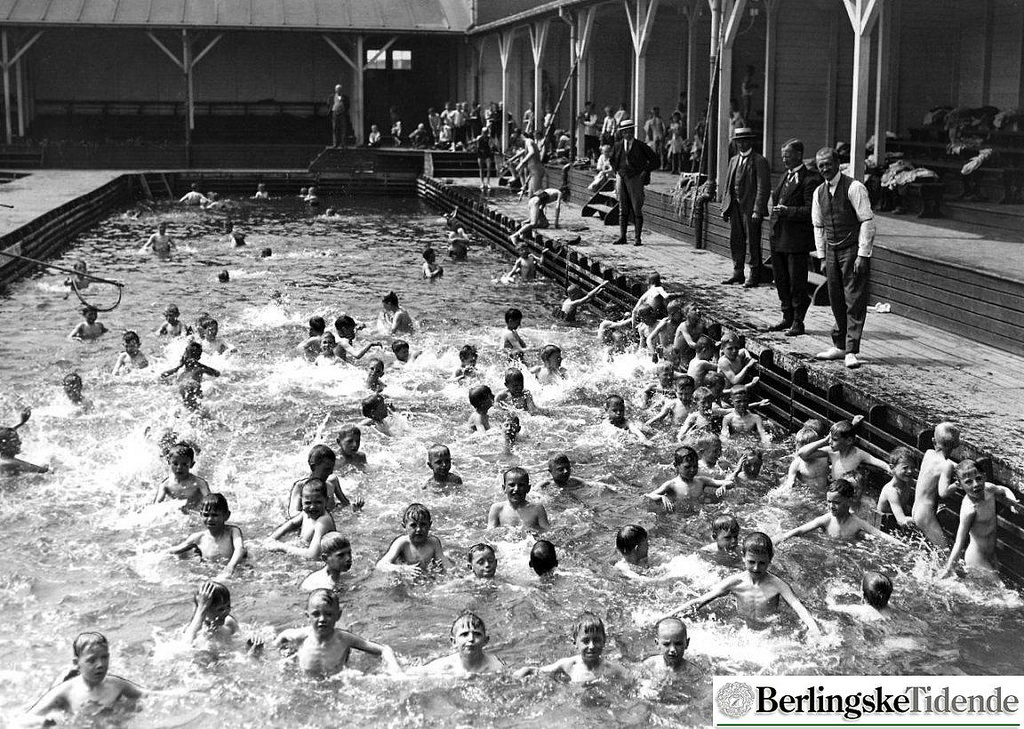
We jump across the pond for this oldie. The location is a small archipelago off the northwest corner of Germany. History has given it long, rough ride because of its strategic position in the North Sea, that despite the fact that its name in some old German dialect meant “Holy Land.” It is now something of a resort because its weather is more clement that the mainland.
It is apparently boys’ day in this floating bathhouse and it is apparently being monitored by some well-dressed gentlemen. And that’s where the problem lies. The photo is dated 1933 but the men are wearing outfits that were more stylish in 1903. Either this island is subject to time warping or the photo was misdated.
Point of interest is the pole with the loop intruding on the left side of the picture. I believe this is a rescue device that can be utilized by the aforementioned gentlemen without the hazard of wetting their shoes. In the background, at least two more long poles are leaning against the structure that I surmise are the same type of apparatus.
Thanks to the boys on the lower right who were kind enough the confirm that this is indeed a nude event.

Having just examined an image from this German resort, we now are confronted with a photo of that same location that comes from the Copenhagen (Denmark) Museum with an earlier date attribution. The fact that the Danes have pictures of Helgoland in their archives is not surprising if you look at the map. It is a geographical toss up whether this archipelago would fall under the sovereignty of Germany or Denmark. In politically quiet times, the citizenry of both countries probably vacationed there.
This does not appear to be the same floating bathhouse as in the previous photo, but there is a rescue pole is in the clutches of one of the adults. That technology seems to be standing the test of time. Curiously, there seem to be as many suited men as young swimmers. Of course, there is no doubt concerning the preferred swimming attire.
As noted in my first post, the public floating bathhouses in New York City were phased out beginning in the 1920’s due to public health concerns. This next image shows that the city started a system of indoor pools in parallel with the bathhouse network.

This is a scene in the E 23rd Street indoor municipal pool in New York City. The date is 1912-13. This facility is contemporaneous with the floating bathhouses operating in that same city. Apparently, residents had a choice of the types of swimming venues they could use.
The design provisions are interesting in that the side rails allow controlled access to the water, but would impede a rescue. It appears the pool is well underground based on the height of the windows in the back wall. Still, I am guessing that this is probably a second-generation pool since it has gallery access and what looks like grandstands.
The most noteworthy aspect is that in scrutinizing the boys around the periphery of the pool, it appears that some are in trunk suits and some are nude. The 1926 APHA recommendation for all nude swimming was still some years away.
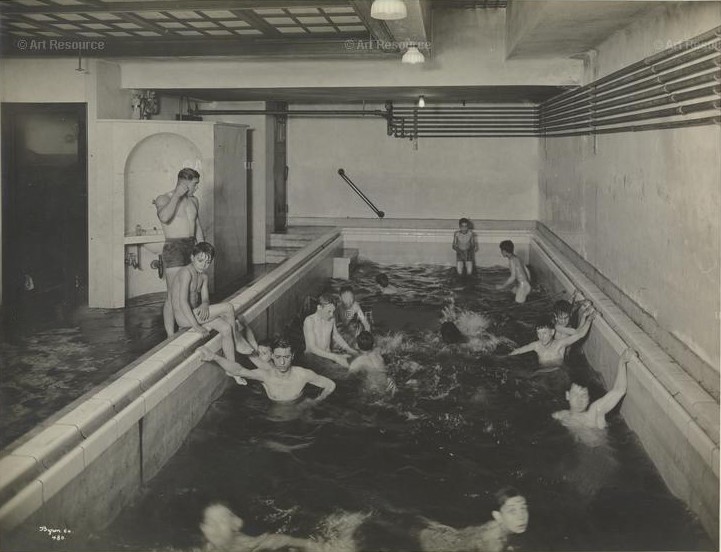
This photo was retrieved from the Museum of the City of New York. The accompanying text says that the boys shown are from the School for the Blind. No date is given. The narrowness of the pool seems to preclude normal swimming activities. Its shape is suggestive of a therapy bath. As in the previous photo, it looks like there is a mix of suited and non-suited participants.
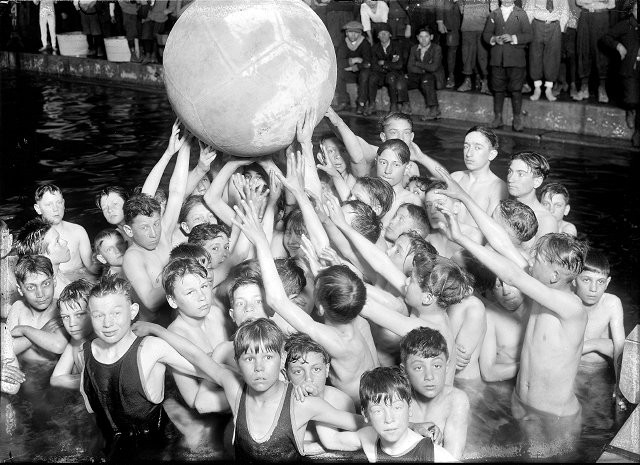
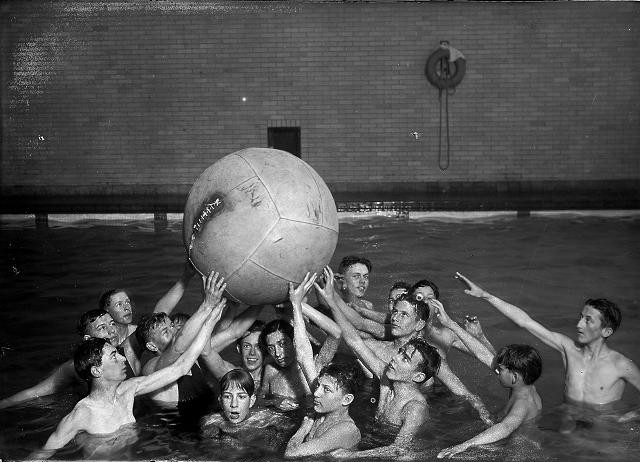
Like many things that have been lost to time (e.g., organized nude male swimming), push ball seems to have slipped away from us. I can only surmise what the object of the game was, but it is clear that the rules did not require the use of swim suits. In both of these images, the participants on the far right provide that evidence that nudity was not prohibited.
These two photos have provenance. They are from the Albert R. Stone Negative Collection, Rochester Museum and Science Center, Rochester, NY. They come to us through the online auspices of the Monroe County Public Library. The aforementioned Mr. Stone was a newspaper photographer in that region of New York. The second of these images featuring the older boys appeared in the Rochester Herald on April 23, 1922. The accompanying story indicated that there was a championship at stake when the picture was taken. I wonder if there was any public reaction to the fact that the genital apparatus of the boy on the far right was visible.

This outdoor pool was located in North Melbourne, Australia. Although the date is uncertain, the clothing worn by both the adult and child bystanders suggests that it is contemporaneous with the bathhouses just examined – probably no later than the 1920’s and likely earlier.
It appears the boys on the deck are awaiting their turn to disrobe in the shelter before entering the pool. Once again, the adult supervisors are in street clothes. I see no evidence of safety equipment.

This scene is from the year 1895. At that time, a new, large bathhouse opened in the Collingwood suburb of Melbourne, Australia. This is a companion to the image in the Diving page and may have appeared in the same publication. In any event, the rule of the day appears to have been nude swimming as evidenced by the 4-5 boys perched on the edge. Note that there is a dark form immediately to the left of the group that suggests that a figure has been blacked out of the frame. The silhouette seems to be that of a fully clothed person. Very mysterious.
Time for a swimming lesson.

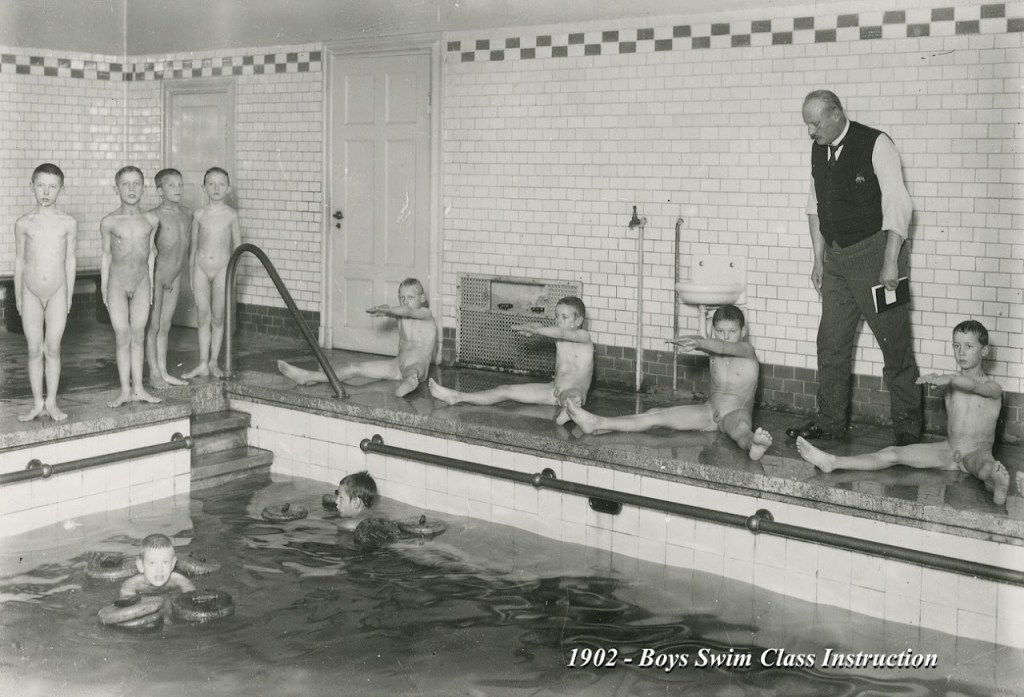
In these two photos, this fierce looking Prussian instructor is using 1902 methods that look alien-going-on-bizarre. Note that instruction was given from the pool deck by a person in street clothes. No in-water demonstrations or assistance was considered required. This is consistent with some situations depicted in The Good posting, so this guy is not unique.
What is unique are the poses he has the boys holding in the second photo. I’m not sure what standing at attention has to do with swimming technique. Leaving that curiosity aside, I am particularly intrigued by the slant board devices in the first picture that allow the student to perform strokes in air while simulating a swimming pose.

The third image in this set is the odd man. Although the inscribed caption is similar, the venue is different. This is a apparently another swim class in a different location. Was this woman actually giving instruction or is the male instructor just out of the frame?
By the way, the boy in the front just off center is not wearing trunks. It’s just a trick of the light in this very old, dark photo.
For what it’s worth, these three pictures are Swedish.
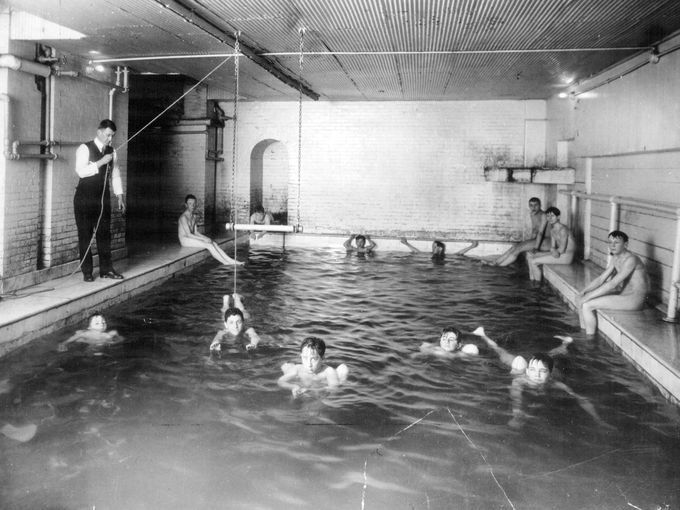
Before we leave this quaint/bizarre era of swim instruction, check this out. Fortunately, the class is small because this very inefficient method could not have turned out many qualified swimmers. The students must have spent the majority of their time just sitting around in their birthday suits. A parting thought: The guy in street clothes could just as easily have been the dungeon master of this cramped, subterranean chamber. Awful.
This image is attributed to the Rochester NY YMCA. The year is unknown, but there is little doubt it dates to the very dawn of the 20th century.

This is another narrow pool in a dungeon-like environment that looks seedy and even unhygienic. However, once you get past that observation, there is a lot to contemplate here. In this later date, swim instruction has become very interactive with multiple suited instructors milling about among the students. The guy with the megaphone appears to be in overall charge. But the real point of interest is the fact that most of the boys are equipped with flotation devices – water wings. Also, some of the kids appear to be wearing suits while others are nude. The slow shutter speed necessitated by the low light causes figures in the foreground to smear in motion.
This image is attributed to the Marietta Ohio YMCA. The date is not known, but I would not be surprised to learn this scene is from the 1920’s. This particular YMCA was founded in 1903.

I can confidently state that this venerable facility was never on the short list to host an Olympic competition.
Hershey, Pennsylvania is home to one of the largest chocolate brands in the US. In the center of town at the junction of Cocoa and Chocolate Avenues, stood a multipurpose building named Cocoa House. (Are you getting the drift here?) In 1911, that venue was expanded to include the Hershey Men’s Club with the addition of a gym and a pool. This image resides in the Hershey Community Archives as proclaimed by the label.
One has to wonder whether the overhead plumbing being used by the naked swimmers as a climbing device was intended for that purpose or not.
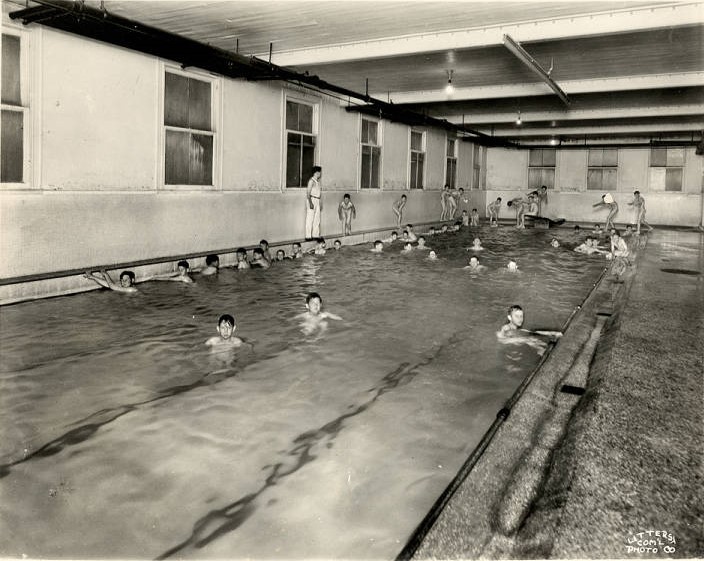
This image is from the archives of the Houston, TX public library. There is no question that birthday suits are the uniform of the day. There are two points of interest here. One is that the adult moderator is in street clothes (except that he’s wearing a tank top. If you can imagine humid Houston in the summer before A/C was available, you get his abbreviated costume.). Nevertheless, it indicates that the custom of dressed moderators was still in force in 1920. The other item is that all of the boys on the deck are hunched over. That pose may have been dictated by the photographer’s desire to tuck those penises out of sight. However, the one boy standing next to the adult apparently didn’t get the message that he was supposed to be turned sideways to the camera.
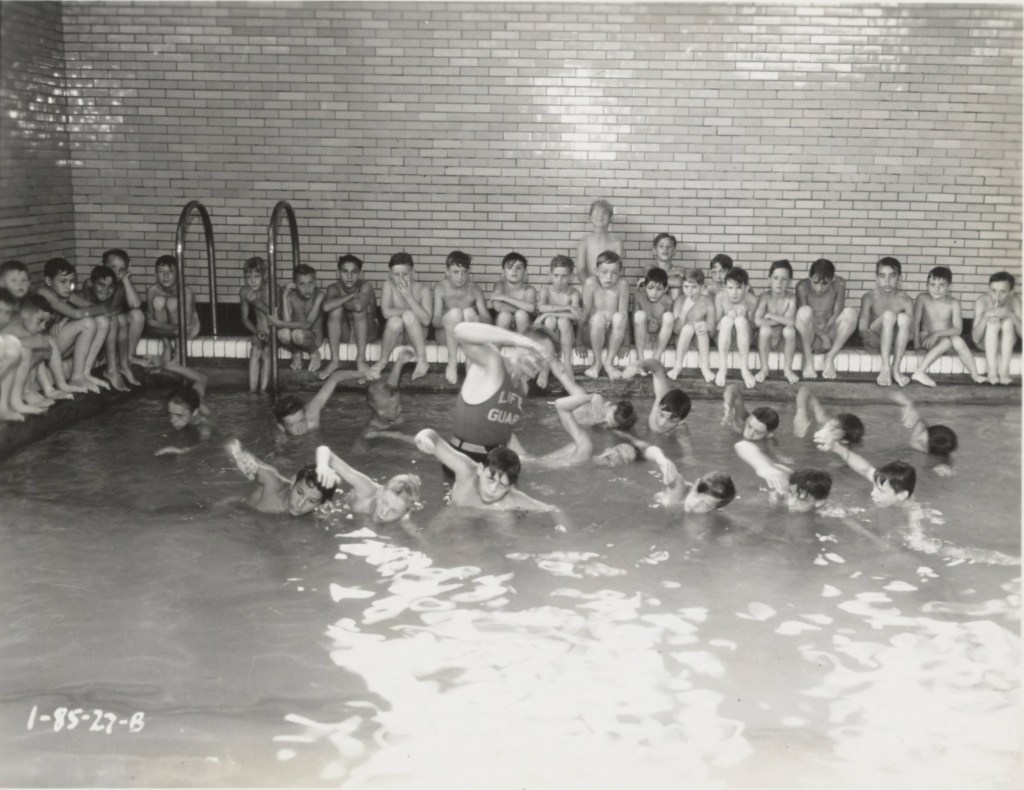
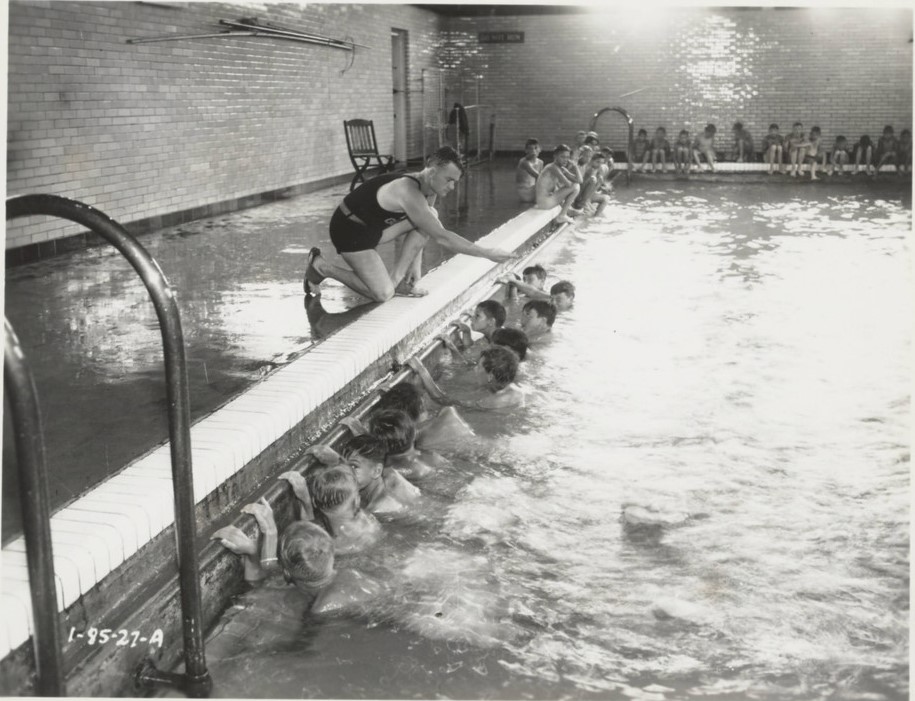

Fast forward another decade. This strapping young man in the immaculate swimming costume is conducting classes in the mid-1930’s. He is apparently an employee of the Chicago Park District posing for publicity photos with his (numerous!) young charges. While some things have changed since 1902, the one thing that remains constant is the nudity of the swimming students. I can imagine that the one injunction that was repeated before each picture was snapped was “Keep those knees together!”
Lessons are over. Time for a free swim.

These two are the companion pictures to the last image included in The Good posting. It is from the Fox Point Boys’ Club in Providence Rhode Island. These pictures of a multi-racial group of boys frolicking in the pool are undated. The nude state of the participants is clear, however. Note the lad sitting on the edge in the upper left of image 22.
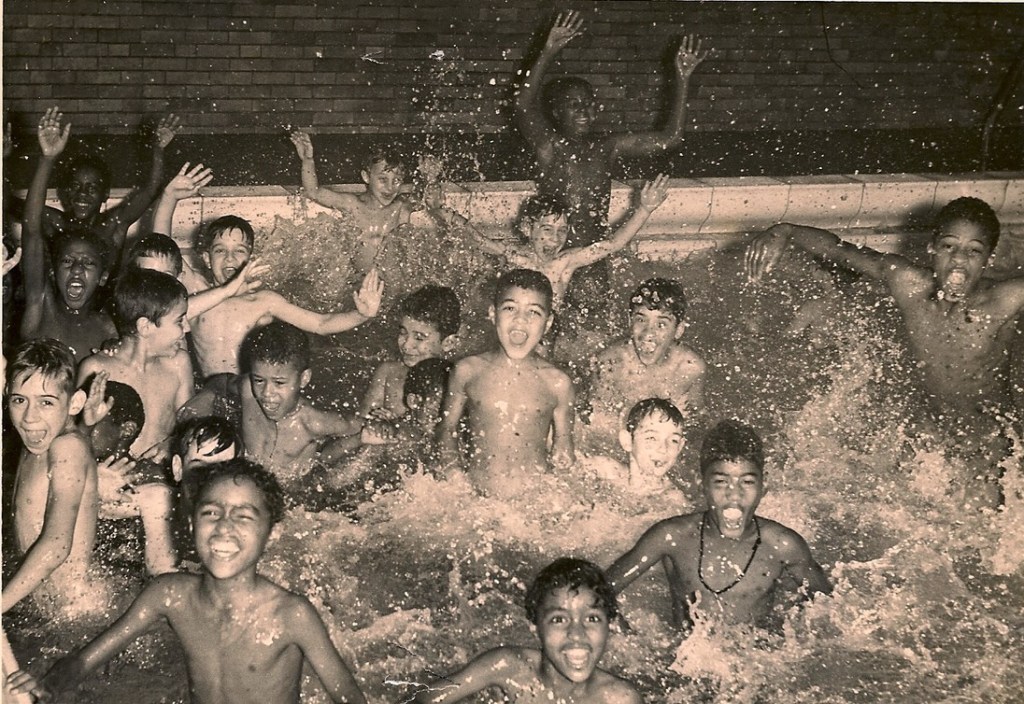
These two are the companion pictures to the last image included in The Good posting. It is from the Fox Point Boys’ Club in Providence Rhode Island. These pictures of a multi-racial group of boys frolicking in the pool are undated. The nude state of the participants is clear, however. Note the lad sitting on the edge in the upper left of image 27.
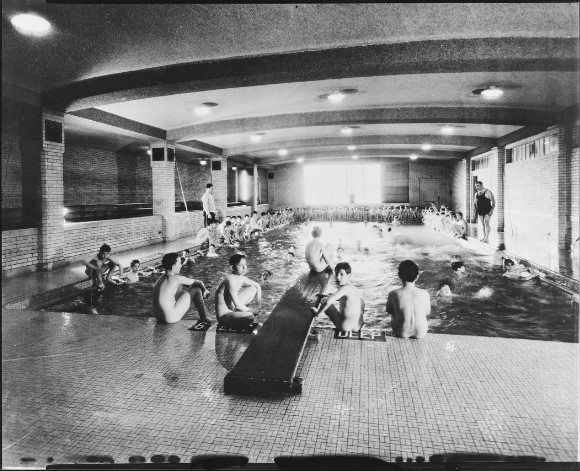
The New York State Historical Society hosts the archives of the Boys’ Clubs of NY from which this image was drawn. The period is between 1920 and 1950. The text accompanying the archive suggests that the photos were commissioned for inclusion in various reports and publications that promoted the work of the Boys’ Clubs. This image conveys the sort of casual innocence that one would attribute to a Norman Rockwell painting or a Tom Sawyer story.
Let’s step up to high school.
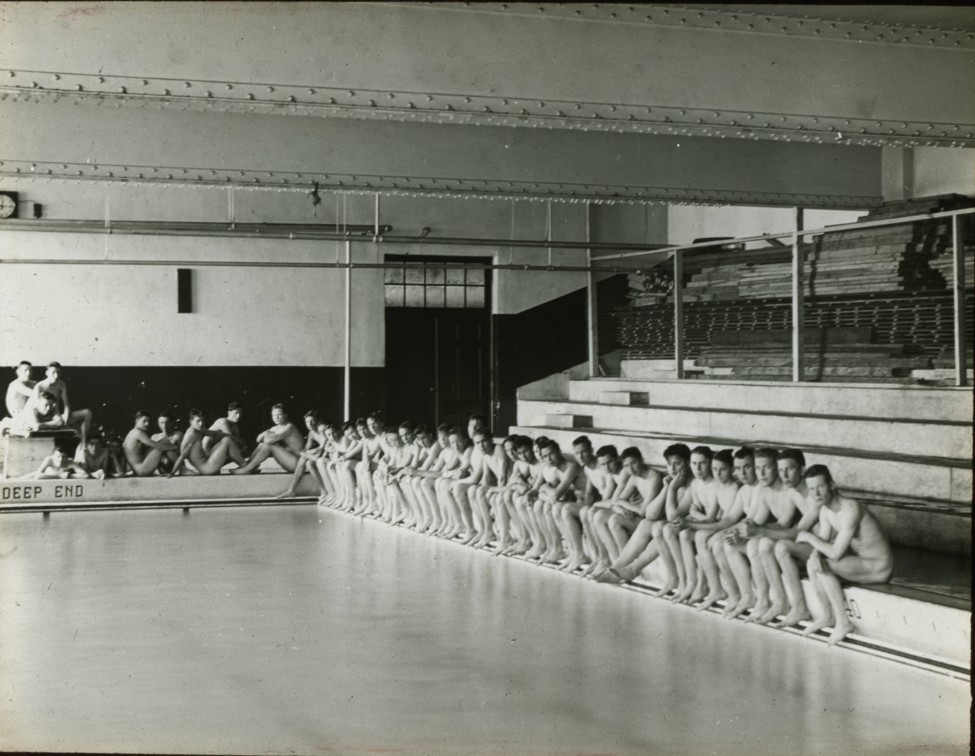
This eye-popping image is from the archives of the Durham County Library in a set from a private photographer that spans the years 1933-47. This large group of teenage boys are indisputably nude. The attributes in the archive does not indicate the composition of the group (swim team, swim class, etc.) or the purpose for which the picture was taken (e.g., yearbook). The photographer obviously had the cooperation of the subjects who seem to be posing with complete aplomb.

This battered image comes to us from the archives of the Plainfield, NJ Public Library. The image is believed to be from the 1920s. Full stop. We know nothing else about what was going on here.
Plainfield had a YMCA from 1869 until 2007. That could be the venue for this image. My first thought is that this is a swim class but the boys look older (teenagers?) and there is no instructor-looking adult present. The guy in the suit sitting in the upper bench appears no older than the naked boys below. The adult at the far end looks like a casual drop-in. But wait, is that a female sitting next to the boy in the suit? The figure is wearing trousers, so it’s anybody’s guess. This is one to ponder.
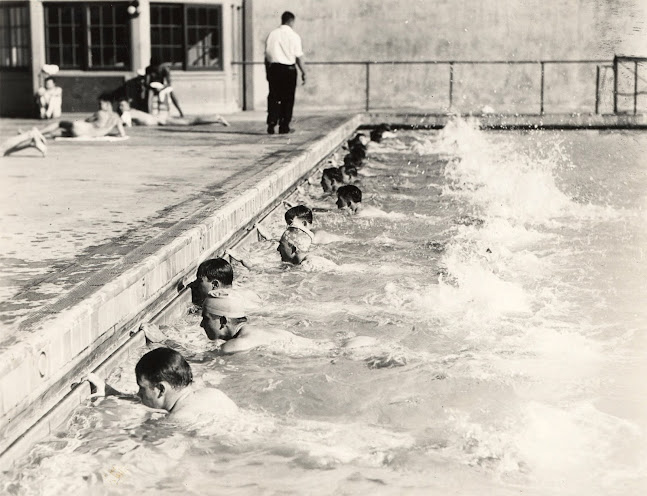
This image is attributed to Stanford University in 1930. This is the Encina Gym pool. These are probably the guys that failed their swimming qualification test, so they’re in a learn-to-swim class. Note the naked males lounging on the deck.
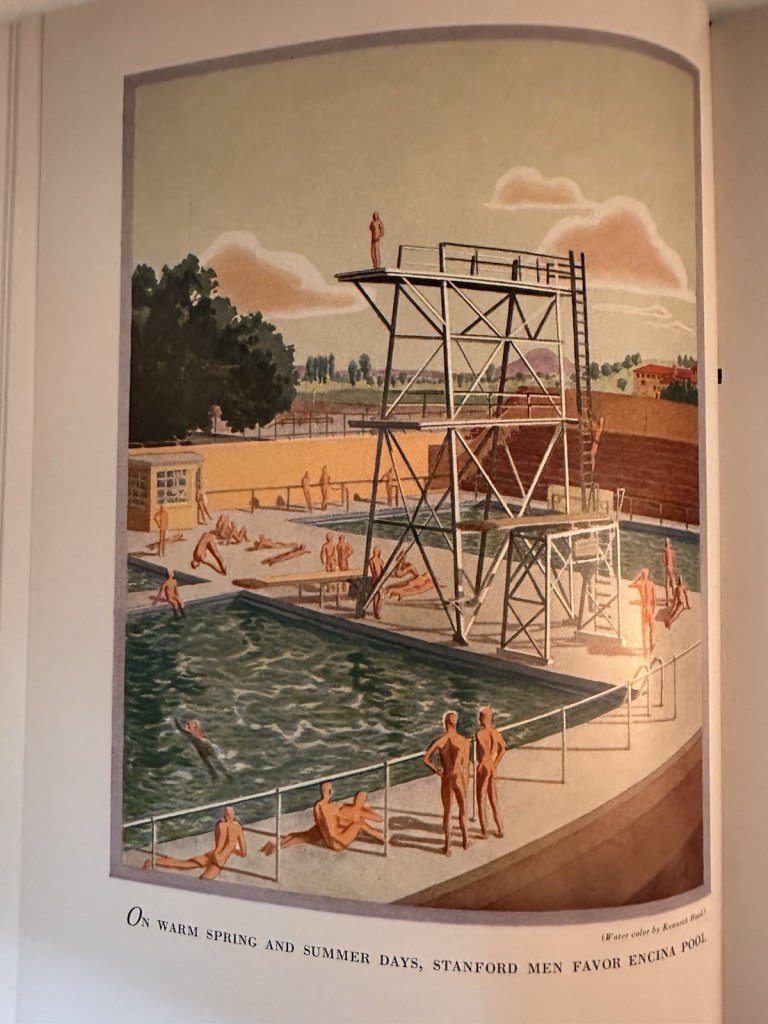
The Encina pool mentioned in the previous image was opened around 1930. In 1938 a book was published for the Standford alumni titled “Sixty Years on the Stanford Quad.” The above image is a page from that book containing a watercolor painting depicting the pool in use. If you look at the booth-like structure on the left edge of the painting and compare it to the pervious photo, you’ll see that same building, complete with the railing.
It is noteworthy that all of the cartoonish patrons are depicted in the nude, no doubt reflecting the practice at the time. The exception is the two figures on the high dive tower. They are wearing suits. I surmise that the patrons using that feature were visible in other parts of campus, so suits were required.
Additionally, I collected a snippet of text some years back (origin now unknown) that gives some of the flavor of the venue. It is presented below.
It is 1963, the Men’s Pool. I am back at Stanford working on a PhD. The day is sunny and, during lunchtime, the spectators’ seats are packed with men — stark naked — sunning themselves. (Swimming suits are not allowed. It is naked or nothing, for health reasons, nude bodies being cleaner than swimsuits that have been hanging damp in a locker for a week.) It is possible to see the great men of Stanford, completely unashamed in their birthday suits, diving into the water. I remember Professor Bark of history and Professor Scowcroft of creative writing. There were surely many others. Somehow nudity made them more approachable, even though I had dined in Professor Bark’s house and spent many an hour in class with Professor Scowcroft.

This is similar to an image of The Good posting. It was taken by a LIFE photographer minutes apart from that previously posted photo. This image was is not as interesting as the original version because the angle hides the faces of the swimmers. Their nudity is not in doubt, however.

This type of industrialized shower is mentioned by some posters. Marching through successive sprays may have sped up the process of pre-swim cleansing. Having said that, no one seems to be soaping up. This treatment may have served some other purpose.

Some accounts claimed there was also a low spray line that addressed the under-crotch area as one straddled it. Here is the photographic confirmation of that story from a no less reliable source than LIFE. This 1937 image was shot as part of an article on the Yale swim team.

This staged photo was distributed in some form to solicit membership applicants. It looks like a postcard, but may have been a leaf of a brochure. It is undated, but obviously very old because of the photography style. It is similar to other images originally posted in The Good. Bare buttocks were apparently considered acceptable viewing for the public in this context.
I thought I’d add a few images from across the pond. I usually avoid non-American material, given the nature of our study, but I thought I’d pass these along in the interest of … well, just because …

The Training Ship Mercury was operated by the British Navy from 1885 to 1968. Its purpose was to train young boys in aquatic and seamanship skills with a view to encouraging future enlistments. As you can see the program had some aspects of a camp which doubtless appealed to the boys. You will note that swim suits were not provided.
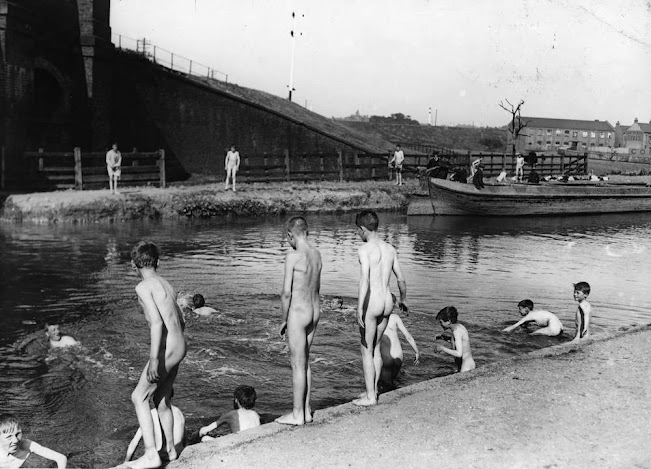
We are on the Regents canal in the UK on August 21, 1911. There is a heat wave in progress and home AC is still several decades in the future. These boys took matters into their own hands – and very effectively.
Now for a big finish …

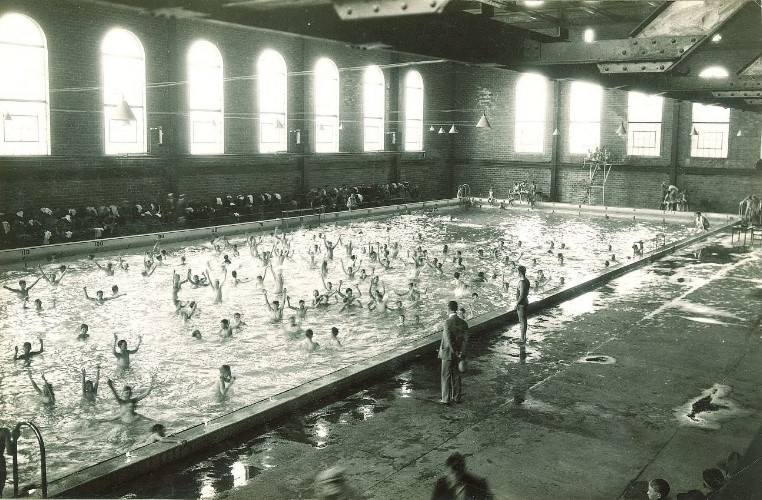

The date is October 29, 1927. The university of Iowa is hosting a Scout Day swim in their Field House pool – no suits required. A grand time was had by all. These images are from the library archives of that seat of higher learning.
We’re not quite done with authentic photos. For the next post we will narrow our focus to swimming in camp.
 Historical Nude Male Swimming Images